00017080352025FYfalsehttp://fasb.org/us-gaap/2025#IncomeLossFromDiscontinuedOperationsNetOfTaxAttributableToReportingEntityhttp://fasb.org/us-gaap/2025#IncomeLossFromDiscontinuedOperationsNetOfTaxAttributableToReportingEntityEnvironmental Loss Contingency Statement Of Financial Position Extensible Enumeration Not Disclosed FlagEnvironmental Loss Contingency Statement Of Financial Position Extensible Enumeration Not Disclosed Flagiso4217:USDxbrli:sharesiso4217:USDxbrli:sharesecvt:planecvt:extensionxbrli:pureecvt:segmentecvt:reporting_unitecvt:derivative00017080352025-01-012025-12-3100017080352025-06-3000017080352026-02-2000017080352025-10-012025-12-3100017080352024-01-012024-12-3100017080352023-01-012023-12-3100017080352025-12-3100017080352024-12-310001708035us-gaap:CommonStockMember2022-12-310001708035us-gaap:AdditionalPaidInCapitalMember2022-12-310001708035us-gaap:RetainedEarningsMember2022-12-310001708035us-gaap:TreasuryStockCommonMember2022-12-310001708035us-gaap:AccumulatedOtherComprehensiveIncomeMember2022-12-3100017080352022-12-310001708035us-gaap:RetainedEarningsMember2023-01-012023-12-310001708035us-gaap:AccumulatedOtherComprehensiveIncomeMember2023-01-012023-12-310001708035us-gaap:TreasuryStockCommonMember2023-01-012023-12-310001708035us-gaap:AdditionalPaidInCapitalMember2023-01-012023-12-310001708035us-gaap:CommonStockMember2023-01-012023-12-310001708035us-gaap:CommonStockMember2023-12-310001708035us-gaap:AdditionalPaidInCapitalMember2023-12-310001708035us-gaap:RetainedEarningsMember2023-12-310001708035us-gaap:TreasuryStockCommonMember2023-12-310001708035us-gaap:AccumulatedOtherComprehensiveIncomeMember2023-12-3100017080352023-12-310001708035us-gaap:RetainedEarningsMember2024-01-012024-12-310001708035us-gaap:AccumulatedOtherComprehensiveIncomeMember2024-01-012024-12-310001708035us-gaap:TreasuryStockCommonMember2024-01-012024-12-310001708035us-gaap:AdditionalPaidInCapitalMember2024-01-012024-12-310001708035us-gaap:CommonStockMember2024-01-012024-12-310001708035us-gaap:CommonStockMember2024-12-310001708035us-gaap:AdditionalPaidInCapitalMember2024-12-310001708035us-gaap:RetainedEarningsMember2024-12-310001708035us-gaap:TreasuryStockCommonMember2024-12-310001708035us-gaap:AccumulatedOtherComprehensiveIncomeMember2024-12-310001708035us-gaap:RetainedEarningsMember2025-01-012025-12-310001708035us-gaap:AccumulatedOtherComprehensiveIncomeMember2025-01-012025-12-310001708035us-gaap:TreasuryStockCommonMember2025-01-012025-12-310001708035us-gaap:AdditionalPaidInCapitalMember2025-01-012025-12-310001708035us-gaap:CommonStockMember2025-12-310001708035us-gaap:AdditionalPaidInCapitalMember2025-12-310001708035us-gaap:RetainedEarningsMember2025-12-310001708035us-gaap:TreasuryStockCommonMember2025-12-310001708035us-gaap:AccumulatedOtherComprehensiveIncomeMember2025-12-310001708035srt:MinimumMemberus-gaap:BuildingAndBuildingImprovementsMember2025-12-310001708035srt:MaximumMemberus-gaap:BuildingAndBuildingImprovementsMember2025-12-310001708035srt:MinimumMemberus-gaap:MachineryAndEquipmentMember2025-12-310001708035srt:MaximumMemberus-gaap:MachineryAndEquipmentMember2025-12-310001708035srt:MaximumMember2025-01-012025-12-310001708035srt:RevisionOfPriorPeriodErrorCorrectionAdjustmentMember2022-01-012022-12-310001708035srt:RevisionOfPriorPeriodErrorCorrectionAdjustmentMember2023-01-012023-12-310001708035srt:RevisionOfPriorPeriodErrorCorrectionAdjustmentMember2024-12-310001708035ecvt:AdvancedMaterialsAndCatalystsSegmentMember2025-09-100001708035ecvt:AdvancedMaterialsAndCatalystsSegmentMember2025-09-102025-09-100001708035ecvt:AdvancedMaterialsAndCatalystsSegmentMember2025-07-012025-09-300001708035ecvt:AdvancedMaterialsAndCatalystsSegmentMember2025-01-012025-12-3100017080352025-09-102025-09-1000017080352025-09-100001708035ecvt:AdvancedMaterialsAndCatalystsSegmentMember2024-01-012024-12-310001708035ecvt:AdvancedMaterialsAndCatalystsSegmentMember2023-01-012023-12-310001708035us-gaap:InProcessResearchAndDevelopmentMember2024-01-012024-12-310001708035ecvt:PQHoldingsEcoServicesMember2025-12-310001708035ecvt:PQHoldingsEcoServicesMember2024-12-310001708035ecvt:PQHoldingsEcoServicesMember2025-01-012025-12-310001708035ecvt:PQHoldingsEcoServicesMember2024-01-012024-12-310001708035ecvt:PQHoldingsEcoServicesMember2023-01-012023-12-310001708035ecvt:ZeolystJointVentureMember2024-01-012024-12-310001708035ecvt:AdvancedMaterialsAndCatalystsSegmentMember2024-12-310001708035srt:AffiliatedEntityMember2024-12-310001708035srt:AffiliatedEntityMember2025-01-012025-12-310001708035srt:AffiliatedEntityMember2024-01-012024-12-310001708035srt:AffiliatedEntityMember2023-01-012023-12-310001708035ecvt:OperatingLeaseRentalPaymentsMemberus-gaap:RelatedPartyMember2024-01-012024-12-310001708035ecvt:OperatingLeaseRentalPaymentsMemberus-gaap:RelatedPartyMember2023-01-012023-12-310001708035ecvt:OperatingLeaseRentalPaymentsMemberus-gaap:RelatedPartyMember2025-01-012025-12-310001708035ecvt:SalesfromPartnershiptoCompanyMemberus-gaap:RelatedPartyMember2025-01-012025-12-310001708035ecvt:SalesfromPartnershiptoCompanyMemberus-gaap:RelatedPartyMember2024-01-012024-12-310001708035ecvt:SalesfromPartnershiptoCompanyMemberus-gaap:RelatedPartyMember2023-01-012023-12-310001708035ecvt:ManufacturingCostsMemberus-gaap:RelatedPartyMember2025-01-012025-12-310001708035ecvt:ManufacturingCostsMemberus-gaap:RelatedPartyMember2024-01-012024-12-310001708035ecvt:ManufacturingCostsMemberus-gaap:RelatedPartyMember2023-01-012023-12-310001708035ecvt:AdvancedMaterialsAndCatalystsSegmentMemberus-gaap:RelatedPartyMemberecvt:ManufacturingCostsMember2025-01-012025-12-310001708035ecvt:AdvancedMaterialsAndCatalystsSegmentMemberus-gaap:RelatedPartyMemberecvt:ManufacturingCostsMember2024-01-012024-12-310001708035ecvt:AdvancedMaterialsAndCatalystsSegmentMemberus-gaap:RelatedPartyMemberecvt:ManufacturingCostsMember2023-01-012023-12-310001708035ecvt:ProductDemonstrationCostsMemberus-gaap:RelatedPartyMember2025-01-012025-12-310001708035ecvt:ProductDemonstrationCostsMemberus-gaap:RelatedPartyMember2024-01-012024-12-310001708035ecvt:ProductDemonstrationCostsMemberus-gaap:RelatedPartyMember2023-01-012023-12-310001708035us-gaap:AdministrativeServiceMembersrt:AffiliatedEntityMember2025-01-012025-12-310001708035us-gaap:AdministrativeServiceMembersrt:AffiliatedEntityMember2024-01-012024-12-310001708035us-gaap:AdministrativeServiceMembersrt:AffiliatedEntityMember2023-01-012023-12-310001708035ecvt:SalesfromPartnershiptoCompanyMemberus-gaap:RelatedPartyMember2024-12-310001708035ecvt:CornerstoneChemicalCompanyLLCMember2025-05-062025-05-060001708035ecvt:CornerstoneChemicalCompanyLLCMember2025-05-052025-05-050001708035ecvt:CornerstoneChemicalCompanyLLCMember2025-05-062025-12-310001708035ecvt:CornerstoneChemicalCompanyLLCMember2025-05-050001708035ecvt:CornerstoneChemicalCompanyLLCMember2025-12-310001708035ecvt:CornerstoneChemicalCompanyLLCMember2025-05-060001708035us-gaap:CustomerRelationshipsMember2025-05-062025-05-060001708035ecvt:CornerstoneMember2025-12-310001708035ecvt:RegenerationAndTreatmentServicesMember2025-01-012025-12-310001708035ecvt:RegenerationAndTreatmentServicesMember2024-01-012024-12-310001708035ecvt:RegenerationAndTreatmentServicesMember2023-01-012023-12-310001708035ecvt:IndustrialMiningAutomotiveMember2025-01-012025-12-310001708035ecvt:IndustrialMiningAutomotiveMember2024-01-012024-12-310001708035ecvt:IndustrialMiningAutomotiveMember2023-01-012023-12-310001708035ecvt:OtherServicesMember2025-01-012025-12-310001708035ecvt:OtherServicesMember2024-01-012024-12-310001708035ecvt:OtherServicesMember2023-01-012023-12-310001708035us-gaap:FairValueInputsLevel1Member2025-12-310001708035us-gaap:FairValueInputsLevel2Member2025-12-310001708035us-gaap:FairValueInputsLevel3Member2025-12-310001708035us-gaap:FairValueInputsLevel1Member2024-12-310001708035us-gaap:FairValueInputsLevel2Member2024-12-310001708035us-gaap:FairValueInputsLevel3Member2024-12-310001708035us-gaap:AccumulatedDefinedBenefitPlansAdjustmentMember2025-12-310001708035us-gaap:AccumulatedDefinedBenefitPlansAdjustmentMember2024-12-310001708035us-gaap:AccumulatedNetUnrealizedInvestmentGainLossMember2025-12-310001708035us-gaap:AccumulatedNetUnrealizedInvestmentGainLossMember2024-12-310001708035us-gaap:AccumulatedTranslationAdjustmentMember2025-12-310001708035us-gaap:AccumulatedTranslationAdjustmentMember2024-12-310001708035us-gaap:AccumulatedDefinedBenefitPlansAdjustmentNetUnamortizedGainLossMember2025-01-012025-12-310001708035us-gaap:AccumulatedDefinedBenefitPlansAdjustmentNetUnamortizedGainLossMember2024-01-012024-12-310001708035us-gaap:AccumulatedDefinedBenefitPlansAdjustmentNetUnamortizedGainLossMember2023-01-012023-12-310001708035us-gaap:AccumulatedDefinedBenefitPlansAdjustmentNetPriorServiceCostCreditMember2025-01-012025-12-310001708035us-gaap:AccumulatedDefinedBenefitPlansAdjustmentNetPriorServiceCostCreditMember2024-01-012024-12-310001708035us-gaap:AccumulatedDefinedBenefitPlansAdjustmentNetPriorServiceCostCreditMember2023-01-012023-12-310001708035us-gaap:AccumulatedDefinedBenefitPlansAdjustmentMember2025-01-012025-12-310001708035us-gaap:AccumulatedDefinedBenefitPlansAdjustmentMember2024-01-012024-12-310001708035us-gaap:AccumulatedDefinedBenefitPlansAdjustmentMember2023-01-012023-12-310001708035us-gaap:AccumulatedGainLossNetCashFlowHedgeParentMember2025-01-012025-12-310001708035us-gaap:AccumulatedGainLossNetCashFlowHedgeParentMember2024-01-012024-12-310001708035us-gaap:AccumulatedGainLossNetCashFlowHedgeParentMember2023-01-012023-12-310001708035us-gaap:AccumulatedTranslationAdjustmentMember2025-01-012025-12-310001708035us-gaap:AccumulatedTranslationAdjustmentMember2024-01-012024-12-310001708035us-gaap:AccumulatedTranslationAdjustmentMember2023-01-012023-12-310001708035us-gaap:AccumulatedDefinedBenefitPlansAdjustmentMember2023-12-310001708035us-gaap:AccumulatedGainLossNetCashFlowHedgeParentMember2023-12-310001708035us-gaap:AccumulatedTranslationAdjustmentMember2023-12-310001708035us-gaap:AccumulatedGainLossNetCashFlowHedgeParentMember2024-12-310001708035us-gaap:AccumulatedGainLossNetCashFlowHedgeParentMember2025-12-310001708035us-gaap:ReclassificationOutOfAccumulatedOtherComprehensiveIncomeMemberus-gaap:AccumulatedDefinedBenefitPlansAdjustmentNetUnamortizedGainLossMember2025-01-012025-12-310001708035us-gaap:ReclassificationOutOfAccumulatedOtherComprehensiveIncomeMemberus-gaap:AccumulatedDefinedBenefitPlansAdjustmentNetUnamortizedGainLossMember2024-01-012024-12-310001708035us-gaap:ReclassificationOutOfAccumulatedOtherComprehensiveIncomeMemberus-gaap:AccumulatedDefinedBenefitPlansAdjustmentNetPriorServiceCostCreditMember2025-01-012025-12-310001708035us-gaap:ReclassificationOutOfAccumulatedOtherComprehensiveIncomeMemberus-gaap:AccumulatedDefinedBenefitPlansAdjustmentNetPriorServiceCostCreditMember2024-01-012024-12-310001708035us-gaap:ReclassificationOutOfAccumulatedOtherComprehensiveIncomeMemberus-gaap:AccumulatedDefinedBenefitPlansAdjustmentMember2025-01-012025-12-310001708035us-gaap:ReclassificationOutOfAccumulatedOtherComprehensiveIncomeMemberus-gaap:AccumulatedDefinedBenefitPlansAdjustmentMember2024-01-012024-12-310001708035us-gaap:ReclassificationOutOfAccumulatedOtherComprehensiveIncomeMemberus-gaap:AccumulatedGainLossNetCashFlowHedgeParentMember2025-01-012025-12-310001708035us-gaap:ReclassificationOutOfAccumulatedOtherComprehensiveIncomeMemberus-gaap:AccumulatedGainLossNetCashFlowHedgeParentMember2024-01-012024-12-310001708035us-gaap:ReclassificationOutOfAccumulatedOtherComprehensiveIncomeMember2025-01-012025-12-310001708035us-gaap:ReclassificationOutOfAccumulatedOtherComprehensiveIncomeMember2024-01-012024-12-310001708035ecvt:StockRepurchaseProgram2022Member2022-04-270001708035ecvt:StockRepurchaseProgram2022Member2022-04-272022-04-270001708035ecvt:StockRepurchaseProgram2022Member2025-10-302025-10-300001708035ecvt:StockRepurchaseProgram2022Member2025-01-012025-12-310001708035ecvt:OpenMarketMemberecvt:StockRepurchaseProgram2022Member2025-01-012025-12-310001708035ecvt:OpenMarketMemberecvt:StockRepurchaseProgram2022Member2025-12-310001708035ecvt:StockRepurchaseProgram2022Member2025-12-310001708035ecvt:StockRepurchaseProgram2022Member2024-01-012024-12-310001708035ecvt:StockRepurchaseProgram2022Member2024-12-310001708035ecvt:SecondaryOfferingMemberecvt:StockRepurchaseProgram2022Member2024-12-310001708035us-gaap:LandMember2025-12-310001708035us-gaap:LandMember2024-12-310001708035us-gaap:BuildingAndBuildingImprovementsMember2025-12-310001708035us-gaap:BuildingAndBuildingImprovementsMember2024-12-310001708035us-gaap:MachineryAndEquipmentMember2025-12-310001708035us-gaap:MachineryAndEquipmentMember2024-12-310001708035us-gaap:ConstructionInProgressMember2025-12-310001708035us-gaap:ConstructionInProgressMember2024-12-310001708035ecvt:CustomerAMemberus-gaap:CustomerConcentrationRiskMemberus-gaap:SalesRevenueNetMember2025-01-012025-12-310001708035ecvt:CustomerAMemberus-gaap:CustomerConcentrationRiskMemberus-gaap:SalesRevenueNetMember2024-01-012024-12-310001708035ecvt:CustomerAMemberus-gaap:CustomerConcentrationRiskMemberus-gaap:SalesRevenueNetMember2023-01-012023-12-310001708035ecvt:CustomerBMemberus-gaap:CustomerConcentrationRiskMemberus-gaap:SalesRevenueNetMember2024-01-012024-12-310001708035us-gaap:IntellectualPropertyMember2025-12-310001708035us-gaap:IntellectualPropertyMember2024-12-310001708035us-gaap:CustomerRelationshipsMember2025-12-310001708035us-gaap:CustomerRelationshipsMember2024-12-310001708035us-gaap:NoncompeteAgreementsMember2025-12-310001708035us-gaap:NoncompeteAgreementsMember2024-12-310001708035us-gaap:TradeNamesMember2025-12-310001708035us-gaap:TradeNamesMember2024-12-310001708035us-gaap:TradeNamesMember2025-12-310001708035us-gaap:TradeNamesMember2024-12-310001708035srt:MinimumMemberus-gaap:IntellectualPropertyMember2025-12-310001708035srt:MaximumMemberus-gaap:IntellectualPropertyMember2025-12-310001708035srt:MinimumMemberus-gaap:CustomerRelationshipsMember2025-12-310001708035srt:MaximumMemberus-gaap:CustomerRelationshipsMember2025-12-310001708035us-gaap:TrademarksMember2025-12-310001708035us-gaap:CostOfSalesMember2024-01-012024-12-310001708035us-gaap:CostOfSalesMember2023-01-012023-12-310001708035us-gaap:CostOfSalesMember2025-01-012025-12-310001708035us-gaap:OtherOperatingIncomeExpenseMember2025-01-012025-12-310001708035us-gaap:OtherOperatingIncomeExpenseMember2023-01-012023-12-310001708035us-gaap:OtherOperatingIncomeExpenseMember2024-01-012024-12-310001708035ecvt:TermLoanFacility2025Member2025-12-310001708035ecvt:TermLoanFacility2025Member2024-12-310001708035us-gaap:LineOfCreditMember2025-12-310001708035us-gaap:LineOfCreditMember2024-12-310001708035ecvt:TermLoanFacilityMemberus-gaap:MediumTermNotesMember2021-06-090001708035ecvt:TermLoanFacilityMemberus-gaap:MediumTermNotesMember2021-06-092021-06-090001708035us-gaap:SecuredOvernightFinancingRateSofrMemberecvt:TermLoanFacilityMemberus-gaap:MediumTermNotesMember2023-02-092023-02-090001708035ecvt:TermLoanFacilityMemberus-gaap:MediumTermNotesMember2023-02-092023-02-090001708035us-gaap:SecuredOvernightFinancingRateSofrMemberecvt:VariableRateComponentOneMembersrt:MinimumMemberecvt:TermLoanFacility2025Member2024-06-122024-06-120001708035us-gaap:SecuredOvernightFinancingRateSofrMemberecvt:VariableRateComponentOneMembersrt:MaximumMemberus-gaap:MediumTermNotesMember2024-06-122024-06-120001708035us-gaap:BaseRateMemberecvt:VariableRateComponentTwoMembersrt:MinimumMemberus-gaap:MediumTermNotesMember2024-06-122024-06-120001708035us-gaap:BaseRateMemberecvt:VariableRateComponentTwoMembersrt:MaximumMemberus-gaap:MediumTermNotesMember2024-06-122024-06-120001708035us-gaap:SecuredOvernightFinancingRateSofrMemberus-gaap:MediumTermNotesMember2024-06-122024-06-120001708035us-gaap:SecuredOvernightFinancingRateSofrMemberecvt:VariableRateComponentOneMembersrt:MinimumMemberecvt:TermLoanFacility2025Member2025-01-302025-01-300001708035us-gaap:SecuredOvernightFinancingRateSofrMemberecvt:VariableRateComponentOneMembersrt:MaximumMemberecvt:TermLoanFacility2025Member2025-01-302025-01-300001708035us-gaap:BaseRateMemberecvt:VariableRateComponentTwoMembersrt:MinimumMemberecvt:TermLoanFacility2025Member2025-01-302025-01-300001708035us-gaap:BaseRateMemberecvt:VariableRateComponentTwoMembersrt:MaximumMemberecvt:TermLoanFacility2025Member2025-01-302025-01-300001708035us-gaap:SecuredOvernightFinancingRateSofrMemberecvt:TermLoanFacility2025Member2025-12-310001708035ecvt:TermLoanFacility2025Member2025-12-312025-12-3100017080352025-12-312025-12-310001708035ecvt:TermLoanFacility2025Member2025-01-012025-12-310001708035ecvt:TermLoanFacility2025Member2024-01-012024-12-310001708035us-gaap:LineOfCreditMember2016-05-0400017080352020-03-202020-03-2000017080352020-03-200001708035currency:USD2020-03-200001708035currency:CAD2020-03-200001708035currency:EUR2020-03-200001708035us-gaap:LineOfCreditMember2020-03-202020-03-200001708035srt:MinimumMemberus-gaap:LineOfCreditMember2020-03-202020-03-200001708035srt:MaximumMemberus-gaap:LineOfCreditMember2020-03-202020-03-200001708035us-gaap:BaseRateMembersrt:MinimumMemberus-gaap:LineOfCreditMember2020-03-202020-03-200001708035us-gaap:BaseRateMembersrt:MaximumMemberus-gaap:LineOfCreditMember2020-03-202020-03-2000017080352021-06-092021-06-0900017080352021-06-090001708035currency:USD2021-06-090001708035currency:EUR2021-06-090001708035ecvt:SecuredOvernightFinancingRateMemberus-gaap:LineOfCreditMember2023-02-172023-02-170001708035ecvt:SecuredOvernightFinancingRateMembersrt:MinimumMemberus-gaap:LineOfCreditMember2023-02-172023-02-170001708035ecvt:SecuredOvernightFinancingRateMembersrt:MaximumMemberus-gaap:LineOfCreditMember2023-02-172023-02-170001708035us-gaap:BaseRateMembersrt:MinimumMemberus-gaap:LineOfCreditMember2023-02-172023-02-170001708035us-gaap:BaseRateMembersrt:MaximumMemberus-gaap:LineOfCreditMember2023-02-172023-02-170001708035ecvt:SecuredOvernightFinancingRateMemberus-gaap:LineOfCreditMember2025-12-310001708035us-gaap:RevolvingCreditFacilityMember2025-12-310001708035ecvt:TermLoanFacilityMember2025-12-310001708035ecvt:TermLoanFacilityMember2024-12-310001708035us-gaap:CashFlowHedgingMember2025-12-310001708035ecvt:InterestRateCapOneMemberus-gaap:CashFlowHedgingMember2025-12-310001708035ecvt:InterestRateCapTwoMemberus-gaap:CashFlowHedgingMember2025-12-310001708035ecvt:InterestRateCapThreeMemberus-gaap:CashFlowHedgingMember2025-12-310001708035ecvt:InterestRateCapThreePeriodOneMemberus-gaap:CashFlowHedgingMember2025-12-310001708035ecvt:InterestRateCapThreePeriodTwoMemberus-gaap:CashFlowHedgingMember2025-12-310001708035ecvt:InterestCapFourMemberus-gaap:CashFlowHedgingMember2025-12-310001708035us-gaap:InterestRateCapMemberus-gaap:DesignatedAsHedgingInstrumentMemberus-gaap:CashFlowHedgingMember2025-12-310001708035us-gaap:InterestRateCapMemberus-gaap:DesignatedAsHedgingInstrumentMemberus-gaap:CashFlowHedgingMember2024-12-310001708035us-gaap:InterestRateCapMemberus-gaap:NondesignatedMemberus-gaap:CashFlowHedgingMember2025-12-310001708035us-gaap:InterestRateCapMemberus-gaap:NondesignatedMemberus-gaap:CashFlowHedgingMember2024-12-310001708035us-gaap:InterestRateCapMemberus-gaap:CashFlowHedgingMember2025-12-310001708035us-gaap:InterestRateCapMemberus-gaap:CashFlowHedgingMember2024-12-310001708035us-gaap:DesignatedAsHedgingInstrumentMember2025-12-310001708035us-gaap:DesignatedAsHedgingInstrumentMember2024-12-310001708035us-gaap:InterestRateCapMember2025-01-012025-12-310001708035us-gaap:InterestRateCapMember2024-01-012024-12-310001708035us-gaap:InterestRateCapMember2023-01-012023-12-310001708035us-gaap:InterestRateCapMemberus-gaap:InterestExpenseMember2025-01-012025-12-310001708035us-gaap:InterestRateCapMemberus-gaap:InterestExpenseMember2024-01-012024-12-310001708035us-gaap:InterestRateCapMemberus-gaap:InterestExpenseMember2023-01-012023-12-310001708035us-gaap:InterestRateCapMemberus-gaap:ReclassificationOutOfAccumulatedOtherComprehensiveIncomeMemberus-gaap:AccumulatedGainLossCashFlowHedgeIncludingNoncontrollingInterestMember2025-01-012025-12-310001708035us-gaap:InterestRateCapMemberus-gaap:ReclassificationOutOfAccumulatedOtherComprehensiveIncomeMemberus-gaap:AccumulatedGainLossCashFlowHedgeIncludingNoncontrollingInterestMember2024-01-012024-12-310001708035us-gaap:InterestRateCapMemberus-gaap:ReclassificationOutOfAccumulatedOtherComprehensiveIncomeMemberus-gaap:AccumulatedGainLossCashFlowHedgeIncludingNoncontrollingInterestMember2023-01-012023-12-310001708035stpr:LA2025-01-012025-12-310001708035us-gaap:StateAndLocalTaxJurisdictionOtherMember2025-01-012025-12-310001708035country:GB2025-01-012025-12-310001708035us-gaap:ForeignTaxJurisdictionOtherMember2025-01-012025-12-310001708035us-gaap:DomesticCountryMember2024-01-012024-12-310001708035us-gaap:DomesticCountryMember2023-01-012023-12-310001708035us-gaap:ForeignCountryMember2024-01-012024-12-310001708035us-gaap:ForeignCountryMember2023-01-012023-12-310001708035us-gaap:StateAndLocalJurisdictionMember2025-01-012025-12-310001708035us-gaap:ValuationAllowanceOfDeferredTaxAssetsMember2025-01-012025-12-310001708035us-gaap:PensionPlansDefinedBenefitMember2024-12-310001708035us-gaap:PensionPlansDefinedBenefitMember2023-12-310001708035us-gaap:OtherPostretirementBenefitPlansDefinedBenefitMember2024-12-310001708035us-gaap:OtherPostretirementBenefitPlansDefinedBenefitMember2023-12-310001708035us-gaap:PensionPlansDefinedBenefitMember2025-01-012025-12-310001708035us-gaap:PensionPlansDefinedBenefitMember2024-01-012024-12-310001708035us-gaap:OtherPostretirementBenefitPlansDefinedBenefitMember2025-01-012025-12-310001708035us-gaap:OtherPostretirementBenefitPlansDefinedBenefitMember2024-01-012024-12-310001708035us-gaap:PensionPlansDefinedBenefitMember2025-12-310001708035us-gaap:OtherPostretirementBenefitPlansDefinedBenefitMember2025-12-310001708035us-gaap:PensionPlansDefinedBenefitMember2023-01-012023-12-310001708035us-gaap:OtherPostretirementBenefitPlansDefinedBenefitMember2023-01-012023-12-310001708035us-gaap:PensionPlansDefinedBenefitMemberecvt:EcoServicesPensionEquityPlanMemberus-gaap:DefinedBenefitPlanEquitySecuritiesMember2025-12-310001708035us-gaap:PensionPlansDefinedBenefitMemberecvt:EcoServicesPensionEquityPlanMemberus-gaap:DefinedBenefitPlanDebtSecurityMember2025-12-310001708035us-gaap:PensionPlansDefinedBenefitMemberecvt:EcoServicesHourlyPensionPlanMemberus-gaap:DefinedBenefitPlanEquitySecuritiesMember2025-12-310001708035us-gaap:PensionPlansDefinedBenefitMemberecvt:EcoServicesHourlyPensionPlanMemberus-gaap:DefinedBenefitPlanDebtSecurityMember2025-12-310001708035us-gaap:DefinedBenefitPlanCashAndCashEquivalentsMemberus-gaap:PensionPlansDefinedBenefitMember2025-12-310001708035us-gaap:FairValueInputsLevel1Memberus-gaap:PensionPlansDefinedBenefitMemberus-gaap:DefinedBenefitPlanCashAndCashEquivalentsMember2025-12-310001708035us-gaap:FairValueInputsLevel2Memberus-gaap:PensionPlansDefinedBenefitMemberus-gaap:DefinedBenefitPlanCashAndCashEquivalentsMember2025-12-310001708035us-gaap:FairValueInputsLevel3Memberus-gaap:PensionPlansDefinedBenefitMemberus-gaap:DefinedBenefitPlanCashAndCashEquivalentsMember2025-12-310001708035us-gaap:DefinedBenefitPlanEquitySecuritiesUsMemberus-gaap:PensionPlansDefinedBenefitMember2025-12-310001708035us-gaap:FairValueInputsLevel1Memberus-gaap:PensionPlansDefinedBenefitMemberus-gaap:DefinedBenefitPlanEquitySecuritiesUsMember2025-12-310001708035us-gaap:FairValueInputsLevel2Memberus-gaap:PensionPlansDefinedBenefitMemberus-gaap:DefinedBenefitPlanEquitySecuritiesUsMember2025-12-310001708035us-gaap:FairValueInputsLevel3Memberus-gaap:PensionPlansDefinedBenefitMemberus-gaap:DefinedBenefitPlanEquitySecuritiesUsMember2025-12-310001708035us-gaap:DefinedBenefitPlanEquitySecuritiesNonUsMemberus-gaap:PensionPlansDefinedBenefitMember2025-12-310001708035us-gaap:FairValueInputsLevel1Memberus-gaap:PensionPlansDefinedBenefitMemberus-gaap:DefinedBenefitPlanEquitySecuritiesNonUsMember2025-12-310001708035us-gaap:FairValueInputsLevel2Memberus-gaap:PensionPlansDefinedBenefitMemberus-gaap:DefinedBenefitPlanEquitySecuritiesNonUsMember2025-12-310001708035us-gaap:FairValueInputsLevel3Memberus-gaap:PensionPlansDefinedBenefitMemberus-gaap:DefinedBenefitPlanEquitySecuritiesNonUsMember2025-12-310001708035us-gaap:USTreasuryAndGovernmentMemberus-gaap:PensionPlansDefinedBenefitMember2025-12-310001708035us-gaap:FairValueInputsLevel1Memberus-gaap:PensionPlansDefinedBenefitMemberus-gaap:USTreasuryAndGovernmentMember2025-12-310001708035us-gaap:FairValueInputsLevel2Memberus-gaap:PensionPlansDefinedBenefitMemberus-gaap:USTreasuryAndGovernmentMember2025-12-310001708035us-gaap:FairValueInputsLevel3Memberus-gaap:PensionPlansDefinedBenefitMemberus-gaap:USTreasuryAndGovernmentMember2025-12-310001708035us-gaap:CorporateDebtSecuritiesMemberus-gaap:PensionPlansDefinedBenefitMember2025-12-310001708035us-gaap:FairValueInputsLevel1Memberus-gaap:PensionPlansDefinedBenefitMemberus-gaap:CorporateDebtSecuritiesMember2025-12-310001708035us-gaap:FairValueInputsLevel2Memberus-gaap:PensionPlansDefinedBenefitMemberus-gaap:CorporateDebtSecuritiesMember2025-12-310001708035us-gaap:FairValueInputsLevel3Memberus-gaap:PensionPlansDefinedBenefitMemberus-gaap:CorporateDebtSecuritiesMember2025-12-310001708035us-gaap:FairValueInputsLevel1Memberus-gaap:PensionPlansDefinedBenefitMember2025-12-310001708035us-gaap:FairValueInputsLevel2Memberus-gaap:PensionPlansDefinedBenefitMember2025-12-310001708035us-gaap:FairValueInputsLevel3Memberus-gaap:PensionPlansDefinedBenefitMember2025-12-310001708035us-gaap:DefinedBenefitPlanCashAndCashEquivalentsMemberus-gaap:PensionPlansDefinedBenefitMember2024-12-310001708035us-gaap:FairValueInputsLevel1Memberus-gaap:PensionPlansDefinedBenefitMemberus-gaap:DefinedBenefitPlanCashAndCashEquivalentsMember2024-12-310001708035us-gaap:FairValueInputsLevel2Memberus-gaap:PensionPlansDefinedBenefitMemberus-gaap:DefinedBenefitPlanCashAndCashEquivalentsMember2024-12-310001708035us-gaap:FairValueInputsLevel3Memberus-gaap:PensionPlansDefinedBenefitMemberus-gaap:DefinedBenefitPlanCashAndCashEquivalentsMember2024-12-310001708035us-gaap:DefinedBenefitPlanEquitySecuritiesUsMemberus-gaap:PensionPlansDefinedBenefitMember2024-12-310001708035us-gaap:FairValueInputsLevel1Memberus-gaap:PensionPlansDefinedBenefitMemberus-gaap:DefinedBenefitPlanEquitySecuritiesUsMember2024-12-310001708035us-gaap:FairValueInputsLevel2Memberus-gaap:PensionPlansDefinedBenefitMemberus-gaap:DefinedBenefitPlanEquitySecuritiesUsMember2024-12-310001708035us-gaap:FairValueInputsLevel3Memberus-gaap:PensionPlansDefinedBenefitMemberus-gaap:DefinedBenefitPlanEquitySecuritiesUsMember2024-12-310001708035us-gaap:DefinedBenefitPlanEquitySecuritiesNonUsMemberus-gaap:PensionPlansDefinedBenefitMember2024-12-310001708035us-gaap:FairValueInputsLevel1Memberus-gaap:PensionPlansDefinedBenefitMemberus-gaap:DefinedBenefitPlanEquitySecuritiesNonUsMember2024-12-310001708035us-gaap:FairValueInputsLevel2Memberus-gaap:PensionPlansDefinedBenefitMemberus-gaap:DefinedBenefitPlanEquitySecuritiesNonUsMember2024-12-310001708035us-gaap:FairValueInputsLevel3Memberus-gaap:PensionPlansDefinedBenefitMemberus-gaap:DefinedBenefitPlanEquitySecuritiesNonUsMember2024-12-310001708035us-gaap:USTreasuryAndGovernmentMemberus-gaap:PensionPlansDefinedBenefitMember2024-12-310001708035us-gaap:FairValueInputsLevel1Memberus-gaap:PensionPlansDefinedBenefitMemberus-gaap:USTreasuryAndGovernmentMember2024-12-310001708035us-gaap:FairValueInputsLevel2Memberus-gaap:PensionPlansDefinedBenefitMemberus-gaap:USTreasuryAndGovernmentMember2024-12-310001708035us-gaap:FairValueInputsLevel3Memberus-gaap:PensionPlansDefinedBenefitMemberus-gaap:USTreasuryAndGovernmentMember2024-12-310001708035us-gaap:CorporateDebtSecuritiesMemberus-gaap:PensionPlansDefinedBenefitMember2024-12-310001708035us-gaap:FairValueInputsLevel1Memberus-gaap:PensionPlansDefinedBenefitMemberus-gaap:CorporateDebtSecuritiesMember2024-12-310001708035us-gaap:FairValueInputsLevel2Memberus-gaap:PensionPlansDefinedBenefitMemberus-gaap:CorporateDebtSecuritiesMember2024-12-310001708035us-gaap:FairValueInputsLevel3Memberus-gaap:PensionPlansDefinedBenefitMemberus-gaap:CorporateDebtSecuritiesMember2024-12-310001708035us-gaap:FairValueInputsLevel1Memberus-gaap:PensionPlansDefinedBenefitMember2024-12-310001708035us-gaap:FairValueInputsLevel2Memberus-gaap:PensionPlansDefinedBenefitMember2024-12-310001708035us-gaap:FairValueInputsLevel3Memberus-gaap:PensionPlansDefinedBenefitMember2024-12-310001708035us-gaap:EmployeeStockOptionMember2025-01-012025-12-310001708035us-gaap:EmployeeStockOptionMember2022-12-310001708035us-gaap:EmployeeStockOptionMember2023-01-012023-12-310001708035us-gaap:EmployeeStockOptionMember2023-12-310001708035us-gaap:EmployeeStockOptionMember2024-01-012024-12-310001708035us-gaap:EmployeeStockOptionMember2024-12-310001708035us-gaap:EmployeeStockOptionMember2025-12-310001708035us-gaap:RestrictedStockMember2025-01-012025-12-310001708035us-gaap:RestrictedStockUnitsRSUMember2025-01-012025-12-310001708035srt:DirectorMemberus-gaap:RestrictedStockUnitsRSUMember2025-01-012025-12-310001708035ecvt:EmployeeMemberus-gaap:RestrictedStockUnitsRSUMember2025-01-012025-12-310001708035us-gaap:PerformanceSharesMemberecvt:Grants2025Member2025-01-012025-12-310001708035us-gaap:PerformanceSharesMemberecvt:Grants2025Memberecvt:CompanyPerformanceMeasureMember2025-01-012025-12-310001708035us-gaap:PerformanceSharesMemberecvt:Grants2025Memberecvt:TotalShareholderReturnTSRMember2025-01-012025-12-310001708035us-gaap:PerformanceSharesMemberecvt:Grants2025Membersrt:MinimumMember2025-01-012025-12-310001708035us-gaap:PerformanceSharesMemberecvt:Grants2025Membersrt:MaximumMember2025-01-012025-12-310001708035us-gaap:PerformanceSharesMember2024-01-012024-12-310001708035us-gaap:PerformanceSharesMemberecvt:Grants2024Memberecvt:CompanyPerformanceMeasureMember2025-01-012025-12-310001708035us-gaap:PerformanceSharesMemberecvt:Grants2024Memberecvt:TotalShareholderReturnTSRMember2025-01-012025-12-310001708035us-gaap:PerformanceSharesMemberecvt:Grants2024Member2025-01-012025-12-310001708035us-gaap:PerformanceSharesMemberecvt:Grants2024Membersrt:MinimumMember2025-01-012025-12-310001708035us-gaap:PerformanceSharesMemberecvt:Grants2024Membersrt:MaximumMember2025-01-012025-12-310001708035us-gaap:PerformanceSharesMember2023-01-012023-12-310001708035us-gaap:PerformanceSharesMemberecvt:Grants2023Member2023-01-012023-12-310001708035us-gaap:PerformanceSharesMemberecvt:Grants2023Membersrt:MinimumMember2023-01-012023-12-310001708035us-gaap:PerformanceSharesMemberecvt:Grants2023Membersrt:MaximumMember2023-01-012023-12-310001708035us-gaap:PerformanceSharesMemberecvt:A2022GrantsMember2025-02-012025-02-280001708035us-gaap:PerformanceSharesMemberecvt:A2022GrantsMembersrt:MinimumMember2025-01-012025-12-310001708035us-gaap:PerformanceSharesMemberecvt:Grants2023Member2025-01-012025-12-310001708035us-gaap:RestrictedStockMember2022-12-310001708035us-gaap:RestrictedStockUnitsRSUMember2022-12-310001708035us-gaap:PerformanceSharesMember2022-12-310001708035us-gaap:RestrictedStockMember2023-01-012023-12-310001708035us-gaap:RestrictedStockUnitsRSUMember2023-01-012023-12-310001708035us-gaap:RestrictedStockMember2023-12-310001708035us-gaap:RestrictedStockUnitsRSUMember2023-12-310001708035us-gaap:PerformanceSharesMember2023-12-310001708035us-gaap:RestrictedStockMember2024-01-012024-12-310001708035us-gaap:RestrictedStockUnitsRSUMember2024-01-012024-12-310001708035us-gaap:RestrictedStockMember2024-12-310001708035us-gaap:RestrictedStockUnitsRSUMember2024-12-310001708035us-gaap:PerformanceSharesMember2024-12-310001708035us-gaap:PerformanceSharesMember2025-01-012025-12-310001708035us-gaap:RestrictedStockMember2025-12-310001708035us-gaap:RestrictedStockUnitsRSUMember2025-12-310001708035us-gaap:PerformanceSharesMember2025-12-310001708035us-gaap:PerformanceSharesMember2025-01-012025-12-310001708035us-gaap:PerformanceSharesMember2024-01-012024-12-310001708035us-gaap:PerformanceSharesMember2023-01-012023-12-310001708035ecvt:RestrictedStockRestrictedStockUnitsRSUsandPerformanceStockUnitsPSUsMember2025-01-012025-12-310001708035ecvt:RestrictedStockRestrictedStockUnitsRSUsandPerformanceStockUnitsPSUsMember2024-01-012024-12-310001708035ecvt:RestrictedStockRestrictedStockUnitsRSUsandPerformanceStockUnitsPSUsMember2023-01-012023-12-310001708035us-gaap:EmployeeStockOptionMember2025-01-012025-12-310001708035us-gaap:EmployeeStockOptionMember2024-01-012024-12-310001708035us-gaap:EmployeeStockOptionMember2023-01-012023-12-310001708035ecvt:SubsurfaceRemediationAndWetlandsManagementMember2025-12-310001708035ecvt:SubsurfaceRemediationAndWetlandsManagementMember2024-12-310001708035ecvt:SubsurfaceRemediationAndSoilVaporExtractionMember2025-12-310001708035ecvt:SubsurfaceRemediationAndSoilVaporExtractionMember2024-12-310001708035ecvt:CompanysHammondIndianaSiteMember2025-12-310001708035ecvt:CompanysHammondIndianaSiteMember2024-12-3100017080352025-01-012025-03-3100017080352025-04-012025-06-3000017080352025-07-012025-09-3000017080352024-01-012024-03-3100017080352024-04-012024-06-3000017080352024-07-012024-09-3000017080352024-10-012024-12-310001708035srt:ParentCompanyMember2025-01-012025-12-310001708035srt:ParentCompanyMember2024-01-012024-12-310001708035srt:ParentCompanyMember2023-01-012023-12-310001708035srt:ParentCompanyMember2025-12-310001708035srt:ParentCompanyMember2024-12-310001708035srt:ParentCompanyMember2023-12-310001708035srt:ParentCompanyMember2022-12-31
UNITED STATES
SECURITIES AND EXCHANGE COMMISSION
Washington, D.C. 20549
FORM 10-K
| | | | | |
(Mark One) |
☒ | ANNUAL REPORT PURSUANT TO SECTION 13 OR 15(d) OF THE SECURITIES EXCHANGE ACT OF 1934 |
For the fiscal year ended December 31, 2025
OR
| | | | | |
| ☐ | TRANSITION REPORT PURSUANT TO SECTION 13 OR 15(d) OF THE SECURITIES EXCHANGE ACT OF 1934 |
For the transition period from to
Commission File Number: 001-38221
Ecovyst Inc.
| | | | | | | | | | | |
| Delaware | | 81-3406833 |
(State or other jurisdiction of
incorporation or organization) | | (I.R.S. Employer
Identification No.) |
| |
| 600 Lee Road, Suite 200 | | |
Wayne, Pennsylvania | | 19087 |
| (Address of principal executive offices) | | (Zip Code) |
| | | | | |
(484) | 617-1200 |
| (Registrant’s telephone number, including area code) |
Securities registered pursuant to Section 12(b) of the Act:
| | | | | | | | |
| Title of each class | Trading symbol | Name of each exchange on which registered |
| Common stock, par value $0.01 per share | ECVT | New York Stock Exchange |
| | |
| | |
Indicate by check mark if the registrant is a well-known seasoned issuer, as defined in Rule 405 of the Securities Act. ý Yes ¨ No |
Indicate by check mark if the registrant is not required to file reports pursuant to Section 13 or Section 15(d) of the Act. ¨ Yes ý No |
Indicate by check mark whether the registrant (1) has filed all reports required to be filed by Section 13 or 15(d) of the Securities Exchange Act of 1934 during the preceding 12 months (or for such shorter period that the registrant was required to file such reports), and (2) has been subject to such filing requirements for the past 90 days. ý Yes ¨ No |
Indicate by check mark whether the registrant has submitted electronically every Interactive Data File required to be submitted pursuant to Rule 405 of Regulation S-T (§ 232.405 of this chapter) during the preceding 12 months (or for such shorter period that the registrant was required to submit such files). ý Yes ¨ No |
| | | | | | | | | | | | | | | | | | | | |
Indicate by check mark whether the registrant is a large accelerated filer, an accelerated filer, a non-accelerated filer, a smaller reporting company, or an emerging growth company. See the definitions of “large accelerated filer,” “accelerated filer,” “smaller reporting company,” and “emerging growth company” in Rule 12b-2 of the Exchange Act. |
| Large accelerated filer | | ☒ | | Accelerated filer | | ☐ |
| | | |
| Non-accelerated filer | | ☐ | | Smaller reporting company | | ☐ |
| | | | | | |
| | | | Emerging growth company | | ☐ |
| | | | | | |
If an emerging growth company, indicate by check mark if the registrant has elected not to use the extended transition period for complying with any new or revised financial accounting standards provided pursuant to Section 13(a) of the Exchange Act. ☐ |
Indicate by check mark whether the registrant has filed a report on and attestation to its management’s assessment of the effectiveness of its internal control over financial reporting under Section 404(b) of the Sarbanes-Oxley Act (15 U.S.C 7262(b)) by the registered public accounting firm that prepared or issued its audit report. ☒ |
Indicate by check mark whether the registrant is a shell company (as defined in Rule 12b-2 of the Act). ☐ Yes ý No |
If securities are registered pursuant to Section 12(b) of the Act, indicate by check mark whether the financial statements of the registrant included in the filing reflect the correction of an error to previously issued financial statements. ☐ |
Indicate by check mark whether any of those error corrections are restatements that required a recovery analysis of incentive-based compensation received by any of the registrant's executive officers during the relevant recovery period pursuant to §240.10D-1(b). ☐ |
The aggregate market value of Ecovyst Inc. voting and non-voting common equity held by non-affiliates as of June 30, 2025 (the last business day of the registrant’s most recently completed second fiscal quarter) based on the closing sale price of $8.23 per share as reported on the New York Stock Exchange was $932,918,934. |
The number of shares of common stock outstanding as of February 20, 2026 was 110,586,098. |
| | | | | | | | | | | | | | |
| | | | |
| | | | |
DOCUMENTS INCORPORATED BY REFERENCE |
Portions of the Ecovyst Inc. Proxy Statement for the 2026 Annual Meeting of Stockholders are incorporated by reference into Part III of this report. |
Ecovyst Inc.
INDEX—FORM 10-K
December 31, 2025
PART I
Forward-looking Statements and Risk Factor Summary
This Annual Report on Form 10-K (“Form 10-K”) includes “forward-looking statements” that express our opinions, expectations, beliefs, plans, objectives, assumptions or projections regarding future events or future results. The words “believe,” “may,” “will,” “estimate,” “continue,” “anticipate,” “intend,” “expect,” “should” and similar expressions are intended to identify these forward-looking statements. We have based these forward-looking statements largely on our current expectations and projections about future events and financial trends that we believe may affect our financial condition, results of operations, business strategy, short- and long-term business operations and objectives, and financial needs. Examples of forward-looking statements include, but are not limited to, statements we make regarding demand trends, economic effects on our operations and financial results and our liquidity, potential strategic acquisitions or divestitures, potential increased borrowing under our credit facilities, and our belief that our current level of operations, cash and cash equivalents, cash flow from operations and borrowings under our credit facilities and other lines of credit will provide us adequate cash to fund working capital requirements, capital expenditure projects, debt service requirements, the potential impact of new legislation, including the One Big Beautiful Bill Act and other requirements for our business for at least the next twelve months.
These forward-looking statements are subject to a number of risks, uncertainties and assumptions. Moreover, we operate in a very competitive and rapidly changing environment and new risks emerge from time to time. It is not possible for our management to predict all risks, nor can we assess the impact of all factors on our business or the extent to which any factor, or combination of factors, may cause actual results to differ materially from those contained in any forward-looking statements we may make. In light of these risks, uncertainties and assumptions, the forward-looking events and circumstances discussed herein may not occur and actual results could differ materially and adversely from those anticipated or implied in the forward-looking statements.
Some of the key factors that could cause actual results to differ from our expectations include the following risks related to our business:
•we are exposed to general business risks;
•we are affected by general economic conditions and economic downturns;
•our operations require us to comply with regulations of the U.S. government as well as state and local governments where we operate;
•alternative technology may reduce or eliminate the need for certain of our products;
•our substantial level of indebtedness could adversely affect our financial condition;
•if we are unable to manage the current and future inflationary environment and to pass on increases in raw material prices, including natural gas, or labor costs to our customers or to retain or replace our key suppliers, our results of operations and cash flows may be negatively affected;
•we face substantial competition in the industries in which we operate;
•we are subject to the risk of loss resulting from non-payment or non-performance by our customers;
•we rely on a limited number of customers for a meaningful portion of our business;
•multi-year customer contracts are subject to potential early termination and such contracts may not be renewed at the end of their respective terms;
•our quarterly results of operations are subject to fluctuations because demand for some of our products is seasonal;
•our growth projects may result in significant expenditures before generating revenues, if any, which may materially and adversely affect our ability to implement our business strategy;
•we may be liable for damages based on product liability claims brought against us or our customers for costs associated with recalls of our or our customers’ products;
•we are subject to extensive environmental, health and safety regulations and face various risks associated with potential non-compliance or releases of hazardous materials;
•existing and proposed regulations to address climate change by limiting greenhouse gas emissions may cause us to incur significant additional operating and capital expenses and may impact our business and results of operations;
•other governmental legislation and regulation;
•production and distribution of our products could be disrupted for a variety of reasons, including as a result of supply chain constraints, and such disruptions could expose us to significant losses or liabilities;
•the insurance that we maintain may not fully cover all potential exposures;
•we could be subject to damages based on claims brought against us by our customers or lose customers as a result of the failure of our products to meet certain quality specifications;
•our failure to protect our intellectual property and infringement on the intellectual property rights of third parties;
•disruption, failure or cyber security breaches affecting or targeting computers and infrastructure used by us or our business partners may adversely impact our business and operations;
•significant trade developments, including tariffs, could have an adverse effect on us or our customers; and
•the other risks and uncertainties discussed in “Item 1A—Risk Factors.”
The forward-looking statements included herein are made only as of the date hereof. You should not rely upon forward-looking statements as predictions of future events. Although we believe that the expectations reflected in the forward-looking statements are reasonable, we cannot guarantee that the future results, levels of activity, performance or events and circumstances reflected in the forward-looking statements will be achieved or occur. Moreover, neither we nor any other person assumes responsibility for the accuracy and completeness of the forward-looking statements. We undertake no obligation to update publicly any forward-looking statements for any reason after the date of this Form 10-K to conform these statements to actual results or to changes in our expectations.
ITEM 1. BUSINESS.
Ecovyst Inc. (“Ecovyst” or the “Company”), formerly PQ Group Holdings Inc., was incorporated in Delaware on August 7, 2015. We trace our roots to the late 1800s with our first sulfuric acid plant and the beginning of our oldest customer relationship.
Our common stock is listed on the New York Stock Exchange under the stock ticker “ECVT”. Unless the context otherwise indicates, the terms “Ecovyst Inc.,” “we,” “us,” “our,” or the “Company” mean Ecovyst Inc. and our subsidiaries.
Effective on December 31, 2025, we completed the sale of our Advanced Materials & Catalysts segment, which includes our investment in affiliated companies, Zeolyst International and Zeolyst C.V. (collectively, the “Zeolyst Joint Venture”) to Technip Energies N.V. for a purchase price of $556.0 million, subject to certain adjustments set forth in the agreement. We used $465.0 million of the net cash proceeds to partially repay the Senior Secured Term Loan Facility due June 2031. The results of operations, financial condition and cash flows for the Advanced Materials & Catalysts business are presented herein as discontinued operations. Refer to Note 4 to our consolidated financial statements for additional information.
Our Company
We are a leading integrated provider of virgin and regenerated sulfuric acid products and services. We believe that our business contributes to improving the sustainability of the environment.
We are a leader in our business, holding what we estimate to be a number one or number two supply share position for products and services that generated more than 95% of our 2025 sales. We believe that our footprint and efficient network of strategically located manufacturing and regeneration facilities provide us with a strong competitive advantage in serving our customers.
Our products and services typically represent a small portion of our customers’ overall end-product costs, yet are critical to their processes. With our long history of customer partnerships and our reputation for providing reliable, quality products and services, we believe we deliver significant value to our customers, as demonstrated by our profit margins.
We are diversified by business application and end use. In 2025, the majority of our sales were for applications that have historically had relatively predictable, consistent demand patterns associated with consumption and industrial processes.
As a result of our competitive strengths, we have generally maintained stable earnings and margins over time and through changing macro economic cycles.
In 2025, we served customers across many end uses and, as of December 31, 2025, operated out of nine strategically located manufacturing facilities.
Our Strategy
We intend to capitalize on our strong business fundamentals and long-term customer partnerships to grow sales, maintain high margins, deploy capital efficiently and generate consistent free cash flow in order to create stockholder value. We believe that our long history of operational excellence and proven reliability, longstanding customer relationships, a network of strategically located manufacturing facilities and consistent business execution developed from our industry experience positions us well to execute our business strategy.
Our Industry
The products and services that we provide to our customers are often high value-add, even when they represent a small portion of our customers’ overall end product costs, and we believe we can continue to be successful by providing customers with quality products and reliable service. We believe many of the end uses that we serve are generally more resilient to economic cycles, minimizing extreme fluctuations in demand. We believe our customers value our geographic proximity to their operations and our plant network provides redundancy in capacity to serve their needs.
We believe the combination of attractive operating margins and generally predictable maintenance capital expenditure requirements improves our ability to generate attractive cash flows.
Our Product End Uses
The table below summarizes our key end use applications and products, as well as the significant growth drivers in those applications.
| | | | | | | | |
| Key End Uses | Significant Growth Drivers | Key Products |
| Regeneration and Treatment Services | • Increase gasoline octane in order to improve fuel efficiency while lowering vapor pressure and sulfur to regulated levels | • Regenerated sulfuric acid |
| • High industry utilization | • Hazardous waste treatment services |
| • Growing demand for applications in hazardous and non-hazardous waste | |
| Industrial, Mining & Automotive | • Demand for metals and minerals for low carbon technologies and infrastructure | • Virgin sulfuric acid for mining |
| • Demand for a wide range of products including construction materials, auto, consumer goods, petrochemicals and chemicals | • Virgin sulfuric acid derivatives for industrial production |
| • Recovery in global oil drilling/U.S. copper production | • Virgin sulfuric acid derivatives for nylon production |
| Other | • Growing demand for ex-situ catalyst activation to support traditional and sustainable fuels production | • Catalyst activation |
| • Improve lubricant characteristics to improve fuel efficiencies | • Aluminum sulfate solution |
| • Municipal and industrial water treatment | • Ammonium bisulfite solution |
The table below summarizes sales for the years ended December 31, 2025, 2024 and 2023, respectively:
| | | | | | | | | | | | | | | | | | | | |
| December 31, 2025 | December 31, 2024 | December 31, 2023 |
| Key End Uses | Sales | % of Sales | Sales | % of Sales | Sales | % of Sales |
| (in millions, except percentages) |
| Regeneration and Treatment Services | $ | 361.2 | | 49.9 | % | $ | 357.4 | | 59.7 | % | $ | 354.6 | | 60.6 | % |
| Industrial, Mining & Automotive | $ | 327.9 | | 45.3 | % | $ | 206.9 | | 34.6 | % | $ | 200.4 | | 34.3 | % |
| Other | $ | 34.4 | | 4.8 | % | $ | 34.0 | | 5.7 | % | $ | 29.8 | | 5.1 | % |
| | | | | | |
| Total | $ | 723.5 | | | $ | 598.3 | | | $ | 584.8 | | |
| | | | | | |
Competitive Business Strengths
Favorable Secular Growth Trends Across the Portfolio
We focus on serving end use applications where we believe our competencies can create value and where significant growth potential exists. Our products and services address our customers’ needs, which are typically driven by regulatory requirements or consumer preferences. We design our products and services to address evolving customer needs.
We believe that stringent fuel efficiency standards that spur the use of high compression engines requiring higher-octane gasoline and continued stringent regulatory requirements for gasoline will continue to encourage strong alkylate production at our refining customers. Our business is well positioned to benefit from any related growth in demand for alkylate.
We also believe we have opportunities to displace other less environmentally friendly materials for industrial and consumer good applications. We are the largest North American recycler of sulfuric acid and one of the largest consumers of refinery sulfur by-products, enabling them to be converted for use in other applications.
Leading Supply Positions
We believe that we maintain a leading supply position, holding what we estimate to be the number one or two supply share position in 2025 for products that generated more than 95% of our sales. We believe that our efficient network of strategically located, owned manufacturing facilities provides us with a strong competitive advantage in serving our customers, and that it would be costly for our competitors to replicate our network.
Long-Term, High Quality Customer Relationships
We collaborate with leading multinational companies. Our customers include large industrial companies. We have long-term relationships with our top ten customers, based on 2025 sales, that average more than 50 years. In addition, our customer base is diversified, with our top ten customers in 2025 representing approximately 61% of our sales for the year ended December 31, 2025, of which one customer had more than 10% of our total sales. This customer represented 12% or $89 million of our sales during this period.
Secured Contractual Pass-through of Raw Material Costs Support Stable Margins
We have been able to mitigate the impact of raw material or energy price volatility using a variety of mechanisms, including raw material cost pass-through mechanisms in our sales contracts and other adjustment provisions. Most of our contracts feature minimum volume protection and/or quarterly price adjustments for items such as commodity inputs, labor, the Chemical Engineering Plant Cost Index and natural gas. In 2025, approximately 90% of our sales occurred under contracts that included some form of raw material pass-through clause. These price adjustments generally reflect our actual cost structure in producing sulfuric acid and tend to provide us with some protection against volatility in labor, fixed costs and raw material pricing. Freight expenses are generally passed through directly to customers.
Our products are produced from readily available raw materials. We also use natural gas in our manufacturing process where our North American facilities have benefited from the plentiful supplies of shale gas. In addition, we have long-term contracts and relationships with many of our key raw material suppliers.
Long-Term Customer Contracts Enhance Sales Predictability and Stability
We partner with many of our customers under long-term contract agreements, 100% requirement arrangements. Approximately 40% of our production capacity serves customers with staggered multi-year commitment contracts with the potential for value pricing resets and cost pass-through for our regeneration services product line that enhance sales and margin predictability and stability. Excluding contracts with automatic evergreen provisions, approximately 40% of our sulfuric acid volume for the year ended December 31, 2025 was under contracts expiring at the end of 2026 or beyond.
Strategic and Differentiated Manufacturing Know-how and Supply Chain Network
Ecoservices’ predecessor company, Stauffer Chemical, was a leader in pioneering the current sulfuric acid regeneration technology in the 1940s. Since then, we have leveraged our process technology expertise and ability to deliver our products by barge, rail, truck and pipeline to become the largest sulfuric acid regenerator in North America and a leading North American producer of high-quality virgin sulfuric acid. In May 2025, we expanded our virgin and regenerated sulfuric acid services capacity through our purchase of the sulfuric acid production assets of Cornerstone
Chemical Company LLC (“Cornerstone”) located in Waggaman, Louisiana. We also apply our capabilities in thermal decomposition to provide treatment services for hazardous/non-hazardous wastes, and to activate third party catalysts with our patented Chem 32, LLC (“Chem32”) technology.
Stable Margins and Cash Flow Generation Across Changing Macroeconomic Cycles
The secular trends supporting our businesses have allowed us to maintain stable margins while continuing to grow and perform throughout challenging macroeconomic environments. We believe that the stability of our margins and cash flows is also aided by long-term sales contracts and material cost pass-through provisions. Our ability to enter into favorable contracts and terms with customers is driven by our long history of collaborative relationships and track record of providing value-added products and services. We believe that our value-added products and services have proven to be critical to our customers’ operations and products and typically represent only a small portion of our customers’ overall end-product costs.
We believe our strong commercial contact structure enables our businesses to generate strong operating cash flow. In addition, our cash flow generation has been driven, in part, by lower debt levels, our disciplined capital investment practices, as well as tax attributes that provide us with cash flow benefits. As of December 31, 2025, we had $142.7 million of tax-deductible intangibles and goodwill, which provides us with cash tax savings as we generate taxable income.
Our Business
We are a leading integrated provider of virgin and regenerated sulfuric acid products and services. We believe that our business contributes to improving the sustainability of the environment.
The table below summarizes certain information for the year ended December 31, 2025:
| | | | | | | | | | | | | | | | | | | | |
|
| Sales | | | | | | Net loss | | Adjusted EBITDA | | |
| (in millions) |
| $ | 723.5 | | | | | | | $ | (71.1) | | | $ | 172.0 | | | |
Refer to “Management’s Discussion and Analysis of Financial Condition and Results of Operations—Key Performance Indicators” for discussion of our use of non-GAAP financial measures and reconciliations.
We are a leading provider of sulfuric acid recycling (“regeneration services”) and end-to-end logistics to North American refineries to support the production of alkylate, a high value gasoline blending component required for meeting gasoline specifications and producing premium grade fuel. We are also a leading North American producer of on-purpose virgin sulfuric acid for water treatment, mining, and industrial applications (“virgin sulfuric acid”). We provide treatment services for hazardous/non-hazardous industrial wastes (“treatment services”) and we are also a leader in ex-situ sulfiding and pre-activation for hydro-processing catalysts, which are used in the production of traditional and sustainable fuels. By providing regeneration services, as well as purchasing by-product sulfur from customers for use in manufacturing virgin sulfuric acid, we believe that we provide our refining customers with a complete solution for their sulfuric acid needs.
We believe recent trends for increased alkylate production are being driven by the following factors: rising demand for premium gasoline used in smaller, more efficient turbocharged engines, which requires an alkylate content of approximately 40%-45%, as compared to the approximately 12%-13% alkylate content in regular gasoline; the need for more alkylate to meet the minimum octane ratings in regular gasoline following the continued significant share growth of shale oil refining in the U.S.; the full implementation of Tier 3 gasoline sulfur standards in the United States enacted in 2020, which requires the blending of additional low sulfur, high octane gasoline components such as alkylate; and rising gasoline exports, which gasoline generally contains no ethanol and generally requires more alkylate to replace the missing ethanol in order to meet minimum octane requirements in the destination countries.
Our business is mostly regional due to shipping costs and our customer integration requirements. Our network of facilities is concentrated in the Gulf Coast and the state of California, where approximately 64% of the United States refining capacity is located. We believe that the strategic locations of our plants in these key refining regions contribute to our efficient supply chain networks with our customers, including in some cases captive pipelines connecting us to our refinery customers. Additionally, product can be shipped to our customers by barge, rail and truck.
Primary Product Groups
Our regeneration services product group serves a critical need for refining customers. Sulfuric acid serves as a catalyst in the alkylation production process. The resulting spent sulfuric acid needs to be regenerated or recycled, which is no longer a core competency of most refiners. Because storage space for fresh and spent sulfuric acid is typically limited, and the cost to refineries of interruption to their alkylation units would be significant, refineries seek to have a continuous and reliable source of supply for sulfuric acid regeneration services.
Our end-to-end regeneration services offering takes the spent acid from the refinery, through our network of plants and transportation systems, and recycles the sulfuric acid into high strength fresh sulfuric acid for reuse in the alkylation process. Because of the number and strategic locations of our plants, and the breadth of our transportation logistics, we believe we bring the highest reliability and flexibility to our refining customers, allowing them to focus on their core competency by optimizing their alkylation capacity.
Virgin sulfuric acid is created either through incinerating sulfur in furnaces, or as a by-product of other industrial processes, primarily the smelting of copper and other base metals. Our sulfur-derived, high quality virgin sulfuric acid products supply a diverse set of end uses. Sulfur derived acid is generally considered to be of higher purity and quality than smelter-produced acid and, as a result, smelter-produced acid is not suitable for some industrial users including several of our larger customers who require higher quality and differentiated sulfuric acid products, such as super-saturated sulfuric acid (oleum). Virgin sulfuric acid is produced at all of our facilities utilizing the same production equipment as our regeneration services product group.
Treatment services is a niche offering providing a thermal destruction solution for the management of bulk quantities of hazardous and non-hazardous by-products, co-products and waste materials. We specialize in handling sulfur-bearing materials, acidic materials, high-temperature molten materials and other hard to handle liquids. Our process provides a beneficial reuse alternative to traditional disposal by capturing the energy value and sulfur content of these materials, supplementing our processes, and offsetting the use of virgin raw materials.
Our catalyst activation offering, also known as Chem32, is a leader in ex-situ sulfiding and pre-activation for hydro-processing catalysts, which are used in the production of traditional and sustainable fuels. Chem32 sulfides and activates catalysts and absorbents which are used in refining, petrochemical and environmental processes, using its proprietary fixed-bed sulfiding technology.
Competition
Given our strategic presence on the Gulf Coast and in California, and our relationships with leading refineries, we estimate that our regenerated sulfuric acid supply share is substantially larger than our closest competitor. We compete in the North American refining services industry with competitors such as Chemtrade and Nexpera, formerly the sulfuric acid business of Veolia. We compete on the basis of price, reliability, and responsiveness to changes in customer demand, which is a function of scale, proximity to customer locations and operational expertise. We believe that we benefit from industry economics that favor incumbent producers because the capital cost and regulatory challenges to expand existing capacity are typically significantly less than to build a new plant. In addition, existing robust supply chains, including captive pipeline connections and other transportation logistics, add to the competitive advantages available to incumbent producers. As a result, we believe that our integrated and strategically located network of facilities and end-to-end logistics assets in the United States provide us with a significant competitive advantage and would be costly for our competitors to replicate.
Manufacturing
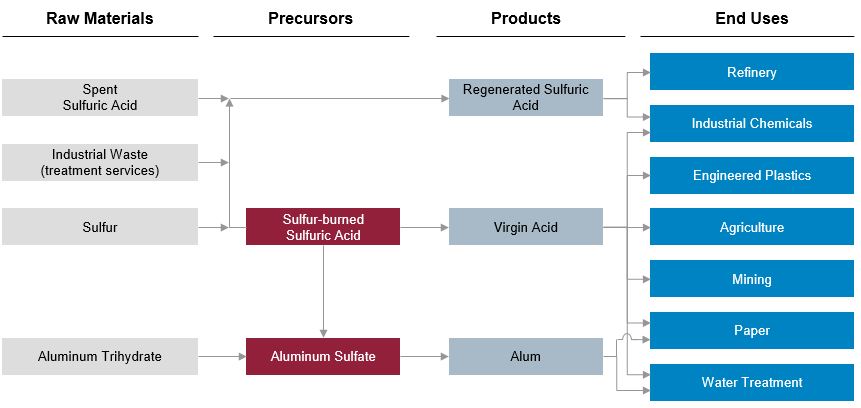
We provide regenerated sulfuric acid and produce virgin sulfuric acid through our furnace operations. Regenerated sulfuric acid is produced by thermally decomposing the spent acid in our furnace into a clean gas stream, which is converted into sulfuric acid. Virgin sulfuric acid is produced by burning sulfur and certain sulfur-rich components at high temperatures within a furnace to create a gas stream. The chart below summarizes the manufacturing platform for our business.
Manufacturing Platform
Intellectual Property
We evaluate how best to use patents, trademarks, copyrights, trade secrets and other available intellectual property protections on a case-by-case basis. Patents extend for varying periods in accordance with the date of patent application filing and the legal life of such patents. The protection afforded depends upon the type of subject matter covered by the patent and the scope of the claims of the patent.
Patent protection may be available for unique applications and production processes. Moreover, we monitor our competitors’ products and, if circumstances were to dictate that we do so, we would vigorously challenge the actions of others that conflict with our patents, trademarks and other intellectual property rights. We maintain appropriate information security policies and procedures reasonably designed to ensure the safeguarding of confidential information including, where appropriate, data encryption, access controls and employee awareness training.
We own or have rights to a number of patents relating to our products and processes. As of December 31, 2025, we owned 5 patented inventions in the United States. As of December 31, 2025, we also had 68 trademark registrations worldwide, including 4 U.S. trademark registrations. We also have 6 pending trademark applications, which include applications in the United States and worldwide. In addition to our registered and applied-for intellectual property portfolio, we also claim ownership of certain trade secrets and proprietary know-how developed by and used in our business.
Seasonality
Our regeneration services product group typically experiences seasonal fluctuations as a result of higher demand for gasoline products in the summer and lower demand in the winter months. These demand fluctuations result in higher sales and working capital requirements in the second and third quarters.
Sustainability Overview
Sustainability is intertwined with our daily business and is reinforced through our strategy and values. We strive to create sustainable products that are safe for the environment, and to reduce waste and increase efficiencies for our customers and stakeholders. We believe that our products contribute to lower emissions and cleaner air. We are committed to creating environmentally responsible products that we believe make a difference in people’s daily lives and for our planet.
While offering products and services that help our customers to advance their own sustainability goals, we also work to advance our commitment to maintain sound environmental, social and governance practices, policies and procedures. For example, we:
•Were awarded a 2025 Gold Sustainability Rating from EcoVadis, a third-party sustainability evaluation company. The Gold Medal rating from EcoVadis placed us among the top 5% (95th percentile) of all companies assessed by EcoVadis over the prior twelve-month period;
•Maintained an executive level position of Vice President – Environment and Sustainability that reports directly to our Chief Executive Officer;
•Under the executive leadership, instituted additional health, safety and process safety programs, as well as continued our company-wide employee health and wellness program that covers both physical and mental health;
•Had one OSHA recordable injury (supervised contractor) in 2025;
•Provided enhanced sustainability information on our website and published our 2024 Sustainability Report in June 2025, our fourth as Ecovyst;
•Continued work towards our End-of-Year 2025 sustainability goals regarding power usage and water management, and our 2030 sustainability goals regarding fuel usage, power usage, waste management, water management, responsible procurement, health, safety and environment performance, governance, and community engagement;
•Continued to reflect our core values - Stewardship, High Standards, Integrity and Engagement (“SHINE”) – in everything we do and presented SHINE awards to two employees each quarter of 2025 that were nominated by their colleagues as exemplifying the SHINE core values at work;
•Continued steps to implement additional improvements in a number of areas, including health, safety and environmental (“HSE”) performance; commitment to building a culture of respect and belonging both within our company and in our supply chain; and ethical and lawful business practices;
•Further integrated a corporate-wide sustainability software platform, which we are utilizing as an internal, real-time sustainability performance dashboard to enable improved analytics and greater visibility into our sustainability impacts; and
•Achieved a greater than 93% performance in our flagship HSE Perfect Days program in 2025, which targets at-risk behaviors and celebrates positive HSE performance across the organization on a daily basis.
The sections that follow provide some highlights of related programs and procedures.
Environmental Stewardship
Our products and technologies continue to address our customers’ sustainability challenges, tightening global regulatory standards and changing consumer preferences. We provide regeneration services that avoid significant landfill or deep well disposal of spent, or used, sulfuric acid and related hazardous and nonhazardous waste streams.
As part of our sustainability commitment regarding our own operations, we apply the principles of the Environmental Management standard of the International Organization for Standardization (ISO 14001) at our facilities. For our United States facilities, we also adhere to the Responsible Care® RC14001 Technical Specifications of the American Chemistry Council (“ACC”).
We maintain policies and procedures to monitor and control HSE risks, and to enable compliance with applicable state, national, and international HSE requirements. We have comprehensive HSE compliance, auditing and management
programs in place to assist in our compliance with applicable regulatory requirements and with internal policies and procedures, as appropriate. Each Ecovyst facility has developed and implemented specific critical occupational health, safety, environmental, security and loss control programs.
We also have strong Health and Safety (“H&S”) and Environmental and Sustainability (“E&S”) organizations staffed by professionals who are responsible for health, safety, process safety, environmental, sustainability, product stewardship and product safety regulatory compliance. Our H&S and E&S organizational structures feature executive management-level leadership, active oversight by our Board and dedicated H&S and E&S experts on staff. We have Health, Safety and Process Safety Management leadership and also have Regional H&S Specialists and Managers who are embedded in the field and provide H&S expertise and support to operating sites. In addition, our Vice President Environmental and Sustainability oversees a team of Regional Environmental Specialists, Managers and Directors that serve our operating sites.
As an ACC Responsible Care® member company, we continue to monitor and report our HSE metrics annually. Most recently, our 2024 sustainability data for Scope 1 and 2 greenhouse gas (“GHG”) emissions, water withdrawal, and the mass of hazardous and nonhazardous waste generated was verified. GHG emissions are verified by an independent third-party to a reasonable level of assurance in accordance with the requirements of the WRI/WBSCD GHG Protocol Corporate Accounting and Reporting Standard, revised edition (2004, as amended in 2013) and the GHG Protocol Scope 2 Guidance (2015). The independent third party also verified the Company’s metrics for water withdrawal and waste generated, to a reasonable level of assurance. We included the assured data on our website and in our 2024 Sustainability Report, which we published in June 2025.
We also maintain a Product Safety and Product Stewardship management system that is compliant with the RC14001 technical specification and is supported by a dedicated Product Stewardship professional. We conduct Product Stewardship reviews as part of new product development and routinely evaluate product safety risk for raw materials, intermediates, and finished products.
Human Capital
We seek to act in a socially responsible manner through our various HSE programs as described above, our commitment to fostering a workplace culture where every employee feels respected, valued, and empowered to contribute their best, engagement with and support for the communities where we live and work, and advancement of socially responsible business practices through partnerships and other industry frameworks.
We believe that a diverse range of experiences, backgrounds, and perspectives strengthens our teams and supports innovation, safety, and long-term success. We are guided by our core SHINE values (Stewardship, High Standards, Integrity, and Engagement) and are intentional in cultivating a workplace where all team members can grow, contribute meaningfully, and thrive.
We are committed to providing equal employment opportunities for all employees and applicants for employment, and do not discriminate on the basis of race, color, religion, sex, sexual orientation, pregnancy, gender identity and expression, national origin, disability, age (40 or above), ancestry, genetic information, marital status, veteran status or any other classification protected by law. This commitment applies to all terms and conditions of employment, including recruiting, hiring, placement, advancement, training, transfer, demotion, lay off and recall, termination, compensation and benefits.
It is our policy to comply with all applicable laws and regulations in each jurisdiction in which we operate in order to provide appropriate working conditions for our colleagues. This means that we comply with applicable laws regarding the employment relationship including those that (1) prohibit child labor, (2) set acceptable working conditions and working hours, (3) provide for fair wages, including minimum wages and overtime, (4) prohibit forced or bonded labor, (5) permit freedom of association and collective bargaining, and (6) prohibit discrimination, harassment and other forms of degrading or inhumane treatment. Using tools such as our Supplier Code of Conduct and contractual provisions, we also hold our business partners to these same standards.
We support our people by acknowledging our workforce is key to our success. We offer highly competitive salaries, benefits, developmental opportunities and work/life balance. We proactively seek to attract, incentivize and retain a talented and motivated workforce. Our global performance management and succession planning processes are designed to provide sufficient talented personnel to fill key leadership, innovation and manufacturing roles well into the future and to better prepare employees for their future at the Company.
We review our compensation and benefits programs periodically to ensure continued competitiveness. In the United States, our benefit programs are designed to help protect the health and financial well-being of our full-time employees and their family members, offering a choice of several medical & dental plans, as well as vision, flexible spending accounts, short-term and long-term disability insurance and an employee assistance program. To help our employees prepare for their future, we offer a defined contribution savings plan, which includes company contributions.
We benefit from our talented and dedicated employee population, and we actively seek to maintain a workforce that reflects the communities in which we operate. As of December 31, 2025, we had 617 employees, all of which were employed in the United States. Further, as of December 31, 2025, approximately 20% of our executives, managers and professionals were females and 20% were non-white males. As of December 31, 2025, approximately 37% of our employees were represented by a union. We believe we have good relationships with our employees and their respective unions and other bargaining representatives.
Our strengths, supported by our core values of SHINE, foster a rich culture founded on diversity of thought. We firmly believe that success is achieved through the intellect and commitment of our people, so we employ a long-term human capital program to attract, retain and develop talent for the future. We are proud of our highly collaborative teams that enable an inclusive workplace where employees are encouraged to bring their own experiences to promote innovation from all levels of the organization. This constructive work environment is supplemented with a fully integrated on-line performance management process that improves the communication of aligned goals, encourages consistent feedback and furthers employee engagement. Today, we have women on our leadership team overseeing functions that include E&S and Human Resources.
In 2025, our sites continued to have a positive impact in the communities in which we operate. The following table outlines some of those impacts:
| | | | | | | | |
| Location | | Community Impact |
| | |
| The Woodlands, Texas | | • Participated in flood relief efforts by handing out cleaning supplies and food
• Donated diapers during a diaper drive for the Community Assistance Center
• Held a wish list drive for a local animal shelter
• Donated gift cards to a non-profit organization that offers emergency shelter |
| Houston, Texas | | • Provided school supplies to a local elementary school
• Bagged and distributed food at a local food bank
• Provided a $15,000 scholarship for a high school student |
| Hammond, Indiana | | • Provided school supplies to a local elementary school |
| Baytown, Texas | | • Donated supplies, sports apparel and equipment to a local elementary school
• Participated in flood relief efforts by handing out cleaning supplies and food
• Volunteered at a United Way sponsored breakfast
• Read to students at a local elementary school as part of a literacy outreach event |
| Baton Rouge, Louisiana | | • Collaborated with a non-profit organization to renovate residences of those in need
• Donated to the Karen Domingue-Maillet Scholarship, supporting a student through eight college semesters starting January 2026
• Donated school supplies |
| Waggaman, Louisiana | | • Donated supplies to local schools |
| Martinez, California | | • Assisted the Local Chamber of Commerce with the annual County King of BBQ event
• Participated in a shoreline cleanup event to protect the local environment |
| Dominguez, California | | • Provided a monetary donation to support local families at Thanksgiving
• Participated in a blood drive |
| West Orange, Texas | | • Provided school supplies to a local elementary school
• Supplied Thanksgiving donations to a local church |
| Wayne, Pennsylvania | | • Held a Thanksgiving food drive
• Held a Christmas toy drive
• In conjunction with our Texas sites, donated supplies and funds to the American Red Cross for victims of the Central Texas Floods
• Participated in a group volunteering event at Natural Lands Binky Lee Preserve
• Provided non-perishable foods and turkeys to a local food pantry for Thanksgiving meals for families in need
• Participated in the Adopt-a-Child program providing holiday gifts to children
• In coordination with all sites, made monetary donations to local organizations to support families for Thanksgiving |
We also implemented a formal paid volunteer leave policy in 2025 that allows employees to take up to eight hours of paid leave each calendar year to participate in volunteer activities with approved organizations.
Governance
We maintain and consistently reinforce within our organization a series of policies and practices designed to ensure that decisions made on behalf of our company are properly made and executed. Our governance programs and policies start with a strong tone at the top and are summarized in our Executive Statement on Ethics and Compliance, which has been issued by our Chief Executive Officer and our Chief Compliance Officer and distributed throughout the organization.
The principles set forth in the Executive Statement are codified in our Code of Conduct, which sets forth the legal and ethical standards to which our employees must adhere, including (a) acting with integrity, (b) avoiding actual or apparent conflicts of interest, (c) complying with the laws and regulations of federal, state, provincial, local governments, and other appropriate regulatory agencies, (d) complying with all laws and regulations prohibiting fraud, bribery, corrupt practices, anti-competitive activities and trading with embargoed persons and countries, (e) complying with all company policies and procedures, and (f) actively promoting ethical behavior in the workplace.
Our governance programs and policies can be found on the Company’s sustainability webpages, which are routinely updated and include a description of our enterprise risk management program and our policies on child labor, human trafficking, anti-harassment, antibribery, and cybersecurity, all of which are evaluated by third parties, including EcoVadis. In addition, the investors pages of our website contain additional materials regarding our corporate governance process, including our Board committee charters, our corporate governance guidelines, our Code of Conduct, our Supplier Code of Conduct, and other documents.
Additional Sustainability Information: Further information about our sustainability programs can be found on our website at https://www.ecovyst.com/sustainability/. The information available on our sustainability website includes our sustainability report, our sustainability goals (and how such goals map to the UN Sustainable Development Goals), materiality matrix, letters of assurance, Global Reporting Initiative (GRI) Disclosure and Sustainability Accounting Standards Board (SASB) Index, our Health Safety Environment & Security Policy Statement, our Corporate Code of Conduct, our Human Rights Policy Statement, a description of our Ethics & Compliance Complaint and Review Process, and our Labor Policy. The information contained on our website is not incorporated herein by reference and is not a part of this Annual Report on Form 10-K.
Environmental Regulations
We are subject to extensive, evolving and increasingly stringent national, state and/or local environmental laws and regulations, which address, among other things, the following:
•emissions to the air;
•discharges to soils and surface and subsurface waters;
•other releases into the environment;
•prevention and remediation of releases into the indoor or outdoor environment;
•generation, handling, storage, transportation, treatment and disposal of waste materials;
•maintenance of safe conditions in the workplace;
•registration and evaluation of chemicals;
•production, handling, labeling or use of chemicals used or produced by us; and
•stewardship of products after manufacture.
Again, we apply the principles of the Environmental Management standard of the International Organization for Standardization (ISO 14001) at our facilities, and we also adhere to the Responsible Care® RC14001 Technical Specifications of the American Chemistry Council covering health, safety, environmental, and security.
We maintain policies and procedures to monitor and control HSE risks, and to monitor compliance with applicable local, state, national and international HSE requirements. We have a strong HSE organization. We maintain a staff of professionals who are responsible for environmental, safety, health, process safety and product regulatory compliance. We have implemented a corporate audit program for all of our facilities. However, we may not be in full compliance at all times with all applicable environmental laws and regulations. We expect that stringent environmental regulations will continue to be imposed on us and our industry in general. Evolving chemical regulation programs throughout the world could impose testing requirements or restrictions on our chemical raw materials and products.
Environmental Remediation
Environmental laws and regulations require mitigation or remediation of the effects of the disposal or release of chemical substances. Under some of these regulations, as the current or former owner or operator of a property, we could be held liable for the costs of removal or remediation of hazardous substances on or under property or for natural resource damages allegedly associated with these conditions, without regard to whether we knew of or caused the contamination, and regardless of whether the practices that resulted in the contamination were permitted at the time they occurred. Many of our current or former production sites have an extended history of industrial use, and it is impossible to predict precisely what effect these laws and regulations will have on us in the future. Soil and groundwater contamination requiring investigation and remediation has been discovered at some of the sites and might occur or be discovered at other sites. Several active and former facilities currently are undergoing investigation, remediation and/or
surveillance, including sites in Dominguez, California, Martinez, California and Hammond, Indiana. We have established and periodically update reserves for the anticipated and estimable cost of remediation at these sites
Environmental Programs
We have comprehensive HSE compliance, auditing and management programs in place to assist in our compliance with applicable regulatory requirements and with internal policies and procedures, as appropriate. Each facility has developed and implemented specific critical occupational health, safety, environmental, security and loss control programs.
We also have implemented a HSE organizational structure with executive committee level leadership and dedicated environmental experts. We have Health, Safety and Process Safety Management leadership and Regional HS Specialists and Managers who are embedded in the field and provide health and safety expertise and support to operating sites. We also have a Vice President of Environmental and Sustainability as well as Regional Environmental Specialists, Managers and Directors who are onsite to provide environmental expertise and support operating sites. Certain larger sites have dedicated environmental and health and safety personnel.
Product Safety and Product Stewardship
We have established a Product Safety and Product Stewardship management system that is compliant with the RC14001® technical specification and is supported by a dedicated Product Stewardship professional. We conduct Product Stewardship reviews as part of new product development and routinely evaluate product safety risk for raw materials, intermediates, and products.
As a chemical company, we are subject to extensive and evolving regulations regarding the manufacturing, processing, distribution, importing, exporting, and labeling of our products and raw materials.
In the US, all pertinent chemicals have been designated as “active” under the US Frank R. Lautenberg Chemical Safety for the 21st Century Act. At this time, none have been designated as chemicals which the EPA will prioritize and evaluate for regulation. Based on our chemicals and the various regulations promulgated to date, we do not anticipate costly testing requirements nor severe restrictions, but we cannot guarantee that we will not be subject to requirements for our products or raw materials that could materially affect our operations.
We remain alert for any regulatory changes which may impact our products and their end uses.
Available Information
Our website address is www.ecovyst.com. We make available free of charge through our website our Annual Report on Form 10-K, Quarterly Reports on Form 10-Q, Current Reports on Form 8-K and amendments to those reports filed or furnished pursuant to Section 13(a) or 15(d) of the Securities and Exchange Act of 1934, as amended (“Exchange Act”), as well as reports on Forms 3, 4 and 5 filed pursuant to Section 16 of the Exchange Act, as soon as reasonably practicable after such documents are electronically filed with, or furnished to, the Securities and Exchange Commission (“SEC”). The SEC maintains an Internet website, https://www.sec.gov, which contains reports, proxy and information statements, and other information regarding our Company and other issuers that file electronically with the SEC. The information on our website is not, and shall not be deemed to be, a part of this report or incorporated into any other filings we make with the SEC.
Our Corporate Governance Guidelines, Code of Business Conduct and the charters of the Audit Committee, Compensation Committee, Nominating and Corporate Governance Committee and Health, Safety and Environment Committee of our Board of Directors are also available on our website and are available in print to any stockholder upon request by writing to Ecovyst Investor Relations, 600 Lee Road, Suite 200, Wayne, PA 19087. In accordance with SEC rules, we intend to disclose any amendment (other than any technical, administrative or other non-substantive) to the Code of Business Conduct, or any waiver of any provision thereof with respect to any of our executive officers, on our website within four business days following such amendment or waiver.
ITEM 1A. RISK FACTORS.
In addition to the other information contained in this Form 10-K, you should carefully consider the following risks that we believe are the material risks that we face. The risks described below could have a material adverse impact on our business, financial condition, cash flows and results of operations, and should be read together and in conjunction with the forward-looking statements and “Management’s Discussion and Analysis of Financial Condition and Results of Operations” included in Item 7 of this Form 10-K, and our consolidated financial statements and the accompanying notes thereto.
Risks Related to Our Business Operations
We are exposed to local business risks, which could have a material adverse effect on our financial condition, results of operations and cash flows.
We have operations in several locations, including manufacturing sites, a research and development laboratory, sales personnel and customer support operations. As of December 31, 2025, we operated nine manufacturing facilities. Our operations are affected directly and indirectly by global regulatory, economic, political and social conditions, including:
•new and different legal and regulatory requirements in local jurisdictions;
•potential difficulties in staffing and labor disputes;
•potential difficulties in managing and obtaining support and distribution for local operations;
•increased costs of, and availability of, raw materials, energy, transportation or shipping;
•credit risk and financial condition of local customers and distributors;
•potential difficulties in protecting intellectual property rights;
•potential imposition of restrictions on investments;
•capital controls;
•potential difficulties in enforcing agreements and collecting receivables;
•risks relating to environmental, health and safety matters;
•regional conflicts, such as the invasion of Ukraine by Russia and conflicts involving countries in the Middle East;
•risks relating to information security and cyber security events;
•export duties or import quotas;
•domestic and foreign customs and tariffs or other trade barriers, including the threat of escalating trade disputes that may result in higher tariffs and the imposition of trade sanctions against certain countries, persons and entities;
•risks relating to epidemics and pandemics and effects therefrom; and
•local political, economic and social conditions.
We may not be successful in developing and implementing policies and strategies to address the foregoing factors in a timely and effective manner at each location where we do business. Consequently, the occurrence of one or more of the foregoing factors could have a material adverse effect upon our financial condition, results of operations and cash flows.
Our operations and financial results have been and may continue to be adversely affected by general economic conditions.
We sell products and services that are used in manufacturing processes and as components of, or ingredients in, other products and, as a result, our sales are correlated with and affected by fluctuations in the level of industrial production and manufacturing output and by fluctuations in general economic activity. Demand for the products we manufacture and services we provide often depends on trends in demand in the end uses our customers serve. General economic conditions and macroeconomic trends, including economic recessions and inflation, could affect overall demand for our products and any overall decline in such demand could significantly reduce our sales and profitability. In addition, volatility and disruption in financial markets could adversely affect our sales and results of operations by limiting our customers’ ability to obtain the financing necessary to maintain or expand their own operations.
Unfavorable economic conditions could adversely affect our business, financial condition, and results of operations.
Our results of operations could be adversely affected by general conditions in the economy. For example, during the past several years the economy has experienced extreme volatility and disruptions, including significant volatility in commodity and market prices, large fluctuations in energy prices, volatility in sulfur prices, declines in consumer confidence, declines in economic growth, supply chain interruptions, uncertainty about economic stability, rising inflation, fluctuations in interest rates and the threat of recession. Unfavorable economic conditions could result in a variety of risks to our business, including demand and pricing for our products and difficulty in forecasting our financial results. A weak or declining economy also could strain our suppliers, possibly resulting in supply chain disruptions. In addition, inflation has increased our costs, which could impact our profitability. These and other economic factors could adversely impact our business and results of operations.
Exchange rate fluctuations could adversely affect our financial condition, results of operations and cash flows.
We incur currency transaction risk whenever we enter into either a purchase or sale transaction using a currency other than the local currency of the transacting entity. The exchange rates between the currencies of other countries and the U.S. dollar have fluctuated significantly in recent years and may continue to do so in the future. To the extent that we are unable to match sales made in such foreign currencies with costs paid in the same currency, exchange rate fluctuations could adversely affect our financial condition, results of operations and cash flows. Given the volatility of exchange rates, we may not be able to effectively manage our currency transaction risks or that any volatility in currency exchange rates will not have a material adverse effect on our financial condition or results of operations.
Additionally, because our consolidated financial results are reported in U.S dollars, the translation of sales or earnings generated in other currencies into U.S. dollars can result in a significant increase or decrease in the amount of those sales or earnings in our financial statements, which also affects the comparability of our results of operations and cash flows between financial periods.
Our operations require us to comply with anti-corruption laws, economic sanctions, export controls and similar laws and regulations of the U.S. government and various international jurisdictions in which we do business.
Doing business on a worldwide basis requires us and our subsidiaries to comply with the laws and regulations of the U.S. government and various international jurisdictions, and our failure to successfully comply with these laws and regulations may restrict our operations, trade practices, investment decisions and partnering activities and may expose us to liabilities. Such laws and regulations apply to companies, individual directors, officers, employees and agents.
In particular, our operations are subject to U.S. and foreign anti-corruption laws and regulations, such as the Foreign Corrupt Practices Act (“FCPA”) and the U.K. Bribery Act. For example, the FCPA prohibits us from providing anything of value to foreign officials for the purposes of influencing official decisions or obtaining or retaining business or otherwise obtaining favorable treatment, and requires us to maintain adequate record-keeping and internal accounting practices to accurately reflect our transactions. As part of our business, we may deal with state-owned business enterprises, the employees and representatives of which may be considered foreign officials for purposes of the FCPA. In addition, some of the international locations into which we sell our products lack a developed legal system and have elevated levels of corruption. As a result, we are exposed to corruption-related risk.
In addition, we are required to comply with applicable economic sanctions, export controls, and similar laws and regulations imposed by the U.S. government and other countries. These laws and regulations may restrict our business practices, or the counterparties or regions with which we can trade. In addition, these laws and regulations are subject to
frequent change, and such changes may require us to adjust our business practices, including by ceasing business activities in newly sanctioned countries or regions or with newly sanctioned entities or individuals, or to modify our compliance program. For example, the invasion of Ukraine by Russia and the related sanctions, export controls or other actions that have been or may be initiated by nations—including the U.S., the European Union, the United Kingdom, and Russia—could disrupt or otherwise adversely impact our customers in those countries, as well as adversely impact our business or our supply chain, business partners or customers in other countries beyond Ukraine and Russia. Further, violations of these legal requirements are punishable by criminal fines and imprisonment, civil penalties, disgorgement of profits, injunctions, debarment from government contracts, loss of export privileges and other remedial measures.
We have established policies and procedures designed to assist us and our personnel in complying with applicable U.S. and international laws and regulations. These policies and procedures are codified in our Code of Conduct and other various policies. However, there can be no assurance that our policies and procedures will effectively prevent us from violating these laws and regulations in every transaction in which we may engage, and such a violation could subject us to governmental investigations and adversely affect our reputation, business, financial condition and results of operations.
Alternative technology or other changes in our customers’ products may reduce or eliminate the need for certain of our products or services.
Many of our products and services are used in manufacturing processes and/or to produce other products and, as a result, changes in our customers’ end products or processes or alternative technologies may enable our customers to reduce or eliminate consumption or use of our products. Additionally, shifting consumer preference could result in a significant reduction in the future use of fossil fuels, which would have a negative impact on our business. If we are unable to respond appropriately to such new developments, such changes could seriously impair our ability to profitably market certain of our products or services.
If we are unable to pass on increases in raw material prices, including natural gas, to our customers or to retain or replace our key suppliers, our results of operations and cash flows may be negatively affected.
We purchase significant amounts of raw materials, including sulfur, and we purchase significant amounts of natural gas to supply the energy required in our production process. The cost of these raw materials represents a substantial portion of our operating expenses and our results of operations have been, and could in the future be, significantly affected by increases in the costs of such raw materials. In addition, we obtain a significant portion of our raw materials from certain key suppliers. If any one of those suppliers is unable to meet its obligations under current or future supply agreements, we may be forced to pay higher prices to obtain the necessary raw materials. Furthermore, if any of the raw materials that we use become unavailable within the geographic area from which we currently source them, we may not be able to obtain suitable and cost-effective substitutes. Any interruption of supply or any price increase of raw materials could adversely affect our profitability.
While we attempt to match raw material price increases with corresponding product price increases, our ability to pass on increases in the cost of raw materials to our customers is, to a large extent, dependent upon our contractual arrangements and market conditions. There may be periods of time during which we are not able to recover increases in the cost of raw materials due to our contractual arrangements or weakness in demand for, or oversupply of, our products. Specifically, timing differences between price adjustments of raw materials and adjustments to our product prices, which in many cases are adjusted quarterly or less often, have had and may continue to have a negative effect on our profitability. Even in periods during which raw material prices decline, we may suffer decreasing profits if customers seek relief in the form of lower sales prices or if the raw material price reductions occur at a slower rate than decreases in the selling prices of our products. Such volatility can result in commercial disputes with customers and suppliers with respect to interpretations of complex contractual arrangements, the adverse resolution of which could reduce our profitability.
In the past, we have entered into long-term supply contracts for certain of our raw materials. As these contracts expire, we may not be able to renegotiate or enter into new long-term supply contracts that will offer similar protection from price increases and other fluctuations on terms that are satisfactory to us or at all.
We face substantial competition in the industries in which we operate.
Our competitors may improve their competitive position in our core end use applications by improving their manufacturing processes, expanding their capacity or manufacturing facilities or responding more effectively than we do to changes in customer requirements. Some of our competitors may be able to lower prices for products that compete with our products if their costs are lower. In addition, consolidation among our competitors or customers may result in reduced demand for our products or make it more difficult for us to compete effectively. Our competitors may have greater financial and other resources than us, or they may have less debt, and as a result they may be better able to withstand changes to industry conditions. If we fail to compete effectively in the marketplace, it would materially adversely affect our financial condition and results of operations.
We are subject to the risk of loss resulting from non-payment or non-performance by our customers.
Our credit procedures and policies may not be adequate to minimize or mitigate customer credit risk. Our customers may experience financial difficulties, including bankruptcies, restructurings and liquidations. These and other financial problems our customers may experience, as well as potential financial weakness in the industries in which we operate or general economic conditions, may increase our risk in extending trade credit to customers. A significant adverse change in a customer’s financial position could cause us to limit or discontinue business with such customer, require us to assume more credit risk relating to such customer’s receivables or limit our ability to collect accounts receivable from such customer. Any of the foregoing events could have a material adverse effect on our business, results of operations, financial condition and liquidity.
We rely on a limited number of customers for a meaningful portion of our business. A loss of one or more of these customers could adversely impact our profitability.
A loss of any significant customer, including a pipeline customer, or a decrease in the provision of products to any significant customer, could have an adverse effect on our business until alternative arrangements are secured. Any alternative arrangement to replace the loss of a customer could result in increased variable costs relating to product shipment. In addition, any new customer agreement we enter into may not have terms as favorable as those contained in our current customer agreements, which could have a material adverse effect on our business, financial condition and results of operations. For the year ended December 31, 2025, our top ten customers represented approximately 61% of our sales and one single customer represented 12% or $89 million of our sales.
Refineries, which represent a sizable subset of our customer base, have undergone significant consolidation and additional consolidation is possible in the future. Such consolidation could further increase our reliance on a small number of customers and further increase our customers’ leverage over us, resulting in downward pressure on prices and an adverse effect on our profitability.
Multi-year customer contracts are subject to potential early termination and such contracts may not be renewed at the end of their respective terms.
Many of our customer contracts are multi-year agreements. Regeneration services customer contracts are typically on five- to ten-year terms and virgin sulfuric acid customer contracts are typically on one- to five-year terms, with larger customers typically favoring longer terms. Excluding contracts with automatic evergreen provisions, approximately 40% of our sulfuric acid volume for the year ended December 31, 2025 was under contracts expiring at the end of 2026 or beyond. In addition, our regeneration services contracts with major refinery customers typically allow for termination with advance notice of one to two years. Our existing contracts may be subjected to early terminations, and our expiring contracts may not be renewed at the end of their terms. If we receive a significant number of such contract terminations or experience non-renewals from key customers, our results of operations, financial condition and cash flows may be materially adversely affected.
Our quarterly results of operations are subject to fluctuations because the demand for some of our products is seasonal.
Our business typically experiences seasonal fluctuations as a result of higher demand for gasoline products in the summer months. Because of the seasonality of some of our product groups, the results for any one quarter are not necessarily indicative of the results that may be achieved for any other quarter or for the full year.
Our growth projects may result in significant expenditures before generating revenues, if any, which may materially and adversely affect our ability to implement our business strategy.
We have made and continue to make significant investments in our business. These projects require us to commit significant capital to, among other things, implement engineering plans and obtain the necessary permits before we generate revenues related to our investments in these businesses. Such projects may take longer to complete or require additional unanticipated expenditures and may never generate profits. If we fail to recover our investment, or these projects never become profitable, our ability to implement our business strategy may be materially and adversely affected.
We may be liable for damages based on product liability claims brought against us or our customers for costs associated with recalls of our or our customers’ products.
The sale of our products involves the risk of product liability claims and voluntary or government-ordered product recalls. For example, certain of the products that we manufacture are used in chemical manufacturing processes in our customers’ manufacturing operations and are used in and around other chemical manufacturing facilities and other locations where personal injury or property damage may occur. While we attempt to protect ourselves from product liability claims and exposures through our adherence to standards and specifications, quality control and assurance and through contractual negotiations and provisions, there can be no assurance that our efforts will ultimately protect us from such claims. A product liability claim or voluntary or government-ordered product recall could result in substantial and unexpected expenditures, affect customer confidence in our products and divert management’s attention from other responsibilities. A product recall or successful product liability claim or series of claims against us in excess of our insurance coverage and for which we are not otherwise indemnified could have a material adverse effect on our business, financial condition, results of operations or cash flows. We have product liability insurance in amounts that we believe are adequate to cover this product liability risk. However, our insurance may not provide adequate coverage against all potential liabilities, including product recall liabilities. If a claim is brought against us, we might be required to pay legal and other expenses to defend the claim, as well as pay uncovered damage awards resulting from a claim brought successfully against us and these damages could be significant and have a material adverse effect on our financial condition. Furthermore, whether or not we are ultimately successful in defending any such claims, we might be required to direct significant financial and managerial resources to such defense and adverse publicity is likely to result.
We are required to comply with a wide variety of laws and regulations, and are subject to regulation by various federal, state and local agencies, and our failure to comply with existing and future regulatory requirements could adversely affect our financial condition, results of operations and cash flows.
We operate in industries in which we and/or our customers are subject to federal, state, local, international and transnational laws and regulations. Such laws and regulations are numerous and sometimes conflicting, and any future changes to such laws and regulations could adversely affect our business.
In order to obtain regulatory approval for certain of our new products, we must, among other things, demonstrate to the relevant authority that the product is safe and effective for its intended uses and that we are capable of manufacturing the product in accordance with current regulations. The process of seeking approvals can be costly, time-consuming and subject to unanticipated and significant delays. Any delay in obtaining, or any failure to obtain or maintain, these approvals would adversely affect our ability to introduce new products and to generate sales from those products, and could have an adverse effect on our business, financial condition, results of operations or cash flows.
Our products, including the raw materials we handle, are subject to rigorous chemical registration and industrial hygiene regulations and investigation. There is risk that a key raw material, chemical or substance, or one of the end products of which our products are a part of or are utilized to make, may be recharacterized as having a toxicological or health-related impact on the environment, our customers or our employees. Industrial hygiene regulations are continually strengthened, and if such recharacterization occurs, the relevant raw material, chemical or product may be banned, or we may incur increased costs in order to comply with new requirements. Changes in industrial hygiene regulations also affect the marketability of certain of our products, and future regulatory changes may have a material adverse effect on our business.
New laws and regulations, and changes in existing laws and regulations, may become effective in the future and could prevent or inhibit the development, distribution and sale of our products, including, but not limited to, the imposition of additional compliance costs, seizures, confiscation, recall or monetary fines. For example, as discussed in more detail in “Business-Environmental Regulations” and “Business-Chemical Product Regulation,” we may be
materially impacted by regulatory initiatives worldwide with respect to chemical product safety such as the 2016 amendments to the U.S. Toxic Substances Control Act. Additionally, current or future U.S. administrations may seek to alter current environmental standards and regulations, including, but not limited to, the Corporate Average Fuel Economy standards, which could have a material adverse effect on our sales into the clean fuels, emission control and other industries.
We are subject to extensive environmental, health and safety regulations and face various risks associated with potential non-compliance or releases of hazardous materials.
Like other chemical companies, our operations and properties are subject to extensive and stringent federal, state and local environmental laws and regulations. U.S. federal environmental laws that affect us include, but are not limited to, the Resource Conservation and Recovery Act (“RCRA”), the Clean Air Act, the Clean Water Act and the Comprehensive Environmental Response, Compensation and Liability Act (“CERCLA”). These laws govern, among other things, emissions to the air, discharges or releases of hazardous substances to land, surface, subsurface strata and water, wastewater discharges and the generation, handling, storage, transportation, treatment, disposal and remediation of hazardous materials and petroleum products. We are also subject to other federal, state and local laws and regulations regarding chemical and product safety as well as employee health and safety matters, including process safety requirements. These laws and regulations may become more stringent over time and the failure to comply with such laws and regulations can result in significant fines or penalties.
We have in the past been and currently are the subject of investigations and enforcement actions pursuant to environmental laws, including the Clean Air Act. Some of these matters were resolved through the payment of significant monetary penalties and a requirement to implement corrective actions at our facilities. For instance, we remain subject to a 2007 Consent Decree that resolves certain alleged Clean Air Act violations at six operating locations involving New Source Review, Prevention of Significant Deterioration and New Source Performance Standard obligations under the U.S. federal rules for the pollutants sulfur dioxide and sulfuric acid mist. The Consent Decree required Solvay (the owner of such facilities at the time) to pay a $2 million penalty and spend approximately $34 million on air pollution controls at our facilities, the majority of which was received from customers in contractual arrangements. Work under the Consent Decree has proceeded since 2007, and all of the significant capital improvements related to the Consent Decree have been completed. Three of our operating locations have been released from the scope of the Consent Decree and we are seeking release of three other locations covered by the Consent Decree. Upon issuance of New Source Review permit amendments at the remaining sites, we expect to be fully released from the Consent Decree.
We are required by these environmental laws and regulations to obtain and periodically renew registrations, licenses, permits and other approvals in order to operate, make disclosures to public authorities about our chemical handling and usage activities, and install and operate expensive pollution control and spill containment equipment at our facilities, or incur other capital and operational expenditures aimed at achieving or maintaining compliance with such laws, regulations and permits. The failure to timely identify and implement any such capital projects required to achieve or maintain compliance could expose us to enforcement and penalties. In the process of renewing or reissuing our environmental permits, the issuing authority may impose new and more stringent conditions, potentially requiring increased capital or operational costs.
Under CERCLA and analogous statutes in state and local jurisdictions, current and former owners and operators of land impacted by releases of hazardous substances are strictly liable for the investigation and remediation of the contamination resulting from the release. Liability under CERCLA and analogous laws is strict, unlimited, joint, several and retroactive, may be imposed regardless of fault and may relate to historical activities or contamination not caused by the affected property’s current owner or operator. We could be held responsible for all cleanup costs at a site, whether currently or formerly owned or operated, regardless of fault, knowledge, timing or cause of the contamination. Further, under CERCLA and analogous laws, we may be jointly and severally liable for contamination at third party sites where we or our predecessors in interest have sent waste for treatment or disposal, even if we complied with applicable laws at the time of treatment and/or disposal. In addition, we may face liability for personal injury, property damage and/or natural resource damage resulting from environmental conditions attributable to hazardous substance releases at or from facilities we currently own or operate or formerly owned or operated or to which we sent waste. As such, a product spill or unpermitted emission at one of our facilities or otherwise resulting from our operations could have adverse consequences on the environment and the surrounding community and could result in significant liabilities with respect to investigation and remediation.
Our facilities have an extended history of industrial use, and soil and groundwater contamination exists at some of our sites. As of December 31, 2025, we had current remediation, monitoring and/or maintenance obligations at several of our current or former sites, including Dominguez, California, Martinez, California and Hammond, Indiana. As of December 31, 2025, we had established reserves to cover anticipated and estimable expenses at these sites, all of which have reached relatively mature stages of the investigation, remediation or monitoring process. Actual costs to complete these projects may exceed our current estimates.
As of December 31, 2025, our total reserves associated with environmental remediation and enforcement matters noted above were $1.6 million. In addition to the ongoing remediation and monitoring activities discussed above, there is risk that the long-term industrial use at our facilities may have resulted in, or may in the future result in, contamination that has yet to be discovered, which could require additional, unplanned investigation and remediation efforts by us for which no reserves have been established, potentially without regard to whether we knew of, or caused, the release of such contaminants. If contamination not identified through previous investigations are discovered at our current facilities or other properties for which we potentially have responsibility, this could trigger additional investigation and remediation costs. Such environmental liabilities could have a material adverse effect on our results of operations or financial condition.
Existing and proposed regulations to address climate change by limiting greenhouse gas emissions may cause us to incur significant additional operating and capital expenses and may impact our business and results of operations.
Certain of our operations result in emissions of GHG, such as carbon dioxide. Growing concern about the sources and impacts of global climate change has led to a number of domestic legislative and administrative measures, both proposed and enacted, to monitor, regulate and limit carbon dioxide and other GHG emissions. In the United States, the EPA under prior administrations has promulgated federal GHG regulations under the Clean Air Act that affect certain sources. For example, the EPA has issued mandatory GHG reporting requirements, under which some of our facilities report depending upon each facility’s natural gas usage during each prior reporting year. Moreover, California has enacted the Global Warming Solutions Act of 2006 (“Assembly Bill 32”), a law that establishes a comprehensive program to reduce GHG emissions from all sources throughout the state and contains reporting requirements under which our Dominguez and Martinez facilities currently report. Our Dominguez facility also participates in the emissions trading market established under Assembly Bill 32. Although there is not at this time any expectation of increased GHG regulation at the federal level, we believe it is likely that GHG emissions will continue to be regulated in at least some regions of the United States in the future. We cannot yet predict the form such regulation will take (such as a cap-and-trade program, technology mandate, emissions tax or other regulatory mechanism) or what the regulatory trend will be at the federal level during future administrations. Consequently, the costs that we may be required to incur to meet such requirements, which could, for example, require that we install emission control equipment, purchase emissions allowances, administer and manage our GHG emissions program or address other regulatory obligations, are not reasonably predictable or estimable. Such requirements could also adversely affect our energy supply or the costs and types of raw materials that we use for fuel. Accordingly, regulations controlling or limiting GHG emissions could have a material adverse effect on our business, financial condition or results of operations, including by reducing demand for our products.
Sustainability initiatives may result in operational changes and expenditures, reduced demand for our products and services and adversely affect our business.
We recognize that sustainability remains a global environmental concern. Continuing political and social attention to the issue of sustainability has resulted in both existing and pending international agreements and national, regional or local legislation and regulatory measures to increase sustainability. As a result of heightened public awareness and attention to the issue of sustainability as well as continued regulatory initiatives, demand for certain of our products may be reduced, which may have an adverse effect on our sales volumes, revenues and margins.
This global environmental concern is also manifesting in existing sustainability legislation, regulations, and directives at the federal and state levels, including, but not limited to, the California Climate Corporate Data Accountability Act (SB 253) and GHG Climate-related Financial Risk Act (SB 261), and the stayed United States SEC rules addressing Scope 1 and 2 emissions. In the future, these developments are anticipated to increase the cost associated with complying with existing, pending, and future sustainability-related legislation, regulations and directives and such increased costs and/or our failure to comply with any such legislation, regulations and directives could adversely affect our financial condition, results of operations and cash flows.
Production and distribution of our products could be disrupted for a variety of reasons, and such disruptions could expose us to significant losses or liabilities.
Certain of the hazards and risks associated with our manufacturing processes and the related storage and transportation of raw materials, products and wastes may disrupt production at our manufacturing facilities and the distribution of products to our customers. These potentially disruptive risks include, but are not limited to, the following:
•pipeline and storage tank leaks and ruptures;
•explosions and fires;
•inclement weather and natural disasters;
•terrorist attacks, including attacks on critical infrastructure;
•cyberattacks or other security breaches targeting our operational technology, information systems or supply chain;
•failure of mechanical, process safety and pollution control equipment;
•chemical spills and other discharges or releases of toxic or hazardous substances or gases;
•epidemics and pandemics and effects therefrom; and
•exposure to toxic chemicals.
These hazards could expose employees, customers, the community and others to toxic chemicals and other hazards, contaminate the environment, damage property, result in personal injury or death, lead to an interruption or suspension of operations, damage our reputation and adversely affect the productivity and profitability of a particular manufacturing facility or our business as a whole. Such hazards could also result in the need for remediation, governmental enforcement, regulatory shutdowns, the imposition of government fines and penalties and claims brought by governmental entities or third parties. Given our operations impact on the nation's critical infrastructure, disruptions may also attract heightened governmental scrutiny and oversight. Legal claims and regulatory actions could subject us to both civil and criminal penalties, which could affect our product sales, reputation and profitability.
If disruptions at our manufacturing facilities or in our distribution channels occur, alternative options with sufficient capacity or capabilities may not be available, may cost substantially more or may require significant time to start production or distribution. Any of these scenarios could negatively affect our business and financial performance. If one of our manufacturing facilities or distribution channels is unable to produce or distribute our products for an extended period of time, our sales may be reduced by the shortfall caused by the disruption and we may not be able to meet our customers’ needs, which could cause them to seek other suppliers. Additionally, because our products support key sectors of the U.S. industrial sector, prolonged disruptions could adversely affect downstream industries and supply chains that depend on our products. Furthermore, to the extent a production disruption occurs at a manufacturing facility that has been operating at or near full capacity, the resulting shortage of our product could be particularly harmful because production at the manufacturing facility may not be able to reach levels achieved prior to the disruption. Such risks are heightened as our operations and customers are primarily located in the Gulf Coast, which is susceptible to a heightened risk of hurricanes, and in California, which is susceptible to a heightened risk of earthquakes and wildfires. For example, in December 2022, the operations of our Houston and Hammond facilities were disrupted by Winter Storm Elliot.
The insurance that we maintain may not fully cover all potential exposures.
We maintain property, business interruption, casualty and other types of insurance, but such insurance may not cover all risks associated with the operation of our business or our manufacturing process and the related use, storage and transportation of raw materials, products and wastes in or from our manufacturing sites or distribution centers. While we have purchased what we deem to be adequate limits of coverage and broadly worded policies, our coverage is subject to exclusions and limitations, including higher self-insured retentions or deductibles and maximum limits and liabilities covered. Notwithstanding diligent efforts to successfully procure specialty coverage for environmental liability and remediation, we may incur losses beyond the limits or outside the terms of coverage of our insurance policies, including liabilities for environmental remediation. In addition, from time to time, various types of insurance for companies in the industries in which we operate have not been available on commercially acceptable terms or, in some cases, at all. We are potentially at additional risk if one or more of our insurance carriers fail. Additionally, severe disruptions in the
domestic and global financial markets could adversely impact the ratings and survival of some insurers. Future downgrades in the ratings of enough insurers could adversely impact both the availability of appropriate insurance coverage and its cost. In the future, we may not be able to obtain coverage at current levels, if at all, and our premiums may increase significantly on coverage that we maintain.
We could be subject to damages based on claims brought against us by our customers or lose customers as a result of the failure of our products to meet certain quality specifications.
If a product fails to perform in a manner consistent with quality specifications, a customer could seek replacement of the product or damages for costs incurred as a result of the product failing to perform as guaranteed. A successful claim or series of claims against us could cause reputational harm and have a material adverse effect on our financial condition and results of operations and could result in a loss of one or more customers.
We may engage in strategic acquisitions or dispositions of certain assets or businesses that could affect our business, results of operations, financial condition and liquidity.
We may selectively pursue complementary acquisitions, such as the Chem32 and Waggaman sulfuric acid plant acquisitions, or joint ventures, each of which inherently involves a number of risks and presents financial, managerial and operational challenges, including:
•potential disruption of our ongoing business and distraction of management;
•difficulty with integration of personnel and financial and other systems;
•hiring additional management and other critical personnel; and
•increasing the scope, geographic diversity and complexity of our operations.
In addition, we may encounter unforeseen obstacles or costs in the integration of acquired businesses. For example, the presence of one or more material liabilities of an acquired company that are unknown to us at the time of acquisition may have a material adverse effect on our business. Our acquisition and joint venture strategy may not be received positively by customers, and we may not realize any anticipated benefits from acquisitions or joint ventures.
We may also opportunistically pursue dispositions of certain assets and businesses, which may involve material amounts of assets or lines of business, which could adversely affect our results of operations, financial condition and liquidity. For instance, effective on December 31, 2025, we completed the sale of our Advanced Materials & Catalysts segment, which includes the Zeolyst Joint Venture, to Technip Energies N.V. for a purchase price of $556.0 million, subject to certain adjustments set forth in the agreement.
In addition, our strategic acquisitions and dispositions may also affect the diversity of our assets and our capital structure. For instance, the disposition of our former Advanced Materials & Catalysts business resulted in our company having only the Ecoservices segment within its portfolio. As a result, our acquisitions and dispositions could affect our business, results of operations, financial condition, and liquidity. Further, all the risks associated with our acquisitions and dispositions may not be immediately known to us, and the anticipated benefits of such acquisitions or dispositions may not be fully realized.
Our failure to protect our intellectual property rights could adversely affect our future performance and growth.
Protection of our proprietary processes, methods, compounds and other technologies is important to our business. We depend upon our ability to develop and protect our intellectual property rights to distinguish our products and/or processes from those of our competitors. Failure to protect our existing intellectual property rights may allow our competitors to copy our products and/or processes and may result in the loss of valuable proprietary technologies or other intellectual property. Failure to protect our innovations and trademarks by securing intellectual property rights could also result in our having to pay other companies for infringing on their intellectual property rights. We rely on a combination of patent, trade secret, trademark and copyright law as well as regulatory and judicial enforcement to protect such technologies and trademarks. In addition, the laws of many foreign countries do not protect our intellectual property rights to the same extent as the laws of the United States. As of December 31, 2025, we owned 5 patented inventions in the United States.
Competitors and third parties may infringe on our patents or violate our intellectual property rights. Defending and enforcing our intellectual property rights can involve litigation and can be expensive and time consuming. Such
proceedings could put our patents at risk of being invalidated and confidential information may be disclosed through the discovery process; these costs and diversion of resources could harm our business.
We cannot provide any assurances that any future applications for patent protection will mature into issued patents, or that any patents that have issued or may issue in the future do or will include claims with a scope sufficient to provide any competitive advantage. Patents involve complex legal and factual questions and, therefore, the issuance, scope, validity and enforceability of any patent claims we have or may obtain cannot be predicted with certainty. Patents may be challenged, deemed unenforceable, invalidated or circumvented. Patents may be challenged in the courts, as well as in various administrative proceedings before the United States Patent and Trademark Office or foreign patent offices. We may in the future be a party to various adversarial patent office proceedings involving our patents or the patents of third parties. Such challenges can result in some or all of the claims of the challenged patent being invalidated, deemed unenforceable, or interpreted narrowly which, in the case of challenges to our own patents, may be adverse to our interests. Accordingly, the issuance of patents is not conclusive of the validity, scope, or enforceability of such patents. Moreover, even if valid and enforceable, competitors may be able to design around our patents or use pre-existing technologies to compete with us.
We also rely upon unpatented proprietary know-how, continuing technological innovation and other trade secrets to develop and maintain our competitive position, which may not provide us with complete protection against competitors. Misappropriation or unauthorized disclosure of our proprietary know-how could harm our competitive position or have an adverse effect on our business. While it is our policy to enter into confidentiality agreements with our employees and third parties to protect our intellectual property rights and we strive to maintain the physical security of our properties and the security of our IT systems, there can be no assurances that:
•our confidentiality agreements will not be breached;
•our security measures will not be breached;
•such agreements will provide meaningful protection for our trade secrets or proprietary know-how; or
•adequate remedies will be available in the event of an unauthorized use or disclosure of such trade secrets and know-how.
In addition, there can be no assurances that others will not obtain knowledge of these trade secrets through independent development or other access by legal means.
Measures taken by us to protect these assets and rights may not provide meaningful protection for our trade secrets or proprietary manufacturing expertise and adequate remedies may not be available in the event of an unauthorized use or disclosure of our trade secrets or manufacturing expertise. In addition, as noted above, our patents and other intellectual property rights may be challenged, invalidated, circumvented or rendered unenforceable.
Furthermore, we cannot provide assurance that any pending patent or trademark application filed by us will result in an issued patent or registered trademark or, if patents are issued to us, that those patents will provide meaningful protection against competitors or against competitive technologies. The failure of our patents or other measures to protect our processes, apparatuses, technology, trade secrets and proprietary manufacturing expertise, methods and compounds or trademarks and provide us with freedom to exclude competition could have an adverse effect on our business, financial condition, results of operations and cash flows. See “Business-Intellectual Property.”
Our products and services may infringe the intellectual property rights of others, which may cause us to incur unexpected costs or prevent us from selling our products.
Like us, our competitors rely on intellectual property rights to maintain profitability and competitiveness, and there is a likelihood of intellectual property disputes. Although it is our policy and intention not to infringe valid patents of others, our processes, apparatuses, technology, proprietary manufacturing expertise, methods, compounds and products may infringe on issued patents or infringe or misappropriate other intellectual property rights of others. Accordingly, we continually monitor third-party intellectual property to confirm our freedom to operate. Nevertheless, we may be subject to legal proceedings and claims in the ordinary course of our business, including claims of alleged infringement of the patents or trademarks or infringement or misappropriation of other intellectual property rights of third parties by us. Intellectual property litigation is expensive and time-consuming, regardless of the merits of any claim, and could divert the attention of our management and technical personnel away from operating our business. If we were to discover that our processes, apparatuses, technology, products or trademarks infringe the valid intellectual property rights of others, we might need to obtain licenses from these parties or substantially reengineer or rebrand our products or services in
order to avoid infringement. We may not be able to obtain the necessary licenses on acceptable terms, or at all, or be able to reengineer our products or services successfully or at an acceptable cost. Moreover, if we are sued for infringement and lose the suit, we could be required to pay substantial damages and/or be enjoined from using or selling the infringing products or technology or using the infringing trademark. Additionally or alternatively, we may seek to challenge third-party patents in administrative proceedings before the United States patent office or one or more foreign patent offices. Any of the foregoing could cause us to incur significant costs and prevent us from selling our products, which could have an adverse effect on our business, financial condition, results of operations and cash flows. Even if we ultimately prevail, the existence of lawsuits could prompt our customers to switch to alternative products. In addition, we have agreed, and will continue to agree, to indemnify certain customers for certain intellectual property infringement claims related to intellectual property relating to our products and the manufacture thereof. Should there be infringement claims against our licensees, we could be required to indemnify them for losses resulting from such claims or to refund amounts they have paid to us.
Disruption, failure or cybersecurity breaches affecting or targeting computers and infrastructure used by us or our business partners may adversely impact our business and operations.
We use computers and telecommunication systems to analyze and store financial and operating data and to communicate within our company, with outside business partners, and across international borders. These systems can be subject to a variety of problems that include: technical system flaws; power loss; cyber attacks, including viruses, malware, phishing, ransomware, terrorism, and surveillance; unauthorized access; malicious software; intentional or inadvertent data privacy breaches by employees or others with authorized access; hacktivism; ransomware; physical or electronic break-ins; fires or natural disasters; supply chain attacks; and other cybersecurity issues. We have no assurance that our systems are appropriately redundant to withstand these events. Accordingly, such events could cause adverse effects and material disruptions to our operations or systems or those of our business partners; compromise the security, integrity, availability, and confidentiality of customer information, employee information, strategic projects, product formulas and other trade secrets, other business or personal sensitive data, including third-party confidential information in our possession. Release of third-party confidential information could materially harm our reputation, affect our relationships with such parties and expose us to liability. Although we have introduced many security measures, including firewalls and information technology security policies and training, these measures may not offer the appropriate level of security. A security breach or other compromise of our information security safeguards could expose our confidential information, including third-party confidential information in our possession (such as customer information) to theft and misuse, which could in turn adversely affect our relationships with such third parties and have an adverse effect on our business, financial condition, results of operations and cash flows. In addition, a disruption, blockage, failure or a cyber breach of software or operating systems we use, or of the networks and infrastructure on which they rely, could damage critical production, distribution and/or storage assets, delay or prevent delivery to markets, and make it difficult or impossible to accurately account for production and settle transactions.
These impacts may adversely affect our relationships with employees, customers and other third parties and may have an adverse effect on our business reputation, competitiveness, financial condition, results of operations and cash flows, including damage to our operations, employees, or other third parties, resulting in remediation costs, litigation or regulatory actions. Although we have introduced many security measures, including firewalls and information technology security policies and training, these measures may not offer the appropriate level of security. We routinely experience attempts by external actors to penetrate and attack our networks and systems. Although such attempts to date have not resulted in any material breaches, disruptions, financial loss, or loss of business-critical information, our systems and procedures for protecting against such attacks and mitigating such risks may prove to be insufficient in the future. As technologies evolve and these cyber security attacks become more sophisticated, we may incur significant costs to upgrade or enhance our security measures to protect against such attacks, and we may face difficulties in fully anticipating or implementing adequate preventive measures or mitigating potential harm.
Our use of artificial intelligence (“AI”) and other emerging technologies could adversely impact our business and financial results.
We have begun to deploy AI and other emerging technologies in various facets of our operations, and we continue to explore further use cases. The rapid advancement of these technologies presents opportunities for us in research, manufacturing, commercialization, and other business endeavors, but also entails risks, including that AI-generated content, analyses, or recommendations we utilize could be deficient, that our competitors may more quickly or effectively adopt AI capabilities, or that our use of AI or other emerging technologies increases regulatory, privacy, cybersecurity and other significant risks. In addition, any disruption or failure in the AI functionality we incorporate into
our business activities, products or services could adversely impact our business. The legal and regulatory landscape surrounding AI technologies is rapidly evolving and uncertain, including in the areas of intellectual property, cybersecurity and privacy and data protection. Compliance with new or changing laws, regulations or industry standards relating to AI may impose significant costs on us and limit our ability to effectively develop, deploy or use AI technologies. Furthermore, if we are unable to effectively manage the use of AI technologies by our employees and service providers, our confidential information, intellectual property and reputation could be put at risk. Failure to appropriately respond to this evolving landscape may result in reputational, competitive and business harm as well as litigation and regulatory action and fines, penalties and expenses related thereto.
Risks Related to our Financial Condition
The non-GAAP financial information included in this Form 10-K is presented for informational purposes only and may not be an indication of our financial condition or results of operations in the future.
The non-GAAP financial information included in this Form 10-K includes information that we use to evaluate our past performance, but should not be considered in isolation or as an alternative to measures of our performance determined under GAAP.
We may need to recognize impairment charges related to goodwill, identified intangible assets and fixed assets.
We are required to test goodwill and any other intangible asset with an indefinite life for possible impairment on the same date each year and on an interim basis if there are indicators of a possible impairment. We are also required to evaluate indefinite-lived intangible assets and fixed assets if there are indicators of a possible impairment.
There is significant judgment required in the analysis of a potential impairment of goodwill, identified intangible assets and fixed assets. If, as a result of a general economic slowdown or deterioration in one or more of the industries in which we operate or in our financial performance or future outlook, or if the estimated fair value of our long-lived assets decreases, we may determine that one or more of our long-lived assets is impaired. An impairment charge would be determined based on the estimated fair value of the assets and any such impairment charge could have a material adverse effect on our results of operations and financial position.
We performed our annual impairment test on goodwill on October 1, 2025, and determined there was no goodwill impairment at the reporting unit level.
We may be subject to future changes in tax legislation or exposure to additional tax liabilities that may adversely affect our results of operations.
We are subject to taxes in the U.S. where our subsidiaries are organized. Due to economic and political conditions, tax rates, tax laws and other non-tax legislation, such as economic substance regulations, our business may experience significant impacts as a result of prospective changes. For example, the One Big Beautiful Bill Act (“OBBBA”) was enacted in the U.S. on July 4, 2025, which includes significant changes to U.S. tax rules and will be further implemented through the promulgation of regulations and publishing official guidance. These changes include the immediate expensing of domestic research and development expenditures, the reinstatement of 100% bonus depreciation on qualified property, a change in the limitation on the deduction of business interest expense and changes to the taxation in respect of the income earned by our non-U.S. subsidiaries among other changes. We have recognized the effects of the OBBBA provisions in our financial results to the extent they are applicable to the year ended December 31, 2025. We will continue to evaluate the impact of these provisions. Our future effective tax rates may be affected by changes in the valuation of deferred tax assets and liabilities, changes in available tax credits or tax deductions, as well as changes in tax and other non-tax laws or their interpretation.
Our tax returns and other tax matters are subject to examination by local tax authorities and governmental bodies. We regularly assess the likelihood of an adverse outcome resulting from these examinations, in order to determine any resulting impact to our provision for taxes. There can be no assurance as to the outcome of these examinations. If our effective tax rates were to increase as a result of a tax examination, or if the ultimate determination of the taxes owed by us is for an amount in excess of amounts previously accrued, our operating results, cash flows and financial condition could be adversely affected.
We have underfunded pension plan liabilities. We will require current and future operating cash flow to fund these shortfalls. We have no assurance that we will generate sufficient cash flow to satisfy these obligations.
We maintain defined benefit pension plans covering employees who meet age and service requirements. While all of our plans have been frozen, our net pension liability and cost is materially affected by the discount rate used to measure pension obligations, the longevity and actuarial profile of our workforce, the level of plan assets available to fund those obligations and the actual and expected long-term rate of return on plan assets. Significant changes in investment performance or a change in the portfolio mix of invested assets can result in corresponding increases and decreases in the valuation of plan assets, particularly equity securities, or in a change in the expected rate of return on plan assets. Assets available to fund the pension obligations of our plans as of December 31, 2025 were approximately $61.8 million, or approximately $0.3 million less than the measured pension benefit obligation on a GAAP basis. In addition, any changes in the discount rate could result in a significant increase or decrease in the valuation of pension obligations, affecting the reported funded status of our pension plans as well as the net periodic pension cost in the following years. Similarly, changes in the expected return on plan assets can result in significant changes in the net periodic pension cost in the following years.
We also provide certain health care and life insurance benefits through an unfunded plan to a group of retirees in the United States who retired prior to the date on which these benefit programs were frozen. Current employees are not eligible for any post-retirement health care or life insurance benefits. Costs of these other post-employment benefit plans are dependent upon numerous factors, assumptions and estimates.
Risks Related to our Indebtedness
Our substantial level of indebtedness could adversely affect our financial condition.
We have substantial indebtedness, which as of December 31, 2025, totaled approximately $397.1 million. Our substantial indebtedness, combined with our other financial obligations and contractual commitments, could have important consequences, including:
•requiring us to dedicate a substantial portion of our cash flows from operations to payments on our indebtedness, thereby reducing funds available for working capital, capital expenditures, acquisitions, selling and marketing efforts, product development and other purposes;
•increasing our vulnerability to adverse economic and industry conditions, which could place us at a competitive disadvantage compared to our competitors that have relatively less indebtedness;
•limiting our flexibility in planning for, or reacting to, changes in our business and the industries in which we operate;
•increasing our exposure to rising interest rates because certain of our borrowings are at variable interest rates;
•restricting us from making investments, strategic acquisitions or causing us to make non-strategic divestitures; and
•limiting our ability to borrow additional funds, or to dispose of assets to raise funds, if needed, for working capital, capital expenditures, acquisitions, product development and other corporate purposes.
Although the terms of the agreements governing our outstanding indebtedness contain restrictions on the incurrence of additional indebtedness, such restrictions are subject to a number of important exceptions and indebtedness incurred in compliance with such restrictions could be substantial. If we and our restricted subsidiaries incur significant additional indebtedness, the related risks that we face could increase.
The terms of our indebtedness restrict our current and future operations, particularly our ability to respond to change or to take certain actions.
The agreements governing our outstanding indebtedness contain a number of restrictive covenants that impose significant operating and financial restrictions on us and may limit our ability to engage in acts that may be in our long-term best interest, including restrictions on our ability to incur additional indebtedness, make investments, acquisitions, loans and advances, sell, transfer or otherwise dispose of our assets or incur liens. See “Management’s Discussion and Analysis of Financial Condition and Results of Operations—Financial Condition, Liquidity and Capital Resources—Debt.” In addition, the restrictive covenants in the agreements governing our senior secured credit facilities require us to
maintain specified financial ratios and satisfy other financial condition tests. Our ability to meet these financial ratios and tests can be affected by events beyond our control.
A breach of such covenants could result in an event of default unless we obtain a waiver to avoid such default. If we are unable to obtain a waiver, such a default may allow our creditors to accelerate the related debt and may result in the acceleration of, or default under, any other debt to which a cross-acceleration or cross-default provision applies. In the event our lenders or noteholders accelerate the repayment of our borrowings, we and our subsidiaries may not have sufficient assets to repay that indebtedness.
Risks Related to our Common Stock
Our stock price could be extremely volatile and, as a result, you may not be able to resell your shares at or above the price you paid for them.
Since launching our initial public offering (“IPO”) in September 2017, the price of our common stock, as reported on the New York Stock Exchange, has experienced significant fluctuations in price. In addition, the stock market in general has been highly volatile. As a result, the market price of our common stock is likely to be similarly volatile, and investors in our common stock may experience a decrease, which could be substantial, in the value of their stock, including decreases unrelated to our operating performance or prospects, and could lose part or all of their investment. The price of our common stock could be subject to wide fluctuations in response to a number of factors, including those described elsewhere herein and others such as:
•variations in our operating performance and the performance of our competitors;
•actual or anticipated fluctuations in our quarterly or annual operating results;
•publication of research reports by securities analysts about us, our competitors or our industry;
•our failure or the failure of our competitors to meet analysts’ projections or guidance that we or our competitors may give to the market;
•additions or departures of key personnel;
•strategic decisions by us or our competitors, such as acquisitions, divestitures, spin-offs, joint ventures, strategic investments or changes in business strategy;
•the passage of legislation or other regulatory developments affecting us or our industry;
•changes in legislation, regulation and government policy as a result of the U.S. presidential and congressional elections;
•speculation in the press or investment community;
•changes in accounting principles;
•sales of substantial amounts of our stock by current stockholders (including stock by insiders or 5% stockholders);
•terrorist acts, acts of war or periods of widespread civil unrest;
•political and geopolitical instability;
•natural disasters and other calamities; and
•changes in general market and economic conditions.
In addition, broad market and industry factors may negatively affect the market price of our common stock, regardless of our actual operating performance, and factors beyond our control may cause our stock price to decline rapidly and unexpectedly. We are exposed to the impact of any global or domestic economic disruption that may occur.
In the past, securities class action litigation has often been initiated against companies following periods of volatility in their stock price. This type of litigation could result in substantial costs and divert our management’s attention and resources, and it could also require us to make substantial payments to satisfy judgments or to settle litigation.
Your percentage ownership in us may be diluted by future issuances of capital stock, which could reduce your influence over matters on which stockholders vote.
Our board of directors has the authority, without action or vote of our stockholders, to issue all or any part of our authorized but unissued shares of common stock, including shares issuable upon exercise of options, or shares of our authorized but unissued preferred stock. Issuances of common stock or voting preferred stock would reduce your influence over matters on which our stockholders vote and, in the case of issuances of preferred stock, would likely result in your interest in us being subject to the prior rights of holders of that preferred stock.
Provisions in our charter documents and Delaware law may deter takeover efforts that may be beneficial to stockholder value.
Provisions in our certificate of incorporation and bylaws and Delaware law could make it harder for a third party to acquire us, even if doing so might be beneficial to our stockholders. These provisions include a classified board of directors that is currently being phased out and the ability of our board of directors to issue preferred stock without stockholder approval that could be used to dilute a potential hostile acquirer. Our certificate of incorporation imposes some restrictions on mergers and other business combinations between us and any holder of 15% or more of our outstanding common stock other than INEOS Limited and investment funds affiliated with CCMP, Capital Advisors, L.P. (“CCMP”), two of our former stockholders. As a result, you may lose your ability to sell your stock for a price in excess of the prevailing market price due to these protective measures, and efforts by stockholders to change the direction or management of the Company may be unsuccessful.
Our certificate of incorporation designates courts in the State of Delaware as the sole and exclusive forum for certain types of actions and proceedings that may be initiated by our stockholders, which could limit our stockholders’ ability to obtain a favorable judicial forum for disputes with us or our directors, officers or employees.
Our certificate of incorporation provides that, subject to limited exceptions, the Court of Chancery of the State of Delaware is the sole and exclusive forum for:
•any derivative action or proceeding brought on our behalf;
•any action asserting a claim of breach of a fiduciary duty owed by any of our directors, officers or other employees to us or our stockholders;
•any action asserting a claim against us arising pursuant to any provision of the General Corporation Law of the State of Delaware, our certificate of incorporation or our bylaws;
•any action to interpret, apply, enforce or determine the validity of our certificate of incorporation or bylaws; or
•any other action asserting a claim against us that is governed by the internal affairs doctrine (each, a “Covered Proceeding”).
In addition, our certificate of incorporation provides that if any action the subject matter of which is a Covered Proceeding is filed in a court other than the specified Delaware courts without the approval of our board of directors (each, a “Foreign Action”), the claiming party will be deemed to have consented to (i) the personal jurisdiction of the specified Delaware courts in connection with any action brought in any such courts to enforce the exclusive forum provision described above and (ii) having service of process made upon such claiming party in any such enforcement action by service upon such claiming party’s counsel in the Foreign Action as agent for such claiming party.
Any person or entity purchasing or otherwise acquiring any interest in shares of our capital stock shall be deemed to have notice of and to have consented to these provisions. These provisions may limit a stockholder’s ability to bring a claim in a judicial forum that it finds favorable for disputes with us or our directors, officers or other employees, which may discourage such lawsuits against us and our directors, officers and employees. Alternatively, if a court were to find these provisions of our certificate of incorporation inapplicable to, or unenforceable in respect of, one or more of the specified types of actions or proceedings, we may incur additional costs associated with resolving such matters in other jurisdictions, which could adversely affect our business and financial condition.
We may not pay additional dividends on our common stock and, consequentially, you may not receive any return on investment unless you sell your common stock for a price greater than that which you paid for it.
We have not paid special cash dividends since December 2020 and August 2021, and our board of directors may decide to retain future earnings, if any, for future operations, expansion and debt repayment and may not pay any special or regular dividends for the foreseeable future. Any decision to declare and pay special or regular dividends in the future will be made at the discretion of our board of directors and will depend on, among other things, our results of operations, financial condition, cash requirements, contractual restrictions and other factors that our board of directors may deem relevant. In addition, our ability to pay dividends may be limited by covenants of any existing and future outstanding indebtedness we or our subsidiaries incur, including our credit facilities and outstanding notes. As a result, you may not receive any return on an investment in our common stock unless you sell your common stock for a price greater than that which you paid for it.
General Risk Factors
Significant trade developments stemming from the U.S. administration and other countries could have an adverse effect on us.
Tariffs and other trade barriers imposed by the United States or other countries have affected and could continue to adversely affect our manufacturing costs, our ability to source and import raw materials and equipment on a cost-effective basis, and our ability to compete successfully against other companies that are not impacted by tariffs to the same extent as the Company. Additionally, the uncertainties created by tariffs and other trade barriers could negatively continue to affect our customers’ demand for our products. It is difficult to predict the effects of current or future tariffs and other trade barriers and disputes, and the Company’s efforts to reduce the effects of tariffs through pricing and other measures may not be effective.
The United States has in recent years renegotiated a number of trade agreements, such as the United States-Mexico-Canada Agreement, imposed tariffs on goods imported from certain countries, and increasingly levied sanctions and export controls on other countries. It is currently unclear what additional actions, if any, will be taken by the United States and other countries with respect to the imposition of tariffs on goods imported into the United States. Since taking office in January 2025, President Trump’s administration has imposed varying levels of tariffs on goods shipped from a number of countries to the United States, and in some cases those countries have imposed retaliatory tariffs on goods shipped from the United States. We are continuing to evaluate the impact of these announced and other proposed tariffs. Implementation of tariffs by the United States, or the imposition of new or increased retaliatory tariffs and other restrictions by other countries, could result in a material increase in our operating costs and/or the cost of our products, which may result in our products becoming less attractive relative to products offered by our competitors. These changes, as well as any other changes in social, political, regulatory and economic conditions, or further changes to foreign or domestic laws and policies governing foreign trade (including export, import and sanctions), manufacturing and development and foreign direct investment in the territories and countries where we or our customers operate could adversely affect our operating results and our business.
If we lose certain key personnel or are unable to hire additional qualified personnel, we may not be able to execute our business strategy and our business could be adversely affected.
Our success depends, in part, upon the continued services of our highly skilled personnel involved in management, research, production and distribution and, in particular, upon the efforts and abilities of our key officers. Although we believe that we are adequately staffed in key positions, we may not be able to retain such personnel on acceptable terms or at all, and such personnel may seek to compete with us in the future. If we lose the service of any of our key personnel, we may not be able to hire replacements with the same level of industry experience and knowledge necessary to execute our business strategy, which in turn could have a material adverse effect on our business, financial condition, results of operations or cash flows.
We depend on good relations with our workforce, and any significant disruptions could adversely affect our operations.
As of December 31, 2025, we had 617 employees, approximately 37% of which were represented by a union. As of December 31, 2025, 88 of our U.S. unionized employees were covered under collective bargaining agreements that will expire on or before December 31, 2026. Failure to reach agreement with any of our unionized work groups regarding the terms of their collective bargaining agreements or annual pay increases may result in a labor strike, work stoppage or slowdown. For example, unionized employees at our Houston facility went on strike for 21 days in 2024 before agreeing to a new collective bargaining agreement. Although we believe that we have a good working relationship with our employees, a strike, work stoppage or slowdown by our employees or a dispute with our employees could result in a significant disruption to our operations or higher ongoing labor costs. In addition, our ability to make adjustments to control compensation and benefit costs, or otherwise adapt to changing business needs, may be limited by the terms and duration of our collective bargaining agreements.
We are subject to certain risks related to litigation filed by or against us, as well as administrative and regulatory proceedings, and adverse results may harm our business.
We cannot predict with certainty the cost of defense, the cost of prosecution or the ultimate outcome of litigation and other administrative and regulatory proceedings filed by or against us, including remedies or damage awards, and how adverse results in any litigation or other administrative and regulatory proceedings may materially harm our business. Litigation and other administrative and regulatory proceedings may include, but are not limited to, actions relating to intellectual property, commercial arrangements, environmental, health and safety matters, labor and employment matters, antitrust matters or other harms resulting from the actions of individuals or entities outside of our control. In the case of intellectual property litigation and proceedings, adverse outcomes could include the cancellation, invalidation or other loss of material intellectual property rights used in our business and injunctions prohibiting our use of our processes, apparatuses, technology, trade secrets and proprietary manufacturing expertise, methods and compounds that are subject to third-party patents or other third-party intellectual property rights. Litigation based on environmental matters or exposure to hazardous substances in the workplace or from our products could result in significant liability for us. For example, we are currently subject to various asbestos premises liability claims that relate to a contractor exposure to asbestos contained in certain building materials at our sites. Adverse outcomes in any of the foregoing could have a material adverse effect on our business.
ITEM 1B. UNRESOLVED STAFF COMMENTS.
None.
ITEM 1C. CYBERSECURITY.
Risk Management and Strategy
The Company has adopted processes designed to identify, assess and manage material risks from cybersecurity threats, which are integrated into the Company’s overall risk management systems and processes. Those processes include response to and an assessment of internal and external threats to the security, confidentiality, integrity and availability of our data and information systems, along with other material risks to our operations. The Company references the National Institute of Standards and Technology Cybersecurity Framework to help identify, assess and manage cybersecurity risks and has adopted and tested a formal cybersecurity incident response plan. As part of our risk management process, the Company also engages third-party providers to conduct periodic internal and external penetration testing and maturity assessments. The Company stores data on premise and in cloud environments, with security appropriate to the data involved and has adopted controls around, among other things, access and acceptable use, backup and recovery and vendor risk assessment. We also have processes in place designed to mitigate risks from third-party technology and service providers, including, as appropriate, pre-contractual due diligence, review of contractual terms addressing cybersecurity and data protection, and periodic reassessment based on assessed vendor risk.
Our cybersecurity program is managed by the Cyber Incident Response Team (the “CIRT”), which is led by the Senior IT Director, Cybersecurity Manager, and the Infrastructure Operations Manager, each with over 20 years of experience in information technology. The CIRT serves as the core team responsible for managing the enterprise-wide cybersecurity policy, maintenance and compliance across all platforms. The CIRT is responsible for the detection and initial assessment of potential cybersecurity threats and incidents. The CIRT classifies detected cyber incidents to allow prioritization, response and escalation. Incidents are documented for internal reporting processes and regularly shared with senior management.
In the event of a potential cybersecurity incident, the CIRT will conduct an assessment to determine the nature and scope of the incident and manages the incident in accordance with our incident response plan until the incident is contained and resolved. The CIRT will document findings and make them available to the Disclosure Committee, which includes cross functional senior management representation from information technology, legal, finance, investor relations and the business. The Disclosure Committee, in conjunction with third-party experts, including outside legal counsel, is responsible for assessing the materiality of any cybersecurity incident and coordinating external communications and disclosures, including with the Securities and Exchange Commission.
On a quarterly basis, our employees, contractors and other users of the Company’s systems and networks are required to take cybersecurity training. The training is designed to provide employees and contractors with a baseline understanding of cybersecurity fundamentals to prevent security breaches and safely identify potential threats. These trainings are administered through a collaboration with third-party services and systems and address various topics, including how to handle sensitive and personal information, physical security of intellectual property, how to identify phishing attempts, reducing our risk to being phished and how to improve cybersecurity intelligence while working from home.
As of December 31, 2025, we are not aware of any cybersecurity threats that have materially affected or are reasonably likely to materially affect the Company’s business strategy, results of operations, or financial condition, although we may be materially affected in the future by such risks or future material incidents. See “Risk Factors—Risks Related to Our Business Operations—Disruption, failure or cyber security breaches affecting or targeting computers and infrastructure used by us or our business partners may adversely impact our business and operations” for additional information regarding cybersecurity risks.
Governance: Roles and Responsibilities
Cybersecurity is an important part of our risk management processes and an area of focus for Ecovyst’s management and Board of Directors. We continue to invest in cybersecurity and the resiliency of our networks and to enhance our internal controls and processes, which are designed to help protect our systems and infrastructure and the information they contain.
Our Board is actively involved in the assessment, oversight and management of the material risks that could affect the Company. The Board carries out its risk oversight and management responsibilities by monitoring risk directly as a full Board and, where appropriate, through its committees. The Board has delegated to the Audit Committee the responsibility to oversee the integrity of the Company’s information technology and cybersecurity risks and to assess the risks and incidents relating to cybersecurity threats. While our Board and Audit Committee oversee cybersecurity risk, management, through the CIRT, is responsible for the implementation and management of cybersecurity risk management systems and processes and for the communication of incidents to senior management and the Audit Committee.
The CIRT meets with the Chief Executive Officer and other members of our senior management on a quarterly basis and meets with the Audit Committee at least annually. Additionally, the Audit Committee regularly meets with members of the Company’s internal audit function to discuss risk management activities, compliance, best practices, and other related matters.
ITEM 2. PROPERTIES.
Our operating headquarters is currently located in Wayne, Pennsylvania. As of December 31, 2025, we had nine manufacturing facilities and two administrative facilities located in the United States.
The table below presents summary information regarding our principal manufacturing facilities that we own as of December 31, 2025.
| | | | |
| Location | | |
| | |
| Baton Rouge, Louisiana, United States | | |
| Baytown, Texas, United States | | |
| Dominguez, California, United States | | |
| Hammond, Indiana, United States | | |
| Houston, Texas, United States | | |
| Martinez, California, United States | | |
| Waggaman, Louisiana, United States | | |
| West Orange, Texas, United States | | |
| Portland, Oregon, United States | | |
| | |
We believe that these facilities are adequate, suitable and of sufficient capacity to support our immediate needs.
ITEM 3. LEGAL PROCEEDINGS.
From time to time we may be subject to various legal claims and proceedings incidental to the normal conduct of business, relating to such matters as personal injury, product liability and warranty claims, waste disposal practices, release of chemicals into the environment and other matters that may arise in the ordinary course of our business. We currently believe that there is no litigation pending that is likely to have a material adverse effect on our business. Regardless of the outcome, legal proceedings can have an adverse impact on us because of defense and settlement costs, diversion of management resources and other factors.
ITEM 4. MINE SAFETY DISCLOSURES.
Not applicable.
PART II
ITEM 5. MARKET FOR REGISTRANT’S COMMON EQUITY, RELATED STOCKHOLDER MATTERS AND ISSUER PURCHASES OF EQUITY SECURITIES.
Market Information, Holders and Dividends
Our common stock trades on the New York Stock Exchange (“NYSE”) under the symbol “ECVT”. As of February 20, 2026, there were 8 shareholders of record of our common stock. A substantially greater number of holders of our common stock hold their shares in “street name” through banks, brokers and other financial institutions.
We have not and do not currently intend to pay regular dividends on our common stock in the foreseeable future. The declaration and payment of any future dividends by our Board of Directors is subject to compliance with the covenants contained in the agreements governing our credit facilities, applicable law and other considerations. See Note 16 to our consolidated financial statements included in this Form 10-K for information regarding covenant restrictions on the payment of dividends under our debt agreements.
Stock Performance Graph
The graph below shows the cumulative total shareholder return of our common stock for the period from December 31, 2020 to December 31, 2025 as compared to the cumulative total return of the Russell 2000 Total Return Index and the S&P 1500 Specialty Chemicals Index, assuming an investment of $100 made at the respective closing prices on December 31, 2020. The information contained in the graph below is furnished and therefore not to be considered “filed” with the SEC, and is not incorporated by reference into any document that incorporates this Form 10-K by reference.
| | | | | | | | | | | | | | | | | | | | |
| 12/31/2020 | 12/31/2021 | 12/31/2022 | 12/31/2023 | 12/31/2024 | 12/31/2025 |
| ECVT (formerly PQG) | $ | 100 | | $ | 89 | | $ | 77 | | $ | 85 | | $ | 66 | | $ | 85 | |
| Russell 2000 | 100 | | 115 | | 91 | | 107 | | 119 | | 134 | |
| SP 1500 Spec Chem | 100 | | 128 | | 96 | | 110 | | 108 | | 109 | |
| | | | | | |
Issuer Purchases of Equity Securities
Stock Repurchase Program
The following table contains information about purchases of our common stock, excluding excise tax, during the fourth quarter of 2025:
| | | | | | | | | | | | | | | | | | | | | | | |
| Total number of shares of common stock purchased(1) | | Average price paid per share of common stock (2) | | Total number of shares of common stock purchased as part of publicly announced plan or programs | | Maximum number (or dollar value) of shares of common stock that may yet be purchased under the plans or programs (in thousands)(1) |
| October 1, 2025—October 31, 2025 | — | | | $ | — | | | — | | | $ | 202,207 | |
| November 1, 2025—November 30, 2025 | 930,934 | | | $ | 8.62 | | | 930,934 | | | $ | 194,184 | |
| December 1, 2025—December 31, 2025 | 1,284,987 | | | $ | 9.32 | | | 1,284,987 | | | $ | 182,207 | |
| Total | 2,215,921 | | | | | | | |
(1)In April 2022, our Board of Directors (the “Board”) approved a stock repurchase program that authorized the Company to purchase up to $450 million of the Company’s common stock over the four-year period from the date of approval (the “Stock Repurchase Program”). In October 2025, the Board amended the Stock Repurchase Program to remove the limitation that all repurchases must be made within the four-year period from the date of original approval. This program is expected to be funded using cash on hand and cash generated from operations. We primarily expect to conduct the repurchase program through negotiated transactions with the Company’s equity sponsors, as well as through open market repurchases or other means, including through Rule 10b-18 and 10b5-1 trading plans or through the use of other techniques such as accelerated share repurchases. The actual timing, number and nature of shares repurchased will depend on a variety of factors, including stock, price, trading volume, and general business and market conditions. The repurchase program does not obligate us to acquire any number of shares in any specific period or at all and may be amended, suspended or discontinued at any time at our discretion.
On August 16, 2022, the Inflation Reduction Act of 2022, or IRA, was signed into law. Among other things, the IRA levies a 1% excise tax on net stock repurchases after December 31, 2022, and provides tax incentives to promote clean energy. Historically the Company has made discretionary share repurchases under its share repurchase programs. The IRA incentives were subsequently modified by the OBBBA enacted on July 4, 2025, which imposes more stringent eligibility requirements, accelerated phase-outs, and the termination of certain provisions.
During the three months ended December 31, 2025, the Company repurchased 2,215,921 shares of its common stock on the open market pursuant to the stock repurchase program, for a total cost of $20.0 million, excluding brokerage commissions and other costs of execution. As of December 31, 2025, $182.2 million was available for additional share repurchases under the program.
(2)Excludes brokerage commissions and other costs of execution.
Tax Withholdings
In connection with the vesting of restricted stock awards, restricted stock units and performance stock units, shares of common stock may be delivered to the Company by employees to satisfy withholding tax obligations at the instruction of the employee award holders. These transactions when they occur, are accounted for as stock repurchases by the Company, with the shares returned to treasury stock at a cost representing the payment by the Company of the tax obligations on behalf of the employees in lieu of shares for the vesting unit. There were no such transactions during the three months ended December 31, 2025.
ITEM 6. [Reserved]
ITEM 7. MANAGEMENT’S DISCUSSION AND ANALYSIS OF FINANCIAL CONDITION AND RESULTS OF OPERATIONS.
Overview
We are a leading integrated provider of virgin and regenerated sulfuric acid products and services. We believe that our business contributes to improving the sustainability of the environment.
We are a leading provider of sulfuric acid recycling to the North American refining industry for the production of alkylate, an essential gasoline component for lowering vapor pressure and increasing octane to meet stringent gasoline specifications and fuel efficiency standards. We are a leading North American producer of high quality and high strength virgin sulfuric acid for mining and industrial applications. We also provide chemical waste handling and treatment services, as well as ex-situ catalyst activation services for the refining and petrochemical industry.
In 2025, we served customers across many end uses and, as of December 31, 2025, operated out of nine strategically located manufacturing facilities.
On September 10, 2025, we entered into a definitive agreement to sell our Advanced Materials & Catalysts business, which includes the Zeolyst Joint Venture, to Technip Energies N.V. for a purchase price of $556.0 million, subject to certain adjustments including for indebtedness, cash, working capital and transaction expenses. The transaction was concluded effective December 31, 2025. The results of operations, financial condition, and cash flows for the Advanced Materials & Catalysts business are presented herein as discontinued operations. Except where noted, any tables, percentages or metrics included within this filing exclude the results of our Advanced Materials & Catalysts business. Refer to Note 4 to our consolidated financial statements for additional information
Stock Repurchase Program
On April 27, 2022, the Board of Directors approved a stock repurchase program that authorized the Company to purchase up to $450.0 million of the Company’s common stock over the four-year period from the date of approval (the “Stock Repurchase Program”). In October 2025, the Board of Directors amended the Stock Repurchase Program to remove the limitation that all repurchases must be made within the four-year period from the date of original approval. For the year ended December 31, 2025, the Company repurchased 5,752,285 shares on the open market at an average price of $8.24 per share, for a total of $47.4 million excluding brokerage commissions and accrued excise tax. As of December 31, 2025, $182.2 million was available for share repurchases under the program.
During the year ended December 31, 2024, the Company repurchased 552,081 shares on the open market at an average price of $9.05 per share, for a total of $5.0 million, excluding brokerage commissions and accrued excise tax.
For possible future repurchases, the actual timing, number, and nature of shares repurchased will depend on a variety of factors, including stock price, trading volume, and general business and market conditions and may be conducted through negotiated transactions, open market repurchases or other means, including through Rule 10b-18 and 10b5-1 trading plans or accelerated share repurchases.
Key Performance Indicators
Adjusted EBITDA, Adjusted Net Income and Net Debt
Adjusted EBITDA, Adjusted Net Income and Net Debt are financial measures that are not prepared in accordance with GAAP and that we use to evaluate our operating performance, for business planning purposes and to measure our performance relative to that of our competitors. Adjusted EBITDA, Adjusted Net Income and Net Debt are presented as key performance indicators as we believe these financial measures will enhance a prospective investor’s understanding of our results of operations and financial condition. EBITDA consists of net income from continuing operations before interest, taxes, depreciation and amortization. Adjusted EBITDA consists of EBITDA adjusted for (i) non-operating income or expense, and (ii) the impact of certain non-cash, nonrecurring or other items included in net income from continuing operations and EBITDA that we do not consider indicative of our ongoing operating performance. Adjusted Net Income consists of net income from continuing operations adjusted for (i) non-operating income or expense and (ii) the impact of certain non-cash, nonrecurring or other items included in net income from continuing operations that we do not consider indicative of our ongoing operating performance. Net Debt consists of total debt less cash and cash equivalents. We believe that these non-GAAP financial measures provide investors with useful financial metrics to assess our operating performance from period-to-period by excluding certain items that we believe are not representative of our core business.
You should not consider Adjusted EBITDA, Adjusted Net Income, or Net Debt in isolation or as alternatives to the presentation of our financial results in accordance with GAAP. The presentation of Adjusted EBITDA, Adjusted Net Income and Net Debt financial measures may differ from similar measures reported by other companies and may not be comparable to other similarly titled measures. In evaluating Adjusted EBITDA and Adjusted Net Income, you should be aware that we are likely to incur expenses similar to those eliminated in this presentation in the future and that certain of these items could be considered recurring in nature. Our presentation of Adjusted EBITDA and Adjusted Net Income should not be construed as an inference that our future results will be unaffected by unusual or nonrecurring items. Reconciliations of Adjusted EBITDA, Adjusted Net Income to GAAP net income and Net Debt to GAAP total debt are included in this “Item 7. Management’s Discussion and Analysis of Financial Condition and Results of Operations” for each of the respective periods.
Key Factors and Trends Affecting Operating Results and Financial Condition
Sales
Overall, our business continued to benefit from positive demand trends for our products and services in the majority of end uses we serve. Strong demand for refined products continued to support high refinery utilization rates, while more stringent gasoline standards and growing demand for premium gasoline to power higher-compression and turbo-charged engines continued to drive demand for alkylate and for our regeneration services product group. In addition, demand for virgin sulfuric acid across a wide range of industrial applications, including mining, remained favorable.
Cost of Goods Sold
Cost of goods sold consists of variable product costs, fixed manufacturing expenses, depreciation expense and freight expenses. Variable product costs include all raw materials and energy costs that are directly related to the manufacturing process. Fixed manufacturing expenses include all plant employment costs, manufacturing overhead and periodic maintenance costs.
The primary raw materials include spent sulfuric acid, sulfur, acids, bases (including sodium hydroxide, or “caustic soda”) and certain metals. Spent sulfuric acid for our regeneration services product group is supplied by customers as part of their contracts.
Most of our contracts feature take-or-pay volume protection and/or quarterly price adjustments for commodity inputs, labor, the Chemical Engineering Index (U.S. chemical plant construction cost index) and natural gas. About 90% of our sales for the year ended December 31, 2025 were under contracts featuring quarterly price adjustments. The price adjustments generally reflect actual costs for producing sulfuric acid and tend to protect us from volatility in labor, fixed costs and raw material pricing. The take-or-pay volume protection allows us to cover fixed costs through intermittent, temporary production issues at customer refineries.
While natural gas is not a direct feedstock for any product, natural gas powered machinery and equipment are used to heat raw materials and create the chemical reactions necessary to produce end-products. We maintain multiple suppliers wherever possible and structure our customer contracts when possible to allow for the pass-through of raw material, labor and natural gas costs.
Seasonality
Our regeneration services product group typically experiences seasonal fluctuations as a result of higher demand for gasoline products in the summer months and lower demand in the winter months as well as fluctuations associated with customer turnarounds. These demand fluctuations generally result in higher sales and working capital requirements in the second and third quarters.
Results of Operations
Year Ended December 31, 2025 Compared to the Year Ended December 31, 2024
Highlights
The following is a summary of our financial performance for the year ended December 31, 2025 compared with the year ended December 31, 2024, which excludes the results of the Advanced Materials & Catalysts business for all periods.
Sales
Sales increased $125.2 million to $723.5 million. The increase in sales primarily reflects higher average selling prices from the pass-through effect of higher sulfur costs, favorable contractual pricing for regenerated sulfuric acid and higher sales of virgin sulfuric acid, including the contribution from the acquired Waggaman, Louisiana location, partially offset by lower regenerated sulfuric acid volume.
Gross Profit
Gross profit decreased $5.3 million to $158.1 million. The decrease in gross profit was primarily due to lower regenerated sulfuric acid volume and higher manufacturing costs, partially offset by higher average selling prices.
Operating Income
Operating income decreased $20.2 million to $64.9 million. The decrease in operating income was primarily due to the decrease in gross profit and higher other operating expenses, net.
The following is our consolidated statements of loss and a summary of financial results for the years ended December 31, 2025 and 2024.
| | | | | | | | | | | | | | | | | | | | | | | | | | |
| | Years ended December 31, | | Change |
| | 2025 | | 2024 | | $ | | % |
| | (in millions, except percentages) |
| Sales | | $ | 723.5 | | | $ | 598.3 | | | $ | 125.2 | | | 20.9 | % |
| Cost of goods sold | | 565.4 | | | 434.9 | | | 130.5 | | | 30.0 | % |
| Gross profit | | 158.1 | | | 163.4 | | | (5.3) | | | (3.2) | % |
| Gross profit margin | | 21.9 | % | | 27.3 | % | | | | |
| Selling, general and administrative expenses | | 66.0 | | | 65.4 | | | 0.6 | | | 0.9 | % |
| | | | | | | | |
| Other operating expense, net | | 27.2 | | | 12.9 | | | 14.3 | | | 110.9 | % |
| Operating income | | 64.9 | | | 85.1 | | | (20.2) | | | (23.7) | % |
| Operating income margin | | 9.0 | % | | 14.2 | % | | | | |
| | | | | | | | |
| | | | | | | | |
| Interest expense, net | | 34.2 | | | 36.5 | | | (2.3) | | | (6.3) | % |
| Debt modification and extinguishment costs | | 5.5 | | | 4.6 | | | 0.9 | | | 19.6 | % |
| Other income, net | | (0.6) | | | (1.2) | | | 0.6 | | | (50.0) | % |
| Income from continuing operations before income taxes | | 25.8 | | | 45.2 | | | (19.4) | | | (42.9) | % |
| Provision (benefit) for income taxes | | 19.5 | | | (0.3) | | | 19.8 | | | (6,600.0) | % |
| Effective tax rate | | 75.6 | % | | (0.7) | % | | | | |
| Net income from continuing operations | | 6.3 | | | 45.5 | | | (39.2) | | | (86.2) | % |
| Net loss from discontinued operations, net of tax | | (77.4) | | | (52.2) | | | (25.2) | | | 48.3 | % |
| Net loss | | $ | (71.1) | | | $ | (6.7) | | | $ | (64.4) | | | 961.2 | % |
| | | | | | | | |
| | | | | | | | |
| | | | | | | | |
Sales
Sales for the year ended December 31, 2025 were $723.5 million, an increase of $125.2 million, or 20.9%, compared with sales of $598.3 million for the year ended December 31, 2024. The increase in sales reflects higher average selling pricing of $97.9 million, including the pass-through effect of higher sulfur costs of approximately $77 million, and higher sales volume of $27.3 million.
Average selling prices were higher primarily due to the pass-through effect of higher sulfur costs and favorable contract pricing for regenerated sulfuric acid. Sales volume increase was a result of higher sales for virgin sulfuric acid, including the contribution from the acquired Waggaman location, partially offset by lower regenerated sulfuric acid driven by unplanned and extended customer down-time and maintenance turnaround activity at our facilities.
Gross Profit
Gross profit for the year ended December 31, 2025 was $158.1 million, a decrease of $5.3 million, or 3.2%, compared with $163.4 million for the year ended December 31, 2024. The decrease in gross profit is primarily driven by higher manufacturing costs of $30.2 million, exclusive of the approximately $77 million of higher sulfur costs, partially offset by higher average selling prices of $20.9 million, exclusive of the pass-through of sulfur costs, and higher sales volume of $4.0 million. The cost of sulfur is generally passed-through to customers at the same rate as incurred resulting in no net impact to gross profit.
Higher manufacturing costs were driven by additional fixed costs from the acquisition of the Waggaman location, general inflation, maintenance and transportation.
Selling, General and Administrative Expenses
Selling, general and administrative expenses for the year ended December 31, 2025 were $66.0 million, an increase of $0.6 million compared with $65.4 million for the year ended December 31, 2024. The increase in selling, general and administrative expenses was primarily due to an increase in compensation-related expenses of $2.0 million and other expenses of $1.4 million, partially offset by decreases in stock compensation of $1.4 million and professional fees of $1.4 million.
Other Operating Expense, Net
Other operating expense, net for the year ended December 31, 2025 was $27.2 million, an increase of $14.3 million compared with $12.9 million for the year ended December 31, 2024. The increase in other operating expense, net was mainly driven by an increase in loss on disposal of assets of $3.1 million, transaction and integration costs associated with the Waggaman location of $6.1 million, and other costs of $5.1 million primarily related to restructuring, tax related charges, environmental remediation and legal related expenses.
Interest Expense, Net
Interest expense, net for the year ended December 31, 2025 was $34.2 million, a decrease of $2.3 million, as compared with $36.5 million for the year ended December 31, 2024. The decrease in interest expense, net was primarily due to year over year decrease in variable rates, in part due to the reduction in our spread associated with the 2025 Term Loan refinancing transaction, and lower outstanding debt for the year ended December 31, 2025, as compared to the year ended December 31, 2024, partially offset by lower benefit from our interest rate caps.
Debt Modification and Extinguishment Costs
Debt modification and extinguishment costs for the year ended December 31, 2025 were $5.5 million, an increase of $0.9 million, as compared to $4.6 million for the year ended December 31, 2024.
Effective on December 31, 2025, we completed the sale of our Advanced Materials & Catalysts business, which triggered the Company’s obligation to provide partial mandatory repayment under the existing senior secured term loan facility. An additional voluntary prepayment was made utilizing a portion of the proceeds from the sale. As a result of the payments, previous unamortized deferred financing costs of $1.2 million and original issue discount of $3.3 million were recorded as debt modification and extinguishment costs in the consolidated statements of loss during the year ended December 31, 2025.
On January 30, 2025, we amended our existing senior secured term loan facility to reduce the applicable interest rates. The Company evaluated the terms of the amendment in accordance with ASC 470-50 Debt - Modification and Extinguishment and determined that the amendment was a modification of debt. As a result, we recorded $1.0 million of third-party financing fees within debt modification and extinguishment costs in the consolidated statements of loss during the year ended December 31, 2025.
On June 12, 2024, we amended our existing senior secured term loan facility to reduce the applicable interest rates and extend the maturity of the facility to June 2031. The Company evaluated the terms of the amendment in accordance with ASC 470-50 Debt - Modification and Extinguishment and determined that the amendment was primarily a modification of debt. As a result, we recorded $4.5 million of third-party financing fees as debt modification and extinguishment costs in the consolidated statements of loss during the year ended December 31, 2024. In addition, previously unamortized deferred financing costs and original issue discount of $0.1 million associated with the existing senior secured term loan facility were written off as debt extinguishment costs for the year ended December 31, 2024.
Other Income, Net
Other income, net for the year ended December 31, 2025 was $0.6 million, a change of $0.6 million, compared with $1.2 million for the year ended December 31, 2024. The change primarily related to the sale of environmental credits during the year ended December 31, 2024.
Provision (Benefit) For Income Taxes
The provision (benefit) for income taxes for the year ended December 31, 2025 was a provision of $19.5 million compared with a benefit of $0.3 million for the year ended December 31, 2024. The effective income tax rate for the year ended December 31, 2025 was 75.6% compared to (0.7)% for the year ended December 31, 2024. The difference between the U.S. federal statutory income tax rate and our effective income tax rate for the year ended December 31, 2025 was mainly due to the impact of a valuation allowance increase connected to our state investment tax credit carryovers. The difference between the U.S. federal statutory income tax rate and our effective income tax rate for the year ended December 31, 2024 was mainly due to the statute of limitations expiration related to prior year uncertain tax positions.
Net Income From Continuing Operations
For the foregoing reasons, net income from continuing operations was $6.3 million for the year ended December 31, 2025 as compared to $45.5 million for the year ended December 31, 2024.
Adjusted EBITDA
Adjusted EBITDA for the year ended December 31, 2025 was $172.0 million, a decrease of $0.7 million, or (0.4)%, compared to $172.7 million for the year ended December 31, 2024.
The change in Adjusted EBITDA was driven by favorable contractual pricing for regenerated sulfuric acid and higher sales volume of virgin sulfuric acid, largely offset by lower regenerated sulfuric acid volume, driven by unplanned and extended customer down-time, and higher manufacturing costs driven by general inflation, maintenance and transportation.
A reconciliation of net income from continuing operations to Adjusted EBITDA is as follows:
| | | | | | | | | | | | | | |
| | Years ended December 31, |
| | 2025 | | 2024 |
| | (in millions) |
| Reconciliation of net income from continuing operations to Adjusted EBITDA | | | | |
| Net income from continuing operations | | $ | 6.3 | | | $ | 45.5 | |
| Provision (benefit) for income taxes | | 19.5 | | | (0.3) | |
| Interest expense, net | | 34.2 | | | 36.5 | |
| Depreciation and amortization | | 78.6 | | | 70.5 | |
| EBITDA | | 138.6 | | | 152.2 | |
| Debt modification and extinguishment costs | | 5.5 | | | 4.6 | |
Net loss on asset disposals(a) | | 5.4 | | | 2.3 | |
Transaction and other related costs(b) | | 3.4 | | | 0.4 | |
| Equity-based compensation | | 9.7 | | | 11.1 | |
Restructuring, integration and business optimization expenses(c) | | 4.7 | | | 0.3 | |
| | | | |
Other(d) | | 4.7 | | | 1.8 | |
Adjusted EBITDA(1) | | $ | 172.0 | | | $ | 172.7 | |
(a)When asset disposals occur, we remove the impact of net gain/loss of the disposed asset because such impact primarily reflects the non-cash write-off of long-lived assets no longer in use.
(b)Relates to certain transaction costs, including debt financing, due diligence and other costs related to transactions that are completed, pending or abandoned, that we believe are not representative of our ongoing business operations.
(c)Includes the impact of restructuring, integration and business optimization expenses, which are incremental costs that are not representative of our ongoing business operations.
(d)Other consists of adjustments for items that are not core to our ongoing business operations. These adjustments include environmental remediation and other legal costs, expenses for capital and franchise taxes, and defined benefit pension and postretirement plan (benefits) costs, for which our obligations are under plans that are frozen.
(1)We define Adjusted EBITDA as EBITDA adjusted for certain items as noted in the reconciliation above. Our management evaluates our performance and allocates resources based on Adjusted EBITDA. Adjusted EBITDA does not represent cash flow for periods presented and should not be considered as an alternative to net (loss) income from continuing operations as an indicator of our operating performance or as an alternative to cash flows as a source of liquidity. Adjusted EBITDA may not be comparable with EBITDA or Adjusted EBITDA as defined by other companies.
Adjusted Net Income
Summarized Adjusted Net Income information is shown below in the following table:
| | | | | | | | | | | | | | | | | | | | | | | | | | | | | | | | | | | | | | |
| | Years ended December 31, |
| | 2025 | | 2024 |
| | Pre-tax | | Tax expense (benefit) | | After-tax | | Pre-tax | | Tax expense (benefit) | | After-tax |
| | (in millions) |
Reconciliation of net income from continuing operations to Adjusted Net Income (1)(2) | | | | | | | | | | | | |
| Net income from continuing operations | | $ | 25.8 | | | $ | 19.5 | | | $ | 6.3 | | | $ | 45.2 | | | $ | (0.3) | | | $ | 45.5 | |
| Debt modification and extinguishment costs | | 5.5 | | | 1.4 | | | 4.1 | | | 4.6 | | | 1.2 | | | 3.4 | |
Net loss on asset disposals(a) | | 5.4 | | | 1.3 | | | 4.1 | | | 2.3 | | | 0.6 | | | 1.7 | |
Transaction and other related costs(b) | | 3.4 | | | 0.9 | | | 2.5 | | | 0.4 | | | 0.1 | | | 0.3 | |
| Equity-based compensation | | 9.7 | | | 1.3 | | | 8.4 | | | 11.1 | | | 2.4 | | | 8.7 | |
Restructuring, integration and business optimization expenses(c) | | 4.7 | | | 1.2 | | | 3.5 | | | 0.3 | | | 0.1 | | | 0.2 | |
Other(d) | | 4.7 | | | 1.1 | | | 3.6 | | | 1.8 | | | 0.5 | | | 1.3 | |
| Adjusted Net Income, including impact of valuation allowance increase and changes in uncertain tax positions | | 59.2 | | | 26.7 | | | 32.5 | | | 65.7 | | | 4.6 | | | 61.1 | |
Impact of valuation allowance increase(3) | | — | | | (13.3) | | | 13.3 | | | — | | | — | | | — | |
Changes in uncertain tax positions(4) | | — | | | 0.1 | | | (0.1) | | | — | | | 9.4 | | | (9.4) | |
Adjusted Net Income(1) | | $ | 59.2 | | | $ | 13.5 | | | $ | 45.7 | | | $ | 65.7 | | | $ | 14.0 | | | $ | 51.7 | |
(1)We define Adjusted Net Income as net income from continuing operations adjusted for non-operating income or expense and the impact of certain non-cash or other items that are included in net income from continuing operations that we do not consider indicative of our ongoing operating performance. Adjusted Net Income is presented as a key performance indicator as we believe it will enhance a prospective investor’s understanding of our results of operations and financial condition. Adjusted Net Income may not be comparable with net income from continuing operations or Adjusted Net Income as defined by other companies.
(2)Refer to the Adjusted EBITDA notes above for more information with respect to each adjustment.
(3)Represents the tax impact of the state tax credit valuation allowance increase. Item is not expected to be recurring.
(4)Represents the tax impact of previously net unrecognized tax benefits, excluding interest and penalties, primarily due to the expiration of statutes of limitations.
The adjustments to net income from continuing operations are shown net of applicable tax rates of 24.8% and 25.3% for the years ended December 31, 2025 and 2024, respectively, except for equity-based compensation. The tax effect on equity-based compensation is derived by removing the tax effect of any equity-based compensation expense disallowed as a result of its inclusion within Section 162(m) of the Internal Revenue Code of 1986 (as amended) and adding the tax effect of equity-based compensation shortfall recorded as a discrete item.
Results of Operations
Year Ended December 31, 2024 Compared to the Year Ended December 31, 2023
Highlights
The following is a summary of our financial performance for the year ended December 31, 2024 compared with the year ended December 31, 2023, which excludes the results of the Advanced Materials & Catalysts business for all periods.
Sales
Sales increased $13.5 million to $598.3 million. The increase in sales was primarily due to higher sales volume of regenerated sulfuric acid and virgin sulfuric acid, partially offset by lower average selling prices as a result of the pass-through of costs.
Gross Profit
Gross profit decreased $3.0 million to $163.4 million. The decrease in gross profit was primarily due to lower average selling prices and unfavorable manufacturing costs, partially offset by higher sales volume and favorable variable costs.
Operating Income
Operating income decreased $4.4 million to $85.1 million. The decrease in operating income was primarily due to the decrease in gross profit and higher other operating expenses, net.
The following is our consolidated statements of (loss) income and a summary of financial results for the years ended December 31, 2024 and 2023.
| | | | | | | | | | | | | | | | | | | | | | | | | | |
| | Years ended December 31, | | Change |
| | 2024 | | 2023 | | $ | | % |
| | (in millions, except percentages) |
| Sales | | $ | 598.3 | | | $ | 584.8 | | | $ | 13.5 | | | 2.3 | % |
| Cost of goods sold | | 434.9 | | | 418.4 | | | 16.5 | | | 3.9 | % |
| Gross profit | | 163.4 | | | 166.4 | | | (3.0) | | | (1.8) | % |
| Gross profit margin | | 27.3 | % | | 28.5 | % | | | | |
| Selling, general and administrative expenses | | 65.4 | | | 60.5 | | | 4.9 | | | 8.1 | % |
| Other operating expense, net | | 12.9 | | | 16.4 | | | (3.5) | | | (21.3) | % |
| Operating income | | 85.1 | | | 89.5 | | | (4.4) | | | (4.9) | % |
| Operating income margin | | 14.2 | % | | 15.3 | % | | | | |
| | | | | | | | |
| | | | | | | | |
| Interest expense, net | | 36.5 | | | 31.7 | | | 4.8 | | | 15.1 | % |
| Debt modification and extinguishment costs | | 4.6 | | | — | | | 4.6 | | | NM |
| Other (income) expense, net | | (1.2) | | | 0.9 | | | (2.1) | | | (233.3) | % |
| Income from continuing operations before income taxes | | 45.2 | | | 56.9 | | | (11.7) | | | (20.6) | % |
| (Benefit) provision for income taxes | | (0.3) | | | 8.7 | | | (9.0) | | | (103.4) | % |
| Effective tax rate | | (0.7) | % | | 15.3 | % | | | | |
| Net income from continuing operations | | 45.5 | | | 48.2 | | | (2.7) | | | (5.6) | % |
| Net (loss) income from discontinued operations, net of tax | | (52.2) | | | 23.0 | | | (75.2) | | | (327.0) | % |
| Net (loss) income | | $ | (6.7) | | | $ | 71.2 | | | $ | (77.9) | | | (109.4) | % |
| | | | | | | | |
| | | | | | | | |
| | | | | | | | |
Sales
Sales for the year ended December 31, 2024 were $598.3 million, an increase of $13.5 million, or 2.3%, compared with sales of $584.8 million for the year ended December 31, 2023. The increase in sales reflects higher sales volume of $42.4 million, partially offset by lower average selling pricing of $28.9 million, including the pass-through effect of lower sulfur costs of approximately $7 million.
Sales volume increased driven by higher virgin sulfuric acid and regenerated sulfuric acid sales for the year ended December 31, 2024 as compared to the year ended December 31, 2023, which had the adverse impact of Winter Storm Elliott and extended maintenance turnaround activity at our facilities in 2023, as well as strong demand for regenerated sulfuric acid in the gulf coast in 2024. Average selling prices were lower primarily due to the pass-through of lower costs, including sulfur, natural gas, freight and other variable costs, partially offset by favorable contract-pricing for regenerated sulfuric acid.
Gross Profit
Gross profit for the year ended December 31, 2024 was $163.4 million, a decrease of $3.0 million, or (1.8)%, compared with $166.4 million for the year ended December 31, 2023. The decrease in gross profit is primarily driven by unfavorable manufacturing costs of $5.0 million and lower average selling prices of $21.9 million, exclusive of the approximately $7 million of lower sulfur costs, partially offset by higher sales volume of $24.0 million. The cost of sulfur is generally passed-through to customers at the same rate as incurred resulting in no net impact to gross profit.
Higher manufacturing costs was primarily driven by general inflation, higher planned maintenance costs and costs associated with our manufacturing plant reliability improvement program. Average selling prices were lower primarily due to the pass-through of lower costs, including sulfur, natural gas, freight and other variable costs. The increase in sales volume was primarily related to higher demand for regenerated sulfuric acid and virgin sulfuric acid.
Selling, General and Administrative Expenses
Selling, general and administrative expenses for the year ended December 31, 2024 were $65.4 million, an increase of $4.9 million compared with $60.5 million for the year ended December 31, 2023. The increase in selling, general and administrative expenses was primarily due to an increase in other compensation-related expenses of $9.0 million, partially offset by decreases in stock compensation of $1.9 million, professional fees of $0.8 million and other expenses of $1.4 million.
Other Operating Expense, Net
Other operating expense, net for the year ended December 31, 2024 was $12.9 million, a decrease of $3.5 million compared with $16.4 million for the year ended December 31, 2023. The decrease in other operating expense, net was mainly driven by smaller losses on asset disposals during the year ended December 31, 2024 and residual costs from the sale of a former business segment and other transactions costs that occurred during the year ended December 31, 2023.
Interest Expense, Net
Interest expense, net for the year ended December 31, 2024 was $36.5 million, an increase of $4.8 million, as compared with $31.7 million for the year ended December 31, 2023. The increase in interest expense, net was primarily due to year over year increase in variable rates and the decrease in the benefits associated with our interest rate caps, partially offset by lower outstanding debt for the year ended December 31, 2024, as compared to the year ended December 31, 2023 and the reduction in our spread associated with the June 2024 refinancing.
Debt Modification and Extinguishment Costs
Debt modification and extinguishment costs for the year ended December 31, 2024 were $4.6 million.
On June 12, 2024, we amended our existing senior secured term loan facility to reduce the applicable interest rates and extend the maturity of the facility to June 2031. The Company evaluated the terms of the amendment in accordance with ASC 470-50 Debt - Modification and Extinguishment and determined that the amendment was primarily a modification of debt. As a result, we recorded $4.5 million of third-party financing fees as debt modification and extinguishment costs in the consolidated statements of (loss) income during the year ended December 31, 2024. In addition, previously unamortized deferred financing costs and original issue discount of $0.1 million associated with the existing senior secured term loan facility were written off as debt extinguishment costs for the year ended December 31, 2024.
Other (Income) Expense, Net
Other (income) expense, net for the year ended December 31, 2024 was income of $1.2 million, a change of $2.1 million, compared with expense of $0.9 million for the year ended December 31, 2023. The change primarily related to the sale of environmental credits during the year ended December 31, 2024.
(Benefit) Provision For Income Taxes
The (benefit) provision for income taxes for the year ended December 31, 2024 was a benefit of $0.3 million compared with a provision of $8.7 million for the year ended December 31, 2023. The effective income tax rate for the year ended December 31, 2024 was (0.7)% compared to 15.3% for the year ended December 31, 2023. The difference between the U.S. federal statutory income tax rate and our effective income tax rate for the year ended December 31, 2024 was mainly due to the statute of limitations expiration related to prior year uncertain tax positions. The difference between the U.S. federal statutory income tax rate and our effective income tax rate for the year ended December 31, 2023 was mainly due the impact of a valuation allowance release connected to our state investment tax credit carryovers and the Section 162(m) deduction limitation for “covered” employees with compensation in excess of $1 million, along with the tax deductibility of stock compensation.
Net Income From Continuing Operations
For the foregoing reasons, net income from continuing operations was $45.5 million for the year ended December 31, 2024 as compared to $48.2 million for the year ended December 31, 2023.
Adjusted EBITDA
Adjusted EBITDA for the year ended December 31, 2024 was $172.7 million, a decrease of $4.5 million, or (2.5)%, compared to $177.2 million for the year ended December 31, 2023. The change in Adjusted EBITDA was a result of higher transportation costs and planned maintenance costs inclusive of turnarounds, an increase in other compensation-related expenses, as well as unfavorable net pricing, reflecting the timing and contractual pass-through of certain costs, including energy and other indexed costs, partially offset by higher sales volumes and favorable contract pricing.
A reconciliation of net income from continuing operations to Adjusted EBITDA is as follows:
| | | | | | | | | | | | | | |
| | Years ended December 31, |
| | 2024 | | 2023 |
| | (in millions) |
| Reconciliation of net income from continuing operations to Adjusted EBITDA | | | | |
| Net income from continuing operations | | $ | 45.5 | | | $ | 48.2 | |
| (Benefit) provision for income taxes | | (0.3) | | | 8.7 | |
| Interest expense, net | | 36.5 | | | 31.7 | |
| Depreciation and amortization | | 70.5 | | | 66.0 | |
| EBITDA | | 152.2 | | | 154.6 | |
| Debt modification and extinguishment costs | | 4.6 | | | — | |
Net loss on asset disposals(a) | | 2.3 | | | 4.1 | |
Transaction and other related costs(b) | | 0.4 | | | 2.9 | |
| Equity-based compensation | | 11.1 | | | 13.0 | |
Restructuring, integration and business optimization expenses(c) | | 0.3 | | | 0.4 | |
| | | | |
Other(d) | | 1.8 | | | 2.2 | |
Adjusted EBITDA(1) | | $ | 172.7 | | | $ | 177.2 | |
(a)When asset disposals occur, we remove the impact of net gain/loss of the disposed asset because such impact primarily reflects the non-cash write-off of long-lived assets no longer in use.
(b)Relates to certain transaction costs, including debt financing, due diligence and other costs related to transactions that are completed, pending or abandoned, that we believe are not representative of our ongoing business operations.
(c)Includes the impact of restructuring, integration and business optimization expenses, which are incremental costs that are not representative of our ongoing business operations.
(d)Other consists of adjustments for items that are not core to our ongoing business operations. These adjustments include environmental remediation and other legal costs, expenses for capital and franchise taxes, and defined benefit pension and postretirement plan (benefits) costs, for which our obligations are under plans that are frozen.
(1)We define Adjusted EBITDA as EBITDA adjusted for certain items as noted in the reconciliation above. Our management evaluates our performance and allocates resources based on Adjusted EBITDA. Adjusted EBITDA does not represent cash flow for periods presented and should not be considered as an alternative to net (loss) income from continuing operations as an indicator of our operating performance or as an alternative to cash flows as a source of liquidity. Adjusted EBITDA may not be comparable with EBITDA or Adjusted EBITDA as defined by other companies.
Adjusted Net Income
Summarized Adjusted Net Income information is shown below in the following table:
| | | | | | | | | | | | | | | | | | | | | | | | | | | | | | | | | | | | | | |
| | Years ended December 31, |
| | 2024 | | 2023 |
| | Pre-tax | | Tax expense (benefit) | | After-tax | | Pre-tax | | Tax expense (benefit) | | After-tax |
| | (in millions) |
Reconciliation of net income from continuing operations to Adjusted Net Income (1)(2) | | | | | | | | | | | | |
| Net income from continuing operations | | $ | 45.2 | | | $ | (0.3) | | | $ | 45.5 | | | $ | 56.9 | | | $ | 8.7 | | | $ | 48.2 | |
| Debt modification and extinguishment costs | | 4.6 | | | 1.2 | | | 3.4 | | | — | | | — | | | — | |
Net loss on asset disposals(a) | | 2.3 | | | 0.6 | | | 1.7 | | | 4.1 | | | 1.1 | | | 3.0 | |
Transaction and other related costs(b) | | 0.4 | | | 0.1 | | | 0.3 | | | 2.9 | | | 0.7 | | | 2.2 | |
| Equity-based compensation | | 11.1 | | | 2.4 | | | 8.7 | | | 13.0 | | | 0.9 | | | 12.1 | |
Restructuring, integration and business optimization expenses(c) | | 0.3 | | | 0.1 | | | 0.2 | | | 0.4 | | | 0.1 | | | 0.3 | |
Other(d) | | 1.8 | | | 0.5 | | | 1.3 | | | 2.2 | | | 0.6 | | | 1.6 | |
| Adjusted Net Income, including impact of valuation allowance release and changes in uncertain tax positions | | 65.7 | | | 4.6 | | | 61.1 | | | 79.5 | | | 12.1 | | | 67.4 | |
Impact of valuation allowance release(3) | | — | | | — | | | — | | | — | | | 10.2 | | | (10.2) | |
Changes in uncertain tax positions(4) | | — | | | 9.4 | | | (9.4) | | | — | | | (1.0) | | | 1.0 | |
| Adjusted Net Income | | $ | 65.7 | | | $ | 14.0 | | | $ | 51.7 | | | $ | 79.5 | | | $ | 21.3 | | | $ | 58.2 | |
(1)We define Adjusted Net Income as net income from continuing operations adjusted for non-operating income or expense and the impact of certain non-cash or other items that are included in net income from continuing operations that we do not consider indicative of our ongoing operating performance. Adjusted Net Income is presented as a key performance indicator as we believe it will enhance a prospective investor’s understanding of our results of operations and financial condition. Adjusted Net Income may not be comparable with net income from continuing operations or Adjusted Net Income as defined by other companies.
(2)Refer to the Adjusted EBITDA notes above for more information with respect to each adjustment.
(3)Represents the tax impact of the state tax credit valuation allowance release. Item is not expected to be recurring.
(4)Represents the tax impact of previously net unrecognized tax benefits, excluding interest and penalties, primarily due to the expiration of statutes of limitations.
The adjustments to net income from continuing operations are shown net of applicable tax rates of 25.3% and 25.4% for the years ended December 31, 2024 and 2023, respectively, except for equity-based compensation. The tax effect on equity-based compensation is derived by removing the tax effect of any equity-based compensation expense disallowed as a result of its inclusion within Section 162(m) of the Internal Revenue Code of 1986 (as amended) and adding the tax effect of equity-based compensation shortfall recorded as a discrete item.
Critical Accounting Policies and Estimates
We prepare our consolidated financial statements in conformity with GAAP and our significant accounting policies are described in Note 2 to our consolidated financial statements. The preparation of financial statements in conformity with GAAP requires us to make estimates and assumptions that affect reported amounts and related disclosures. We base our estimates and judgments on historical experience and other relevant factors that we believe to be reasonable under the circumstances, the results of which form the basis for making judgments about the carrying values of assets and liabilities that are not readily apparent from other sources. Actual results may differ from these estimates under different assumptions or conditions. We review these matters and reflect changes in estimates as appropriate. We have identified below the accounting policies, estimates and critical judgment areas that we believe could have a material effect on our financial position, liquidity or results of operations.
Revenue Recognition
In determining the appropriate amount of revenue to be recognized as we fulfill our obligations under our agreements, we perform the following steps: (i) identify the contract with the customer; (ii) determine whether the promised goods or services are performance obligations, including whether they are distinct in the context of the contract; (iii) measure the transaction price; (iv) allocate the transaction price to the performance obligations based on estimated selling prices; and (v) recognize revenue when (or as) we satisfy each performance obligation.
We identify a contract when an agreement with a customer creates legally enforceable rights and obligations, which occurs when a contract has been approved by both parties, the parties are committed to perform their respective obligations, each party’s rights and payment terms are clearly identified, commercial substance exists and it is probable that we will collect the consideration to which we are entitled.
Evidence of a contract with a customer may take the form of a master service agreement (“MSA”), a MSA in combination with an underlying purchase order, a combination of a pricing quote with an underlying purchase order or an individual purchase order received from a customer. Certain of our customers enter into MSAs that establish the terms, including prices, under which orders to purchase goods may be placed. In cases where the MSA contains a distinct order for goods or contains an enforceable minimum quantity to be purchased by the customer, we consider the MSA to be evidence of a contract with a customer as the MSA creates enforceable rights and obligations. In cases where the MSA does not contain a distinct order for goods, evidence of a contract with a customer is the purchase order issued under the MSA. Our customers may also negotiate orders via pricing quotes, which typically detail product pricing, delivery terms and payment information. When a customer procures goods under this method, we consider the combination of the pricing quote and the purchase order to create enforceable rights and obligations. Absent either a MSA or pricing quote, we consider an individual purchase order to create enforceable rights and obligations.
We identify a performance obligation in a contract for each promised good that is separately identifiable from other promises in the contract and for which the customer can benefit from the good. The majority of our contracts have a single performance obligation, which is the promise to transfer individual goods to the customer. Certain of our contracts include multiple performance obligations under which the purchase price for each distinct performance obligation is defined in the contract.
As described above, our MSAs with our customers may outline prices for individual products or contract provisions. MSAs may contain provisions whereby raw materials costs are passed-through to the customer per the terms of their contract. Our exposure to fluctuations in raw materials prices is limited, as the majority of pass-through contract provisions reset based on fluctuations in the underlying raw material price. MSAs also contain take-or-pay arrangements, whereby the customer would incur a penalty in the form of a shortfall volume fee. Revenue from product sales are recorded at the sales price, which includes estimates of variable consideration for which reserves are established and which result from discounts, returns or other allowances that are offered within contracts with our customers.
We recognize revenues when performance obligations under the terms of a contract with our customer are satisfied, which generally occurs at a point in time by transferring control of a product to the customer. We determine the point in
time when a customer obtains control of a product and we satisfy the performance obligation by considering factors including when we have a right to payment for the product, the customer has legal title to the product, we have transferred possession of the product, the customer has assumed the risks and rewards of ownership of the product and the customer has accepted the product. Revenue is measured as the amount of consideration we expect to receive in exchange for transferring goods. We do not have any significant payment terms as payment is received at, or shortly after, the point of sale.
Goodwill and Intangible Assets
Assets and liabilities of acquired businesses are measured at their estimated fair values at the dates of acquisition. The excess of the purchase price over the estimated fair value of the net assets acquired, including identified intangibles, is recorded as goodwill. The determination and allocation of fair value to the assets acquired and liabilities assumed is based on various assumptions and valuation methodologies requiring considerable management judgment, including estimates based on historical information, current market data and future expectations.
Goodwill and intangible assets with indefinite lives are not amortized, but are tested for impairment annually or more frequently if events or circumstances exist that would more likely than not reduce the fair value of the reporting unit below its carrying amount.
Goodwill is tested for impairment at the reporting unit level. In performing tests for goodwill impairment, we are able to use our discretion to first perform an optional qualitative assessment about the likelihood of the carrying value of a reporting unit exceeding its fair value. The qualitative assessment need not be applied to all reporting units. If we determine that it is more likely than not that the fair value of a reporting unit is less than its carrying amount based on the qualitative assessment, we perform a quantitative goodwill impairment test to identify the potential goodwill impairment and measure the amount of the goodwill impairment loss, if any, to be recognized for that reporting unit. For the annual assessments in 2025 and 2024, we bypassed the option to perform the qualitative assessment and proceeded directly to performing the quantitative goodwill impairment test for each of our reporting units. The quantitative test identifies both the potential existence of impairment and the amount of impairment loss.
In applying the quantitative test, the Company calculates and compares the reporting unit’s estimated fair value to its carrying value, including goodwill. If the fair value of a reporting unit exceeds its carrying value, goodwill is not impaired. If the carrying value of a reporting unit exceeds its fair value, an impairment loss is recognized for the amount by which the carrying value exceeds the reporting unit’s fair value. An impairment loss cannot exceed the carrying value of goodwill assigned to a reporting unit and the loss establishes a new basis in the goodwill. Subsequent reversal of an impairment loss is not permitted.
For the purposes of the quantitative goodwill impairment test, we determine the fair value of our reporting units using a combination of a market approach and an income, or discounted cash flow, approach. Estimating the fair value of a reporting unit requires various assumptions including the use of projections of future cash flows and discount rates that reflect the risks associated with achieving those cash flows. The key assumptions used in estimating the fair value are operating margin growth rates, revenue growth rates, the weighted average cost of capital, the perpetual growth rate, and the estimated earnings market multiples of each reporting unit. The market value is estimated using publicly traded comparable company values by applying their most recent annual Adjusted EBITDA multiples to the reporting unit’s Adjusted EBITDA for the trailing twelve months. The income approach value is estimated using a discounted cash flow approach. The assumptions about future cash flows and growth rates are based on our assessment of a number of factors including the reporting unit’s recent performance against budget as well as management’s ability to execute planned future strategic initiatives. Discount rate assumptions are based on an assessment of the risk inherent in those future cash flows.
For intangible assets other than goodwill, definite-lived intangible assets are amortized over their respective estimated useful lives. Intangible assets with indefinite lives are not amortized, but rather are tested for impairment at least annually or more frequently if events occur or circumstances change that would more likely than not reduce the fair value of the intangible asset below its carrying amount. Our indefinite-lived intangible assets include trade names and certain trademarks. Similar to the goodwill impairment test, we may first assess qualitative factors to determine whether it is necessary to perform a quantitative impairment test. If we choose to bypass the qualitative assessment, or if the qualitative assessment indicates that the indefinite-lived intangible asset is more likely than not impaired, a quantitative impairment test must be performed. The quantitative test for indefinite-lived intangible assets is a one-step test
comparing the fair value of the asset to its carrying amount. If the fair value of the indefinite-lived intangible asset is less than the carrying amount, an impairment loss is recognized in an amount equal to the difference.
The unit of accounting used to test our indefinite-lived intangible assets for impairment is at the reporting unit level. The fair values of our indefinite-lived trade names and trademarks are determined for impairment testing purposes based on an income approach using a discounted cash flow valuation model under a relief from royalty methodology. Significant assumptions under the relief from royalty method include the royalty rate a market participant may assume, projected sales and the discount rate applied to the estimated cash flows.
For definite-lived intangible assets, we amortize technical know-how over periods that range from fourteen to twenty years, customer relationships over periods that range from seven to fifteen years, trademarks over a fifteen year period, contracts over periods that range from two to sixteen years, and permits over five years. We perform an impairment review of definite-lived intangible assets when facts and circumstances indicate that the carrying value of an asset may not be recoverable from its undiscounted future cash flows. The impairment test for definite-lived intangible assets is consistent with the test applied to property, plant and equipment as described in our policy.
Assessment of the potential impairment of goodwill and intangible assets is an integral part of our normal ongoing review of operations. Testing for potential impairment of these assets is significantly dependent on numerous assumptions and reflects management's best estimates at a particular point in time. Estimates based on these assumptions may differ significantly from actual results. Changes in factors and assumptions used in assessing potential impairments can have a significant impact on the existence and magnitude of impairments, as well as the time in which such impairments are recognized.
In addition, we continually review our diverse portfolio of assets to ensure they are achieving their greatest potential and are aligned with our growth strategy. Strategic decisions involving a particular group of assets may trigger an assessment of the recoverability of the related assets. Such an assessment could result in impairment losses.
For further information, see Note 14 to our consolidated financial statements.
Investments in Affiliated Companies
Investments in affiliated companies are accounted for using the equity method of accounting if the investment provides the Company with the ability to exercise significant influence, but not control, over the investee. Under the equity method of accounting, the investments in equity-method investees are recorded in the consolidated balance sheets as investments in affiliated companies, and the Company’s share of the investees’ earnings or losses, together with other than temporary impairments in value, is recorded as equity in net income from affiliated companies in the consolidated statements of income. Any differences between the Company’s cost of an equity method investment and the underlying equity in the net assets of the investment, such as fair value step-ups resulting from acquisitions, are accounted for according to their nature and impact the amounts recognized as equity in net income from affiliated companies in the consolidated statements of income.
The Company evaluates its equity method investments for impairment whenever events or changes in circumstances indicate that the carrying amounts of such investments may be impaired. If a decline in the fair value of an equity method investment is determined to be other than temporary, a loss is recorded in earnings in the current period.
For the purposes of the equity method investment impairment test, we determine the fair value of our investment using a combination of a market approach and an income, or discounted cash flow. Estimating the fair value of an equity method investment requires various assumptions including the use of projections of future cash flows and discount rates that reflect the risks associated with achieving those cash flows. The key assumptions used in estimating the fair value are operating margin growth rates, revenue growth rates, selling, general and administrative expenses growth rates, the weighted average cost of capital, the perpetual growth rate, the estimated earnings market multiple, and the estimated control premium. The market value is estimated using publicly traded comparable company values by applying their most recent annual Adjusted EBITDA multiples to the reporting unit’s Adjusted EBITDA for the trailing twelve months. The income approach value is estimated using a discounted cash flow approach. The assumptions about future cash flows and growth rates are based on our assessment of a number of factors including the investee’s recent performance against budget as well as its ability to execute planned future strategic initiatives. Discount rate assumptions are based on an assessment of the risk inherent in those future cash flows.
Assessment of the potential impairment of investments in affiliate companies is an integral part of our normal ongoing review of operations. Testing for potential impairment of these assets is significantly dependent on numerous
assumptions and reflects management’s best estimates at a particular point in time. Estimates based on these assumptions may differ significantly from actual results. Changes in factors and assumptions used in assessing potential impairments can have a significant impact on the existence and magnitude of impairments, as well as the time in which such impairments are recognized.
In addition, we continually review our diverse portfolio of assets to ensure they are achieving their greatest potential and are aligned with our growth strategy. Strategic decisions may trigger an assessment of the recoverability of the related assets. Such an assessment could result in impairment losses.
For further information, see Note 4 to these consolidated financial statements.
Income Taxes
We operate within multiple state taxing jurisdictions and are subject to tax filing requirements and potential audits within these jurisdictions. Our operations and the complexity of tax regulations require assessments of uncertainties and judgments in estimating taxes we will ultimately pay. The final taxes paid are dependent upon many factors, including negotiations with taxing authorities in various jurisdictions, outcomes of tax litigation and resolution of disputes arising from federal, state and international tax audits in the normal course of business. The resolution of these uncertainties may result in adjustments to our tax assets and tax liabilities. We use the asset and liability method in accounting for income taxes. Deferred tax assets and liabilities are recorded for temporary differences between the tax basis of assets and liabilities and their reported amounts in the financial statements, using statutory tax rates in effect for the year in which the differences are expected to reverse. The effect on deferred tax assets and liabilities of a change in tax rates is recognized in the results of operations in the period that includes the enactment date. We evaluate our deferred tax assets each period to ensure that estimated future taxable income will be sufficient in character (e.g., capital gain versus ordinary income treatment), amount and timing, to result in their realizability. A valuation allowance is recorded to reduce the carrying amounts of deferred tax assets, unless it is more likely than not that those assets will be realized. Considerable judgments are required in establishing deferred tax valuation allowances. The ultimate realization of deferred tax assets is dependent upon the generation of future taxable income during the periods in which those temporary differences and carryforward deferred tax assets become deductible or utilized. We consider the scheduled reversal of taxable temporary differences, projected future taxable income and tax-planning strategies in making this assessment. As events and circumstances change, valuation allowances are adjusted within results from operations when applicable.
We recognize net tax benefits under the recognition and measurement criteria of ASC 740, which prescribes requirements and other guidance for financial statement recognition and measurement of positions taken or expected to be taken on tax returns. We recognize a financial statement benefit for positions taken for tax return purposes when it will be more likely than not (i.e. greater than 50%) that the positions will be sustained upon tax examination, based solely on the technical merits of the tax positions. Otherwise, no tax benefit is recognized. The tax benefits recognized are measured based on the largest benefit that has a greater than 50% likelihood of being realized upon ultimate settlement. We recognize potential accrued interest and penalties related to unrecognized tax benefits as a component of income tax expense. Tax examinations are often complex as tax authorities may disagree with the treatment of items reported by us and may require several years to resolve. These accrued liabilities represent a provision for taxes that are reasonably expected to be incurred on the basis of available information but which are not certain.
The Company has elected an accounting policy under ASC 740 to record all subsequent changes in the measurement of unrecognized tax benefits (“UTBs”) in income from continuing operations, including those related to positions that originally arose in discontinued operations. Although U.S. GAAP permits alternative classification approaches, the Company applies this policy consistently, and all reversals or remeasurements of UTBs are reflected in continuing operations in the period of change.
The OBBBA introduces multiple tax law and other legislative changes, including modifications to income tax provisions such as domestic research and development expenses, capital expenditures, and U.S. taxation of international earnings; the repeal of acceleration of the sunset of certain tax credits under the IRA and elimination of certain penalties for violations of certain regulatory credit programs. We have recognized the effects of the OBBBA provisions in our financial results to the extent they are applicable to the year ended December 31, 2025. We will continue to evaluate the impact of these provisions.
Stock-Based Compensation
We grant stock-based compensation awards in connection with our stock incentive plans. Under the terms of the incentive plans, we are authorized to issue equity awards to our employees, directors and affiliates. The grants have taken the form of restricted stock awards, restricted stock units, performance stock units and stock options. Restricted stock awards provide the recipient with shares of our stock subject to certain vesting requirements. Restricted stock units and performance stock units provide the recipient with the right to receive shares of our stock at a future date if certain vesting conditions are met. Stock option awards provide the recipient the ability to purchase shares of our stock at a given strike price upon the satisfaction of certain vesting requirements.
The vesting requirements associated with the awards include a mix of both service and/or performance conditions. Depending on the award and recipient, the service condition may reflect a cliff vesting provision (e.g., 100% vested upon four years of service) or a graded vesting provision (e.g., 33.3% vested each year over a period of three years). Prior to the Company’s IPO, the Company issued restricted stock awards and stock options with performance conditions that were based on the occurrence of a defined liquidity event upon which certain investment funds affiliated with CCMP receive proceeds exceeding defined thresholds. Although achievement of the performance condition is subject to continued service with us, the terms of awards issued with performance conditions stipulate that the performance vesting condition can be attained for a period of six months following separation from service under certain circumstances, depending on the means of separation from the Company and subject to other factors such as individual separation agreements. The same performance vesting condition for our restricted stock awards also governs the achievement of the performance vesting condition for our stock options. The value of the restricted stock awards granted was based on the average of the high and low trading prices of our common stock on the NYSE on the preceding trading day, in accordance with our policy for valuing such awards.
In addition to restricted stock awards, we have granted restricted stock units and performance stock units as part of our equity incentive compensation program. Each restricted stock unit provides the recipient with the right to receive a share of common stock subject to graded vesting terms based on service, which generally requires one year of service for members of our board of directors and three years of service for employees. Performance stock units vest upon the achievement of Company-specific financial performance targets and the provision of service through the vesting date.
We recognize compensation expense related to our equity awards with service conditions on a straight-line basis over the stated vesting period for each award. Expense related to our equity awards with performance conditions is recognized in the period in which it becomes probable that the performance target will be achieved. No compensation expense has been recognized to-date on any of our restricted stock awards and stock options subject to vesting based on performance conditions, since a liquidity event triggering vesting of the awards has not occurred, nor is it considered probable.
The grant date fair value of restricted stock awards, restricted stock units and performance stock units is based on the value of our common stock as traded on the NYSE. The grant date fair value of stock option awards is estimated using a Black-Scholes option pricing model. Determining the fair value of stock option awards at the grant date requires judgment, including estimates of the average risk-free interest rate, dividend yield, volatility and expected term. Since we have limited experience with respect to historical exercise and forfeiture rates or patterns, we have estimated certain assumptions using acceptable simplified methods and through benchmarking to our peer group of companies.
Recently Issued Accounting Standards
See Note 3 to our consolidated financial statements for a discussion of recently issued accounting standards and their effect on us.
Financial Condition, Liquidity and Capital Resources
Our primary sources of liquidity consist of cash flows from operations, existing cash balances as well as funds available under our asset based lending revolving credit facility (“ABL Facility”). We expect that ongoing requirements for debt service and capital expenditures will be funded from these sources of funds. Our primary liquidity requirements include funding working capital requirements (primarily inventory and accounts receivable, net of accounts payable and other accrued liabilities), debt service requirements and capital expenditures. Our capital expenditures include both maintenance of business, which include spending on maintenance and health, safety and environmental initiatives as well as growth, which includes spending to drive organic sales growth and cost savings initiatives.
We believe that our existing cash and cash equivalents and cash flows from operations, combined with availability under our ABL Facility, will be sufficient to meet our presently anticipated future cash needs for at least the next twelve months. We may also pursue strategic acquisition or divestiture opportunities, which may impact our future cash requirements. We may, from time to time, increase borrowings under our ABL Facility to meet our future cash needs. As of December 31, 2025, we had cash and cash equivalents of $197.2 million and availability of $67.6 million under our ABL Facility, after giving effect to $3.2 million of outstanding letters of credit, for a total available liquidity of $264.8 million. We did not have any revolving credit facility borrowings as of December 31, 2025. As of December 31, 2025, we were in compliance with all covenants under our debt agreements.
Prior to April 10, 2025, our ABL Facility has one financial covenant with two ratios to maintain. The first ratio compares the total ABL availability against a threshold: the greater of 10% of the line cap (which was defined as the lesser of our revolving loan commitments and the value of our assets) or $10.0 million. The greater of this threshold could not be greater than the total availability of the ABL Facility. The second ratio compares the ABL Facility availability of the U.S. revolving credit facility against a $7.5 million threshold. On April 10, 2025, we amended the ABL Facility to, among other things, reallocate all European revolving loan commitments thereunder as U.S. revolving loan commitments. As a result of the amendment, on and after April 10, 2025, the U.S. revolving credit facility comprises all availability of the ABL Facility, and we are only required to comply with the first ratio described above. As of December 31, 2025, we were in compliance with the financial covenant under the ABL Facility.
The 2025 Term Loan Facility and the ABL Facility contain various restrictive covenants. Each limits the ability of the Company and its restricted subsidiaries to incur certain indebtedness or liens, merge, consolidate or liquidate, dispose of certain property, make investments or declare or pay dividends, make optional payments, modify certain debt instruments, enter into certain transactions with affiliates, enter into certain sales and leasebacks and certain other non-financial restrictive covenants. During such time, the Company is required to maintain a fixed-charge coverage ratio of at least 1.0 to 1.0. The Company was compliant with all debt covenants under the 2025 Term Loan Facility and the ABL Facility as of December 31, 2025 and 2024, respectively.
Effective on December 31, 2025, we completed the sale of our Advanced Materials & Catalysts segment, which includes the Zeolyst Joint Venture, to Technip Energies N.V. for a purchase price of $556.0 million, subject to certain adjustments set forth in the agreement. We used a portion of the net cash proceeds to partially repay the Senior Secured Term Loan Facility due June 2031 in the amount of $465.0 million.
We have no cash and cash equivalents held in foreign jurisdictions as of December 31, 2025.
Over the course of the next twelve months and beyond, we anticipate making significant cash payments for known contractual and other obligations, including:
Principal and interest on long-term debt
As of December 31, 2025, our total indebtedness was $397.1 million, with up to $67.6 million of available borrowings under our ABL. Our liquidity requirements are significant, primarily due to debt service requirements. As reported, our cash interest expense for the years ended December 31, 2025, 2024 and 2023 was approximately $50.8 million, $49.0 million and $42.1 million, respectively. Before any impact of hedges, a one percent change in assumed interest rates for our variable interest credit facilities would have an annual impact of approximately $4.0 million on interest expense during the year ended December 31, 2025. No principal balance is due within the next twelve months.
Interest payments due within the next twelve months are $21.2 million using the interest rate effective as of December 31, 2025 on our variable interest credit facilities. Interest on long-term debt excludes amortization of deferred financing fees and original issue discount. The actual interest payments may differ materially based on actual amounts of long-term debt outstanding and actual interest rates in future periods, as well as the hedging impact from our interest rate cap agreements.
Subject to approval by our board of directors, we may raise additional capital or borrowings from time to time or seek to refinance our existing debt. There can be no assurances that future capital or borrowings will be available to us, and the cost and availability of new capital or borrowings could be materially impacted by market conditions. Further, the decision to refinance our existing debt is based on a number of factors, including general market conditions and our ability to refinance on attractive terms at any given point in time. Any attempts to raise additional capital or borrowings or refinance our existing debt could cause us to incur significant charges. Such charges could have a material impact on our financial position, results of operations, or cash flows.
Lease obligations
The Company has operating and finance lease agreements for land, buildings, railcars, vehicles, manufacturing equipment and general office equipment. We utilize an incremental borrowing rate over the relevant operating and finance lease terms, which is the rate of interest that it would have to pay to borrow on a collateralized basis over a similar term an amount equal to the lease payments in a similar economic environment. We utilize a fixed borrowing rate for the financing obligation.
As of December 31, 2025, our total operating lease liabilities was $38.2 million, with $12.1 million of principal and interest payments made during the year. Operating lease payments due within the next twelve months is $11.8 million.
As of December 31, 2025, our total finance lease liabilities were not material. Principal and interest payments made during the year were not material.
As of December 31, 2025, our total finance obligation was not material. Principal and interest payments made during the year were not material. Finance obligation due within the next twelve months is not material.
Cash Flow
| | | | | | | | | | | | | | | | | | | | |
| | Years ended December 31, |
| | 2025 | | 2024 | | 2023 |
| | (in millions) |
| Continuing Operations | | | | | | |
| Net cash provided by (used in) | | | | | | |
| Operating activities | | $ | 118.1 | | | $ | 103.8 | | | $ | 100.5 | |
| Investing activities | | 456.5 | | | (55.6) | | | (59.0) | |
| Financing activities | | (521.7) | | | (14.9) | | | (90.7) | |
| Discontinued Operations | | | | | | |
| Net cash provided by (used in) | | | | | | |
| Operating activities | | 22.2 | | | 46.1 | | | 37.1 | |
| Investing activities | | (21.1) | | | (17.9) | | | (6.3) | |
| Financing activities | | (3.3) | | | (3.0) | | | (2.8) | |
| Effect of exchange rate changes on cash and cash equivalents | | 0.5 | | | (0.9) | | | (1.3) | |
| Net change in cash and cash equivalents | | 51.2 | | | 57.6 | | | (22.5) | |
| Cash and cash equivalents at beginning of period | | 146.0 | | | 88.4 | | | 110.9 | |
| Cash and cash equivalents at end of period | | 197.2 | | | 146.0 | | | 88.4 | |
| Less: cash, cash equivalents, and restricted cash of discontinued operations | | — | | | (14.6) | | | (15.7) | |
| Cash, cash equivalents and restricted cash at end of period of continuing operations | | $ | 197.2 | | | $ | 131.4 | | | $ | 72.7 | |
| | | | | | |
The following discussions related to our cash flows are presented on a continuing operations basis, which excludes the cash flows from our Advanced Materials & Catalysts businesses accounted for as discontinued operations.
Year Ended December 31, 2025 compared to the Year Ended December 31, 2024
Net cash provided by operating activities was $118.1 million for the year ended December 31, 2025, compared with $103.8 million provided for the year ended December 31, 2024. Cash generated by operating activities, other than changes in working capital was higher by $19.8 million during the year ended December 31, 2025, as compared to the prior year which was primarily driven by higher earnings exclusive of non-cash expenses. The decrease in cash from working capital during the year ended December 31, 2025 of $5.4 million was unfavorable compared to the year ended December 31, 2024 primarily due to unfavorable changes in receivables, partially offset by favorable changes in accounts payable and accrued liabilities.
The unfavorable change in receivables was driven by the timing of collection of sales. The unfavorable change in inventories was primarily due to the timing of sales orders and inventory build. The favorable change in accrued
liabilities primarily relates to timing of payments for variable employee compensation liabilities and transaction related liabilities, partially offset by timing of interest payments. The unfavorable change in prepaids and other current assets primarily relates to the timing of interest and other receivables.
Net cash provided by investing activities was $456.5 million for the year ended December 31, 2025, compared to net cash used of $55.6 million during the year ended December 31, 2024. Net cash provided by investing activities for the year ended December 31, 2025 included the proceeds from the sale of the Advanced Materials & Catalysts business. During the year ended December 31, 2025, we acquired the sulfuric acid production assets of Cornerstone Chemical Company LLC located at Waggaman, Louisiana for $41.5 million. Cash used in investing activities also included $70.4 million and $55.6 million to fund capital expenditures during the years ended December 31, 2025 and 2024, respectively.
Net cash used in financing activities was $521.7 million for the year ended December 31, 2025, compared with $14.9 million used during the year ended December 31, 2024. Net cash used in financing activities was driven by the $465.0 million debt prepayment and the higher repurchases of the Company’s common stock of $41.9 million during the year ended December 31, 2025 compared to December 31, 2024.
Year Ended December 31, 2024 compared to the Year Ended December 31, 2023
Net cash provided by operating activities was $103.8 million for the year ended December 31, 2024, compared with $100.5 million provided for the year ended December 31, 2023. Cash generated by operating activities, other than changes in working capital was lower by $3.7 million during the year ended December 31, 2024, as compared to December 31, 2023, which was primarily driven by lower earnings. The increase in cash from working capital during the year ended December 31, 2024 of $6.7 million was favorable compared to the year ended December 31, 2023 primarily due to favorable changes in receivables and prepaids and other currents assets, partially offset by unfavorable changes in inventories.
The favorable change in receivables was driven by the timing of collection of sales. The favorable change in prepaids and other current assets primarily relates to the timing of interest and other receivables. The unfavorable change in inventories was primarily due to the timing of sales orders and inventory build.
Net cash used in investing activities was $55.6 million for the year ended December 31, 2024, compared to net cash used of $59.0 million during the year ended December 31, 2023. Cash used in investing activities consisted of $55.6 million and $59.0 million to fund capital expenditures during the years ended December 31, 2024 and 2023, respectively.
Net cash used in financing activities was $14.9 million for the year ended December 31, 2024, compared with $90.7 million used during the year ended December 31, 2023. The decrease in net cash used in financing activities was driven by lower repurchases of the Company’s common stock of $73.7 million during the year ended December 31, 2024 compared to December 31, 2023.
Debt
| | | | | | | | | | | | | | |
| | December 31, |
| | 2025 | | 2024 |
| | (in millions) |
| 2025 Term Loan Facility | | $ | 397.1 | | | $ | 870.8 | |
| ABL Facility | | — | | | — | |
| Total debt | | 397.1 | | | 870.8 | |
| Original issue discount | | (2.9) | | | (7.2) | |
| Deferred financing costs | | (1.6) | | | (2.8) | |
| Total debt, net of original issue discount and deferred financing costs | | 392.6 | | | 860.8 | |
| Less: current portion | | — | | | (8.7) | |
| Total long-term debt, excluding current portion | | $ | 392.6 | | | $ | 852.1 | |
| | | | |
As of December 31, 2025 our total debt was $397.1 million excluding the original issue discount of $2.9 million and deferred financing fees of $1.6 million for our senior secured credit facilities. Our Net Debt was $199.9 million, which is a non-GAAP financial measure consisting of total debt of $397.1 million (excluding the original issue discount
of $2.9 million and deferred financing fees of $1.6 million for our senior secured credit facilities) less cash and cash equivalents of $197.2 million. Our total available liquidity as of December 31, 2025 was $264.8 million, which represents our cash on hand of $197.2 million plus our excess availability under our ABL of $67.6 million, after giving effect to $3.2 million of outstanding letters of credit and no revolving credit facility borrowings. We may seek, subject to market conditions and other factors, opportunities to repurchase, refinance or otherwise reprice our debt.
2025 Term Loan Facility
On June 9, 2021, we entered into an agreement for a senior secured term loan facility (the “2021 Term Loan Facility”) in an aggregate principal amount of $900.0 million with an original issue discount of 0.25% and interest at a floating rate of LIBOR (with a 0.50% minimum LIBOR floor) plus 2.75% per annum (or, depending on the Borrower’s first lien net leverage ratio, 2.50%), with a maturity date of June 9, 2028. The 2021 Term Loan Facility required scheduled quarterly amortization payments, each equal to 0.25% of the original principal amount of the loans under the 2021 Term Loan Facility.
On February 9, 2023, we amended the 2021 Term Loan Facility to replace LIBOR with a Secured Overnight Financing Rate (“SOFR”) as the benchmark interest rate. Following this amendment, the 2021 Term Loan Facility bore interest at an adjusted SOFR rate (with a 0.50% minimum floor) plus 2.75% per annum (or, depending on the Borrower’s first lien net leverage ratio, 2.50%).
On June 12, 2024, we amended the 2021 Term Loan Facility to, among other things, (a) reduce the interest rate applicable to all outstanding SOFR term loans to term SOFR plus 2.25% per annum from a maximum of adjusted term SOFR plus 2.75% per annum, (b) reduce the interest rate applicable to all outstanding base rate term loans to the alternate base rate plus 1.25% per annum from a maximum of the alternate base rate plus 1.75% per annum and (c) extend the maturity date of all outstanding term loans to June 12, 2031. As a result of the amendment, there is no longer a credit spread adjustment of 10 basis points.
On January 30, 2025, we amended the 2021 Term Loan Facility to, among other things, (a) reduce the interest rate applicable to all outstanding SOFR term loans to term SOFR plus 2.00% per annum from a maximum of term SOFR plus 2.25% per annum and (b) reduce the interest rate applicable to all outstanding base rate term loans to the alternate base rate plus 1.00% per annum from a maximum of the alternate base rate plus 1.25% per annum (the amended term loans, the “2025 Term Loan Facility”).
ABL Facility
On May 4, 2016, we entered a $200.0 million senior secured ABL facility, which provided for $200.0 million in revolving credit commitments.
On March 20, 2020, we amended the ABL Facility to increase the aggregate amount of the revolving loan commitments available by $50.0 million to $250.0 million, consisting of up to $195.0 million in U.S. commitments, up to $15.0 million in Canadian commitments and up to $40.0 million in European commitments. The maturity of the facility was extended to March 20, 2025. In addition, there was an annual commitment fee equal to 0.375%, with a step-down to 0.25% based on average usage of the revolving credit borrowings available.
Following the amendment, the borrowings under the amended ABL Facility bear interest at a rate equal to the LIBOR rate or the base rate plus a margin of between 1.25% to 1.75% or 0.25% to 0.75%, respectively.
On June 9, 2021, we amended the ABL Facility to decrease the aggregate amount of revolving loan commitments available to $100.0 million, consisting of $90.0 million in U.S. commitments and $10.0 million in European commitments and extended the maturity date to August 2, 2026.
On February 17, 2023, we amended the ABL Facility to replace LIBOR with SOFR as the benchmark interest rate with respect to U.S. dollar-denominated borrowings. Following this amendment, U.S. dollar-denominated borrowings under the ABL Facility bear interest at a rate equal to an adjusted SOFR rate or the base rate plus a margin of between 1.25% and 1.75% or 0.25% to 0.75%, respectively.
On April 10, 2025, we amended the ABL credit agreement (“ABL Credit Agreement”) to, among other things, (a) reallocate all European revolving loan commitments thereunder as United States revolving loan commitments, (b) extend the maturity date with respect to borrowings under the ABL Credit Agreement by over three years to April 10, 2030 (subject to acceleration under certain circumstances), (c) reduce the interest rate applicable to outstanding revolving loans that bear interest at a rate equal to Term SOFR by removing the credit spread adjustment that was applied to Term
SOFR in the ABL Credit Agreement in calculating adjusted Term SOFR, and (d) reduce the frequency of borrowing base reporting, field examinations and appraisals (subject to higher frequency under certain circumstances). As a result of the amendment, the Company capitalized $0.6 million of deferred financing costs within long-term debt, excluding current portion in the consolidated balance sheets during the year ended December 31, 2025.
As of December 31, 2025, there were no revolving credit borrowings under the ABL Facility. Revolving credit borrowings are payable at our option throughout the term of the ABL Facility with the balance due April 10, 2030. We have the availability to request letters of credit under the ABL Facility. We had $3.2 million of letters of credit outstanding as of December 31, 2025, which reduce available borrowings under the ABL Facility by such amounts.
We were in compliance with all debt covenants as of December 31, 2025 and 2024, respectively.
Capital Expenditures
Maintenance capital expenditures include spending on maintenance of business, health, safety and environmental initiatives. Growth capital expenditures include spending to drive organic sales growth and cost savings initiatives. These capital expenditures represent our “book” capital expenditures for which the Company has recorded, but not necessarily paid for the capital expenditures.
| | | | | | | | | | | | | | | | | | | | |
| | Years ended December 31, |
| | 2025 | | 2024 | | 2023 |
| | (in millions) |
| Maintenance capital expenditures | | $ | 61.5 | | | $ | 47.9 | | | $ | 49.6 | |
| Growth capital expenditures | | 6.8 | | | 7.1 | | | 4.3 | |
| Total capital expenditures | | $ | 68.3 | | | $ | 55.0 | | | $ | 53.9 | |
Capital expenditures remained at a level sufficient for required maintenance and certain expansion growth initiatives during these periods. Maintenance capital expenditures were higher in the year ended December 31, 2025 as compared to December 31, 2024 due to extended turnaround activities in 2025.
Pension Funding
We paid $0.5 million and $1.6 million in contributions into our defined benefit pension plans and other postretirement plans in the years ended December 31, 2025 and 2024, respectively, and an immaterial amount in the year ended December 31, 2023. The net periodic pension and postretirement expense (benefit) was $0.1 million, $(0.2) million, and $0.1 million for those same periods, respectively.
As of December 31, 2025 and 2024, our pension plans and other post-retirement benefit plans were underfunded by $0.8 million and $2.5 million, respectively.
Off-Balance Sheet Arrangements
We had $3.2 million of outstanding letters of credit on our revolver facility as of December 31, 2025 and 2024, respectively.
ITEM 7A. QUANTITATIVE AND QUALITATIVE DISCLOSURES ABOUT MARKET RISK.
Our major market risk exposure is potential losses arising from changing rates and prices regarding interest rate risk and credit risk. The Company regularly reviews interest rate activity, and monitors compliance with our hedging policy. We do not use financial instruments for speculative purposes, and we limit our hedging activity to the underlying economic exposure.
Interest Rate Risk
We are exposed to fluctuations in interest rates on our senior secured credit facilities. Changes in interest rates will not affect the market value of such debt but will affect the amount of our interest payments over the term of the loans. Likewise, an increase in interest rates could have a material impact on our cash flow. As of December 31, 2025, a 100 basis point increase in assumed interest rates for our variable interest credit facilities, before impact of any hedges, would have an annual impact of approximately $4.0 million on interest expense.
We hedge the interest rate fluctuations on debt obligations through interest rate cap agreements. We record the fair value of these hedges as assets or liabilities and the related unrealized gains or losses are deferred in stockholders’ equity as a component of other comprehensive income (loss), net of tax. The interest rate caps had a fair value net asset of $0.1 million and $11.8 million at December 31, 2025 and 2024, respectively. Fair value is determined based on estimated amounts that would be received or paid to terminate the contracts at the reporting date based on quoted market prices.
For more information about our interest rate cap agreements, refer to Note 17 — Financial Instruments of our consolidated financials statements included in Part II, Item 8 — Financial Statements and Supplementary Data.
Credit Risk
We are exposed to credit risk on financial instruments to the extent our counterparty fails to perform certain duties as required under the provisions of an agreement. We only transact with counterparties having an appropriate credit rating for the risk involved. Credit exposure is managed through credit approval and monitoring procedures.
Concentration of credit risk can result primarily from trade receivables, for example, with certain customers operating in the same industry or customer groups located in the same geographic region. Credit risk related to these types of receivables is managed through credit approval and monitoring procedures. We did not write off any bad debt on our total sales of $723.5 million and $598.3 million for the years ended December 31, 2025 and 2024, respectively.
ITEM 8. FINANCIAL STATEMENTS AND SUPPLEMENTARY DATA.
The consolidated financial statements, supplementary information and financial statement schedules of the Company are set forth beginning on page F-1 of this report.
ITEM 9. CHANGES IN AND DISAGREEMENTS WITH ACCOUNTANTS ON ACCOUNTING AND FINANCIAL DISCLOSURE.
None.
ITEM 9A. CONTROLS AND PROCEDURES.
Evaluation of Disclosure Controls and Procedures
Our management, with the participation of our Chief Executive Officer and Chief Financial Officer, evaluated the effectiveness of our disclosure controls and procedures as of December 31, 2025. The term “disclosure controls and procedures,” as defined in Rules 13a-15(e) and 15d-15(e) under the Exchange Act, means controls and other procedures of a company that are designed to provide reasonable assurance that information required to be disclosed by a company in the reports that it files or submits under the Exchange Act is recorded, processed, summarized and reported within the time periods specified in the SEC’s rules and forms. Disclosure controls and procedures include, without limitation, controls and procedures designed to provide reasonable assurance that information required to be disclosed by a company in the reports that it files or submits under the Exchange Act is accumulated and communicated to the company’s management, including its principal executive and principal financial officers, as appropriate to allow timely decisions regarding required disclosure.
Management recognized that any controls and procedures, no matter how well designed and operated, can provide only reasonable assurance of achieving their objectives and management necessarily applies its judgment in evaluating the cost-benefit relationship of possible controls and procedures. Based on that evaluation, our Chief Executive Officer and Chief Financial Officer concluded that, as of such date, our disclosure controls and procedures were effective at a reasonable assurance level.
Management’s Annual Report on Internal Control over Financial Reporting
Our management is responsible for establishing and maintaining adequate internal control over financial reporting. Internal control over financial reporting is defined in Rules 13a-15(f) and 15d-15(f) under the Exchange Act as a process, designed by, or under the supervision of the Company’s principal executive and principal financial officers and effected by the Company’s board of directors, management and other personnel, to provide reasonable assurance regarding the reliability of financial reporting and the preparation of financial statements for external purposes in accordance with generally accepted accounting principles. Internal control over financial reporting includes maintaining records that in reasonable detail accurately and fairly reflect our transactions and dispositions of assets; providing reasonable assurance that transactions are recorded as necessary for preparation of our financial statements; providing reasonable assurance that receipts and expenditures are made only in accordance with management and board authorizations; and providing reasonable assurance regarding prevention or timely detection of unauthorized acquisition, use or disposition of our assets that could have a material effect on our financial statements. Because of its inherent limitations, internal control over financial reporting may not prevent or detect misstatements. Also, projections of any evaluation of effectiveness to future periods are subject to the risk that controls may become inadequate because of changes in conditions, or that the degree of compliance with the policies or procedures may deteriorate. Our management assessed the effectiveness of our internal control over financial reporting as of December 31, 2025. In making this assessment, management used the criteria for effective internal control over financial reporting described in the “Internal Control-Integrated Framework” (2013) set forth by the Committee of Sponsoring Organizations of the Treadway Commission (“COSO”). Based on the assessment, management concluded that, as of December 31, 2025, our internal control over financial reporting was effective based on those criteria.
The effectiveness of our internal control over financial reporting as of December 31, 2025 has been audited by PricewaterhouseCoopers LLP, an independent registered public accounting firm, as stated in their report, which is included in Item 8.
Previously Disclosed Material Weakness
As a result of our sale of the Advanced Materials & Catalysts segment, the associated risks and controls related to the accounting of the Zeolyst Joint Venture no longer exist, nor does the corresponding material weakness identified to have existed at December 31, 2024.
Changes in Internal Control Over Financial Reporting
No changes in our internal control over financial reporting occurred during the quarter ended December 31, 2025 that materially affected, or which are reasonably likely to materially affect, our internal control over financial reporting.
ITEM 9B. OTHER INFORMATION.
Trading Arrangements
During the quarter ended December 31, 2025, none of the Company’s directors or executive officers adopted or terminated a “Rule 10b5-1 trading arrangement” or “non-Rule 10b5-1 trading arrangement,” as each item is defined in Item 408(a) of Regulation S-K.
Share Repurchase Program Modification
On October 30, 2025, our Board amended our Stock Repurchase Program to remove the limitation that all repurchases must be made within the four-year period from the date of original approval on April 27, 2022.
ITEM 9C. DISCLOSURE REGARDING FOREIGN JURISDICTIONS THAT PREVENT INSPECTIONS.
Not applicable.
PART III
ITEM 10. DIRECTORS, EXECUTIVE OFFICERS AND CORPORATE GOVERNANCE.
The Company has an insider trading policy which governs the purchase, sale, and/or other dispositions of its securities by the Company and its officers, directors, and other covered persons. The Company believes its insider trading policy is reasonably designed to promote compliance with insider trading laws, rules and regulations, as well as applicable listing standards. A copy of our form of insider trading policy is filed as Exhibit 19.1 to this Annual Report on Form 10-K. The remaining information required by this Item 10 will be included in our 2026 Proxy Statement, which we intend to file with the SEC within 120 days of our December 31, 2025 fiscal year end, and is incorporated herein by reference.
ITEM 11. EXECUTIVE COMPENSATION.
The information required by this Item 11 will be included in our 2026 Proxy Statement, which we intend to file with the SEC within 120 days of our December 31, 2025 fiscal year end, and is incorporated herein by reference.
ITEM 12. SECURITY OWNERSHIP OF CERTAIN BENEFICIAL OWNERS AND MANAGEMENT AND RELATED STOCKHOLDER MATTERS.
The information required by this Item 12 will be included in our 2026 Proxy Statement, which we intend to file with the SEC within 120 days of our December 31, 2025 fiscal year end, and is incorporated herein by reference.
ITEM 13. CERTAIN RELATIONSHIPS AND RELATED TRANSACTIONS, AND DIRECTOR INDEPENDENCE.
The information required by this Item 13 will be included in our 2026 Proxy Statement, which we intend to file with the SEC within 120 days of our December 31, 2025 fiscal year end, and is incorporated herein by reference.
ITEM 14. PRINCIPAL ACCOUNTANT FEES AND SERVICES.
The information required by this Item 14 will be included in our 2026 Proxy Statement, which we intend to file with the SEC within 120 days of our December 31, 2025 fiscal year end, and is incorporated herein by reference.
PART IV
ITEM 15. EXHIBIT AND FINANCIAL STATEMENT SCHEDULES.
(a) The following documents are filed as part of this report:
(1) and (2) The response to this portion of Item 15 is submitted as a separate section of this report beginning on page F-1. All other schedules have been omitted as inapplicable or are not required, or because the required information is included in the consolidated financial statements or accompanying notes. (3) The exhibits filed as part of this report are listed in the accompanying index.
| | | | | | | | | | | | | | | | | | | | | | | |
| | | | Incorporated by Reference |
Exhibit
No. | Exhibit
Description | Filed
Herewith | | Form | File
No. | Exhibit | Filing
Date |
| 2.1 | | | | 8-K | 001-38221 | 2.1 | 03/04/2021 |
| 2.2 | | | | 8-K | 001-38221 | 2.1 | 6/30/2021 |
| 2.3 | | | | 8-K | 001-38221 | 2.1 | 7/15/2021 |
| 2.4 | | | | 8-K | 001-38221 | 2.1 | 9/11/2025 |
| 3.1 | | | | 10-Q | 001-38221 | 3.1 | 11/14/2017 |
| 3.2 | | | | 8-K | 001-38221 | 3.1 | 8/3/2021 |
| 3.3 | | | | 10-Q | 001-38221 | 3.3 | 11/9/2021 |
| 3.4 | | | | 8-K | 001-38221 | 3.2 | 8/3/2021 |
| 3.5 | | | | 8-K | 001-38221 | 3.1 | 5/9/2024 |
| 4.1 | | X | | | | | |
| 10.1* | | | | S-8 | 333-262180 | 4.1 | 1/14/2022 |
| 10.2* | | | | 10-K | 001-38221 | 10.7 | 3/1/2022 |
| 10.3* | | | | 10-K | 001-38221 | 10.8 | 3/1/2022 |
| 10.4* | | | | 10-K | 001-38221 | 10.9 | 3/1/2022 |
| 10.5* | | | | 10-K | 001-38221 | 10.10 | 3/1/2022 |
| 10.6* | | | | 10-K | 001-38221 | 10.11 | 3/1/2022 |
| 10.7* | | | | S-1 | 333-218650 | 10.6 | 6/9/2017 |
| 10.8* | | | | S-1 | 333-218650 | 10.7 | 6/9/2017 |
| | | | | | | | | | | | | | | | | | | | | | | |
| | | | Incorporated by Reference |
Exhibit
No. | Exhibit
Description | Filed
Herewith | | Form | File
No. | Exhibit | Filing
Date |
| 10.9* | | | | S-1 | 333-218650 | 10.8 | 6/9/2017 |
| 10.10* | | | | S-1/A | 333-218650 | 10.9 | 9/1/2017 |
| 10.11* | | | | 10-K | 001-38221 | 10.37 | 2/27/2020 |
| 10.12 | Term Loan Credit Agreement, dated as of June 9, 2021 among CPQ Midco I Corporation, PQ Corporation, Ecovyst Catalyst Technologies LLC, Eco Services Operations Corp., Credit Suisse AG, Cayman Islands Branch, as administrative agent and collateral agent, and the lenders from time to time party thereto, with Citibank, N.A., Credit Suisse Loan Funding LLC, BofA Securities, Inc., Deutsche Bank Securities Inc., Goldman Sachs Bank USA, KeyBanc Capital Markets Inc. and Truist Securities, Inc., as Joint Lead Arrangers and Joint Bookrunners | | | 8-K | 001-38221 | 10.1 | 6/11/2021 |
| 10.13 | Third Amendment Agreement, dated as of June 9, 2021, to the ABL Credit Agreement, dated as of May 4, 2016, by and among PQ Corporation, CPQ Midco I Corporation, the Canadian Borrowers from time to time party thereto, the European Borrowers from time to time party thereto, the Lenders from time to time party thereto and Citibank, N.A., as Administrative Agent and Issuing Bank, with Citigroup Global Markets Inc., Credit Suisse Loan Funding LLC, Bank of America, N.A., Deutsche Bank Securities Inc., Goldman Sachs Bank USA, KeyBanc Capital Markets Inc. and Truist Securities, Inc., as Joint Lead Arrangers and Joint Bookrunners | | | 8-K | 001-38221 | 10.2 | 6/11/2021 |
| 10.14* | | | | 10-Q | 001-38221 | 10.3 | 8/9/2021 |
| 10.15* | | | | 10-Q | 001-38221 | 10.4 | 8/9/2021 |
| 10.16* | | | | 10-K | 001-38221 | 10.38 | 3/1/2022 |
| 10.17 * | | | | 8-K | 001-38221 | 10.1 | 12/16/2022 |
| 10.18* | | | | 8-K | 001-38221 | 10.2 | 12/16/2022 |
| 10.19* | | | | 8-K | 001-38221 | 10.3 | 12/16/2022 |
| 10.20 | | | | 10-K | 001-38221 | 10.27 | 2/28/2023 |
| 10.21 | | | | 10-K | 001-38221 | 10.28 | 2/28/2023 |
| | | | | | | | | | | | | | | | | | | | | | | |
| | | | Incorporated by Reference |
Exhibit
No. | Exhibit
Description | Filed
Herewith | | Form | File
No. | Exhibit | Filing
Date |
| 10.22* | | | | 10-K | 001-38221 | 10.30 | 2/28/2023 |
| 10.23* | | | | 10-K | 001-38221 | 10.31 | 2/28/2023 |
| 10.24* | | | | 10-Q | 001-38221 | 10.1 | 5/03/2024 |
| 10.25 | | | | 10-Q | 001-38221 | 10.1 | 8/02/2024 |
| 10.26 | | | | 8-K | 001-38221 | 10.1 | 1/31/2025 |
| 10.27 | ABL Credit Agreement, dated as of May 4, 2016, by and among PQ Corporation, CPQ Midco I Corporation, the Canadian Borrowers from time to time party thereto, the European Borrowers from time to time party thereto, the Lenders from time to time party thereto and Citibank, N.A., as Administrative Agent and Collateral Agent, with Citigroup Global Markets Inc., Credit Suisse Securities (USA) LLC, JPMorgan Chase Bank, N.A., Morgan Stanley Senior Funding, Inc., Deutsche Bank Securities Inc., Goldman Sachs Lending Partners LLC, Jefferies Finance LLC and KeyBanc Capital Markets Inc., as Joint Lead Arrangers and Joint Bookrunners | | | S-1 | 333-218650 | 10.3 | 6/09/2017 |
| 10.28 | First Amendment Agreement, dated as of March 20, 2020, to the ABL Credit Agreement, dated as of May 4, 2016, by and among PQ Corporation, CPQ Midco I Corporation, the Canadian Borrowers from time to time party thereto, the European Borrowers from time to time party thereto, the Guarantors from time to time party thereto, the Replacement Lenders from time to time party thereto, and Citibank, N.A., as Administrative Agent and as Collateral Agent | | | 8-K | 001-38221 | 10.1 | 05/11/2020 |
| 10.29 | Fifth Amendment Agreement, dated as of April 10, 2025 to the ABL Credit Agreement, dated as of May 4, 2016, by and among Ecovyst Catalyst Technologies LLC, Ecovyst Catalyst Technologies UK Limited, Ecovyst Midco II Inc., the guarantors party thereto, the replacement lenders party thereto and Citibank, N.A., as administrative agent and collateral agent | | | 8-K | 001-38221 | 10.1 | 4/11/2025 |
| 10.30* | | | | 10-Q | 001-38221 | 10.1 | 10/05/2025 |
| 19.1 | | | | 10-K | 001-38221 | 19.1 | 2/28/2025 |
| 21.1 | | X | | | | | |
| 23.1 | | X | | | | | |
| | | | | | | | | | | | | | | | | | | | | | | |
| | | | Incorporated by Reference |
Exhibit
No. | Exhibit
Description | Filed
Herewith | | Form | File
No. | Exhibit | Filing
Date |
| 23.2 | | X | | | | | |
| 31.1 | | X | | | | | |
| 31.2 | | X | | | | | |
| 32.1** | | X | | | | | |
| 32.2** | | X | | | | | |
| 97.1 | | | | 10-K | 001-38221 | 97.1 | 2/29/2024 |
| 101 | The following financial statements from the Annual Report on Form 10-K of Ecovyst Inc. for the year ended December 31, 2025, formatted in Inline XBRL: (i) Consolidated Statements of (Loss) Income, (ii) Consolidated Statements of Comprehensive (Loss) Income, (iii) Consolidated Balance Sheets, (iv) Consolidated Statements of Stockholders’ Equity, (v) Consolidated Statements of Cash Flows, and (vi) Notes to Consolidated Financial Statements, tagged as blocks of text and including detailed tags | X | | | | | |
| 104 | The cover page from the Annual Report on Form 10-K of Ecovyst Inc. for the year ended December 31, 2025, formatted in Inline XBRL | X | | | | | |
| | | | | | | |
* Management contract or compensatory plan
** This certification is being furnished pursuant to 18 U.S.C. Section 1350 and is not being filed for purposes of Section 18 of the Exchange Act and is not to be incorporated by reference into any filing of the registrant, whether made before or after the date hereof.
ITEM 16. FORM 10-K SUMMARY.
None.
SIGNATURES
Pursuant to the requirements of Section 13 or 15(d) of the Securities Exchange Act of 1934, the registrant has duly caused this report to be signed on its behalf by the undersigned, thereunto duly authorized.
| | | | | | | | | | | |
| | | ECOVYST INC. |
| | | |
| Date: | February 27, 2026 | By: | /s/ MICHAEL FEEHAN |
| | | Michael Feehan |
| | | Vice President and Chief Financial Officer |
| | | (Duly Authorized Officer and Principal Financial and Accounting Officer) |
Pursuant to the requirements of the Securities Exchange Act of 1934, this report has been signed below by the following persons on behalf of the registrant and in the capacities and on the dates indicated.
| | | | | | | | | | | | | | |
| Signature | | Title | | Date |
| | | | |
| /s/ KURT J. BITTING | | Chief Executive Officer and Director | | February 27, 2026 |
| Kurt J. Bitting | | (Principal Executive Officer) | | |
| | | | |
| /s/ MICHAEL FEEHAN | | Vice President and Chief Financial Officer | | February 27, 2026 |
| Michael Feehan | | (Principal Financial and Accounting Officer) | | |
| | | | |
| /s/ KEVIN M. FOGARTY | | Chairperson of the Board | | February 27, 2026 |
| Kevin M. Fogarty | | | | |
| | | | |
| /s/ DAVID A. BRADLEY | | Director | | February 27, 2026 |
| David A. Bradley | | | | |
| | | | |
| /s/ BRYAN K. BROWN | | Director | | February 27, 2026 |
| Bryan K. Brown | | | | |
| | | | |
| /s/ ANNA CATALANO | | Director | | February 27, 2026 |
| Anna Catalano | | | | |
| | | | |
| /s/ SUSAN F. WARD | | Director | | February 27, 2026 |
| Susan F. Ward | | | | |
| | | | |
| /s/ SARAH LORANCE | | Director | | February 27, 2026 |
| Sarah Lorance | | | | |
| | | | |
| /s/ DONALD ALTHOFF | | Director | | February 27, 2026 |
| Donald Althoff | | | | |
INDEX TO CONSOLIDATED FINANCIAL STATEMENTS
| | | | | | | | |
| ECOVYST INC. AND SUBSIDIARIES | |
| Audited Consolidated Financial Statements | |
| | |
| | |
| | |
| | |
| | |
| | |
| | |
| | |
| | |
| | |
| ZEOLYST INTERNATIONAL | |
| Audited Financial Statements | |
| | |
| | |
| | |
| | |
| | |
| | |
| | |
Report of Independent Registered Public Accounting Firm
To the Board of Directors and Stockholders of Ecovyst Inc.
Opinions on the Financial Statements and Internal Control over Financial Reporting
We have audited the accompanying consolidated balance sheets of Ecovyst Inc. and its subsidiaries (the “Company”) as of December 31, 2025 and 2024, and the related consolidated statements of (loss) income, of comprehensive (loss) income, of stockholders’ equity and of cash flows for each of the three years in the period ended December 31, 2025, including the related notes and schedule I – parent company financial information as of December 31, 2025 and 2024 and for each of the three years in the period ended December 31, 2025 listed in the accompanying index (collectively referred to as the “consolidated financial statements”). We also have audited the Company’s internal control over financial reporting as of December 31, 2025, based on criteria established in Internal Control - Integrated Framework (2013) issued by the Committee of Sponsoring Organizations of the Treadway Commission (COSO).
In our opinion, the consolidated financial statements referred to above present fairly, in all material respects, the financial position of the Company as of December 31, 2025 and 2024, and the results of its operations and its cash flows for each of the three years in the period ended December 31, 2025 in conformity with accounting principles generally accepted in the United States of America. Also in our opinion, the Company maintained, in all material respects, effective internal control over financial reporting as of December 31, 2025, based on criteria established in Internal Control - Integrated Framework (2013) issued by the COSO.
Basis for Opinions
The Company’s management is responsible for these consolidated financial statements, for maintaining effective internal control over financial reporting, and for its assessment of the effectiveness of internal control over financial reporting, included in Management’s Annual Report on Internal Control over Financial Reporting appearing under Item 9A. Our responsibility is to express opinions on the Company’s consolidated financial statements and on the Company’s internal control over financial reporting based on our audits. We are a public accounting firm registered with the Public Company Accounting Oversight Board (United States) (PCAOB) and are required to be independent with respect to the Company in accordance with the U.S. federal securities laws and the applicable rules and regulations of the Securities and Exchange Commission and the PCAOB.
We conducted our audits in accordance with the standards of the PCAOB. Those standards require that we plan and perform the audits to obtain reasonable assurance about whether the consolidated financial statements are free of material misstatement, whether due to error or fraud, and whether effective internal control over financial reporting was maintained in all material respects.
Our audits of the consolidated financial statements included performing procedures to assess the risks of material misstatement of the consolidated financial statements, whether due to error or fraud, and performing procedures that respond to those risks. Such procedures included examining, on a test basis, evidence regarding the amounts and disclosures in the consolidated financial statements. Our audits also included evaluating the accounting principles used and significant estimates made by management, as well as evaluating the overall presentation of the consolidated financial statements. Our audit of internal control over financial reporting included obtaining an understanding of internal control over financial reporting, assessing the risk that a material weakness exists, and testing and evaluating the design and operating effectiveness of internal control based on the assessed risk. Our audits also included performing such other procedures as we considered necessary in the circumstances. We believe that our audits provide a reasonable basis for our opinions.
Definition and Limitations of Internal Control over Financial Reporting
A company’s internal control over financial reporting is a process designed to provide reasonable assurance regarding the reliability of financial reporting and the preparation of financial statements for external purposes in accordance with generally accepted accounting principles. A company’s internal control over financial reporting includes those policies and procedures that (i) pertain to the maintenance of records that, in reasonable detail, accurately and fairly reflect the transactions and dispositions of the assets of the company; (ii) provide reasonable assurance that transactions are recorded as necessary to permit preparation of financial statements in accordance with generally accepted accounting principles, and that receipts and expenditures of the company are being made only in accordance with authorizations of
management and directors of the company; and (iii) provide reasonable assurance regarding prevention or timely detection of unauthorized acquisition, use, or disposition of the company’s assets that could have a material effect on the financial statements.
Because of its inherent limitations, internal control over financial reporting may not prevent or detect misstatements. Also, projections of any evaluation of effectiveness to future periods are subject to the risk that controls may become inadequate because of changes in conditions, or that the degree of compliance with the policies or procedures may deteriorate.
Critical Audit Matters
The critical audit matter communicated below is a matter arising from the current period audit of the consolidated financial statements that was communicated or required to be communicated to the audit committee and that (i) relates to accounts or disclosures that are material to the consolidated financial statements and (ii) involved our especially challenging, subjective, or complex judgments. The communication of critical audit matters does not alter in any way our opinion on the consolidated financial statements, taken as a whole, and we are not, by communicating the critical audit matter below, providing a separate opinion on the critical audit matter or on the accounts or disclosures to which it relates.
Carrying Value - Advanced Materials & Catalysts Disposal Group
As described in Notes 1 and 4 to the consolidated financial statements, on September 10, 2025, the Company entered into a definitive agreement to sell its Advanced Materials & Catalysts business to Technip Energies N.V. for a purchase price of $556.0 million subject to certain adjustments including indebtedness, cash, working capital and transaction expenses. In the third quarter of 2025, the Advanced Materials & Catalysts business met the criteria for classification as held for sale and discontinued operations, as the sale represents a strategic shift that will have a major effect on the Company’s operations and financial results. As a result of the Advanced Materials & Catalysts business meeting held for sale criteria in the third quarter of 2025, the Company was required to measure the disposal group at the lower of its carrying value or fair value less costs to sell. As such, management performed an impairment analysis using a fair value estimate based on the agreed upon arm's length sales price resulting in the recognition of an impairment charge for assets classified as held for sale of $83.9 million during the quarter ended September 30, 2025. This impairment charge primarily consisted of a $49.6 million impairment charge to goodwill along with a $34.3 million valuation allowance for the estimated loss on sale. The Company completed the sale of its Advanced Materials & Catalysts business effective on December 31, 2025. The Company recognized a disposal loss of $33.0 million during the year ended December 31, 2025, which was comprised of the $34.3 million estimated loss recognized during the quarter ended September 30, 2025, and a gain of $1.3 million recognized upon the closing of the transaction. The carrying value of the net assets of the disposal group, net of cash, utilized in the calculation of the loss on sale as of December 31, 2025 was $577.0 million.
The principal considerations for our determination that performing procedures relating to the carrying value of the Advanced Materials & Catalysts disposal group is a critical audit matter are a high degree of auditor effort in performing procedures and evaluating audit evidence related to the disposal group.
Addressing the matter involved performing procedures and evaluating audit evidence in connection with forming our overall opinion on the consolidated financial statements. These procedures included testing the effectiveness of the controls related to management’s accounting for the discontinued operations of the Advanced Materials & Catalysts disposal group, including controls over determining the carrying value of the disposal group. These procedures also included, among others (i) reading the executed sale agreement and (ii) testing management’s process for identifying legal entities in the disposal group and classifying the related transactions between discontinued operations and continuing operations that informed management's determination of the carrying value of the Advanced Materials & Catalysts disposal group.
/s/ PricewaterhouseCoopers LLP
Philadelphia, Pennsylvania
February 27, 2026
We have served as the Company’s auditor since 2015.
ECOVYST INC. AND SUBSIDIARIES
CONSOLIDATED STATEMENTS OF (LOSS) INCOME
(in thousands, except share and per share amounts)
| | | | | | | | | | | | | | | | | |
| Years ended December 31, |
| 2025 | | 2024 | | 2023 |
| Sales | $ | 723,515 | | | $ | 598,295 | | | $ | 584,845 | |
| Cost of goods sold | 565,429 | | | 434,911 | | | 418,396 | |
| Gross profit | 158,086 | | | 163,384 | | | 166,449 | |
| Selling, general and administrative expenses | 66,016 | | | 65,391 | | | 60,535 | |
| | | | | |
| | | | | |
| Other operating expense, net | 27,185 | | | 12,860 | | | 16,363 | |
| Operating income | 64,885 | | | 85,133 | | | 89,551 | |
| | | | | |
| | | | | |
| Interest expense, net | 34,203 | | | 36,488 | | | 31,697 | |
| Debt modification and extinguishment costs | 5,538 | | | 4,560 | | | — | |
| Other (income) expense, net | (642) | | | (1,120) | | | 905 | |
| Income from continuing operations before income taxes | 25,786 | | | 45,205 | | | 56,949 | |
| Provision (benefit) for income taxes | 19,498 | | | (299) | | | 8,726 | |
| Net income from continuing operations | 6,288 | | | 45,504 | | | 48,223 | |
| Net (loss) income from discontinued operations, net of tax | (77,414) | | | (52,156) | | | 22,931 | |
| Net (loss) income | $ | (71,126) | | | $ | (6,652) | | | $ | 71,154 | |
| | | | | |
| | | | | |
| | | | | |
| | | | | |
| | | | | |
| | | | | |
| | | | | |
| | | | | |
| Net (loss) income per share: | | | | | |
| Basic income per share—continuing operations | $ | 0.05 | | | $ | 0.39 | | | $ | 0.41 | |
| Diluted income per share—continuing operations | $ | 0.05 | | | $ | 0.39 | | | $ | 0.40 | |
| Basic (loss) income per share—discontinued operations | $ | (0.67) | | | $ | (0.45) | | | $ | 0.19 | |
| Diluted (loss) income per share—discontinued operations | $ | (0.67) | | | $ | (0.44) | | | $ | 0.19 | |
| Basic (loss) income per share | $ | (0.62) | | | $ | (0.06) | | | $ | 0.60 | |
| Diluted (loss) income per share | $ | (0.61) | | | $ | (0.06) | | | $ | 0.60 | |
| | | | | |
| Weighted average shares outstanding: | | | | | |
| Basic | 115,291,879 | | | 116,719,437 | | | 118,367,214 | |
| Diluted | 115,957,562 | | | 117,447,438 | | | 119,487,709 | |
See accompanying notes to consolidated financial statements.
ECOVYST INC. AND SUBSIDIARIES
CONSOLIDATED STATEMENTS OF COMPREHENSIVE (LOSS) INCOME
(in thousands)
| | | | | | | | | | | | | | | | | |
| Years ended December 31, |
| 2025 | | 2024 | | 2023 |
| Net (loss) income | $ | (71,126) | | | $ | (6,652) | | | $ | 71,154 | |
| Other comprehensive income (loss), net of tax: | | | | | |
| Pension and postretirement benefits | 983 | | | 855 | | | 1,120 | |
| Net loss from hedging activities | (9,081) | | | (2,644) | | | (12,126) | |
| Foreign currency translation | 18,776 | | | (4,660) | | | 4,056 | |
| Total other comprehensive income (loss) | 10,678 | | | (6,449) | | | (6,950) | |
| Comprehensive (loss) income | $ | (60,448) | | | $ | (13,101) | | | $ | 64,204 | |
| | | | | |
| | | | | |
| | | | | |
See accompanying notes to consolidated financial statements.
ECOVYST INC. AND SUBSIDIARIES
CONSOLIDATED BALANCE SHEETS
(in thousands, except share and per share amounts)
| | | | | | | | | | | |
| December 31, |
| 2025 | | 2024 |
| ASSETS | | | |
| Cash and cash equivalents | $ | 197,193 | | | $ | 131,390 | |
| Accounts receivable, net | 85,313 | | | 53,204 | |
| Inventories, net | 26,803 | | | 17,973 | |
| Derivative assets | 1,312 | | | 6,532 | |
| Prepaid and other current assets | 8,736 | | | 10,931 | |
| Current assets held for sale | — | | | 83,684 | |
| Total current assets | 319,357 | | | 303,714 | |
| | | |
| Property, plant and equipment, net | 481,159 | | | 458,684 | |
| Goodwill | 326,744 | | | 326,589 | |
| Other intangible assets, net | 59,288 | | | 67,700 | |
| Right-of-use lease assets | 37,935 | | | 33,082 | |
| Other long-term assets | 36,495 | | | 37,342 | |
| Long-term assets held for sale | — | | | 575,210 | |
| Total assets | $ | 1,260,978 | | | $ | 1,802,321 | |
| LIABILITIES | | | |
| Current maturities of long-term debt | $ | — | | | $ | 8,730 | |
| Accounts payable | 48,048 | | | 32,936 | |
| Operating lease liabilities—current | 9,495 | | | 9,053 | |
| Accrued liabilities | 63,272 | | | 39,825 | |
| Current liabilities held for sale | — | | | 24,582 | |
| Total current liabilities | 120,815 | | | 115,126 | |
| Long-term debt, excluding current portion | 392,581 | | | 852,099 | |
| Deferred income taxes | 113,288 | | | 105,395 | |
| Operating lease liabilities—noncurrent | 28,666 | | | 23,927 | |
| Other long-term liabilities | 2,188 | | | 3,146 | |
| Long-term liabilities held for sale | — | | | 2,168 | |
| Total liabilities | 657,538 | | | 1,101,861 | |
| Commitments and contingencies (Note 22) | | | |
| EQUITY | | | |
Common stock ($0.01 par); authorized shares 450,000,000; issued shares 140,872,846 and 140,872,846 on December 31, 2025 and 2024, respectively; outstanding shares 111,805,102 and 116,534,803 on December 31, 2025 and 2024, respectively | 1,409 | | | 1,409 | |
Preferred stock ($0.01 par); authorized shares 50,000,000; no shares issued or outstanding on December 31, 2025 and 2024, respectively | — | | | — | |
| Additional paid-in capital | 1,108,525 | | | 1,106,792 | |
| Accumulated deficit | (248,634) | | | (177,508) | |
Treasury stock, at cost; shares 29,067,744 and 24,338,043 on December 31, 2025 and 2024, respectively | (261,131) | | | (222,826) | |
| Accumulated other comprehensive income (loss) | 3,271 | | | (7,407) | |
| Total equity | 603,440 | | | 700,460 | |
| Total liabilities and equity | $ | 1,260,978 | | | $ | 1,802,321 | |
See accompanying notes to consolidated financial statements.
ECOVYST INC. AND SUBSIDIARIES
CONSOLIDATED STATEMENTS OF STOCKHOLDERS’ EQUITY
(in thousands, except share data)
| | | | | | | | | | | | | | | | | | | | | | | | | | | | | | | | | | | | | | | | | | | | | | | | | |
| Shares of Common stock | | Common
stock | | Additional
paid-in
capital | | Accum. deficit | | Shares of Treasury stock | | Treasury
stock, at
cost | | Accum. other comp. income (loss) | | | | Total |
| Balance, December 31, 2022 | 139,571,272 | | | $ | 1,396 | | | $ | 1,091,475 | | | $ | (242,010) | | | (17,385,034) | | | $ | (149,624) | | | $ | 5,992 | | | | | $ | 707,229 | |
| Net income | — | | | — | | | — | | | 71,154 | | | — | | | — | | | — | | | | | 71,154 | |
| Other comprehensive loss | — | | | — | | | — | | | — | | | — | | | — | | | (6,950) | | | | | (6,950) | |
| Repurchases of common shares | — | | | — | | | — | | | — | | | (7,541,494) | | | (78,718) | | | — | | | | | (78,718) | |
| Tax withholdings on equity award vesting | — | | | — | | | — | | | — | | | (315,635) | | | (3,372) | | | — | | | | | (3,372) | |
| Excise tax on repurchase of common shares | — | | | — | | | — | | | — | | | — | | | (638) | | | — | | | | | (638) | |
| | | | | | | | | | | | | | | | | |
| | | | | | | | | | | | | | | | | |
| Stock compensation expense | — | | | — | | | 16,252 | | | — | | | — | | | — | | | — | | | | | 16,252 | |
| Shares issued under equity incentive plan, net of forfeitures | 1,172,773 | | | 11 | | | (5,146) | | | — | | | 615,013 | | | 5,642 | | | — | | | | | 507 | |
| Balance, December 31, 2023 | 140,744,045 | | | 1,407 | | | 1,102,581 | | | (170,856) | | | (24,627,150) | | | (226,710) | | | (958) | | | | | 705,464 | |
| Net loss | — | | | — | | | — | | | (6,652) | | | — | | | — | | | — | | | | | (6,652) | |
| Other comprehensive loss | — | | | — | | | — | | | — | | | — | | | — | | | (6,449) | | | | | (6,449) | |
| Repurchases of common shares | — | | | — | | | — | | | — | | | (552,081) | | | (5,010) | | | — | | | | | (5,010) | |
| Tax withholdings on equity award vesting | — | | | — | | | — | | | — | | | (128,801) | | | (1,218) | | | — | | | | | (1,218) | |
| | | | | | | | | | | | | | | | | |
| Stock compensation expense | — | | | — | | | 14,037 | | | — | | | — | | | — | | | — | | | | | 14,037 | |
| Shares issued under equity incentive plan, net of forfeitures | 128,801 | | | 2 | | | (9,826) | | | — | | | 969,989 | | | 10,112 | | | — | | | | | 288 | |
| Balance, December 31, 2024 | 140,872,846 | | | 1,409 | | | 1,106,792 | | | (177,508) | | | (24,338,043) | | | (222,826) | | | (7,407) | | | | | 700,460 | |
| Net loss | — | | | — | | | — | | | (71,126) | | | — | | | — | | | — | | | | | (71,126) | |
| Other comprehensive income | — | | | — | | | — | | | — | | | — | | | — | | | 10,678 | | | | | 10,678 | |
| Repurchases of common shares | — | | | — | | | — | | | — | | | (5,752,285) | | | (47,501) | | | — | | | | | (47,501) | |
| Tax withholdings on equity award vesting | — | | | — | | | — | | | — | | | (189,446) | | | (1,477) | | | — | | | | | (1,477) | |
| Excise tax on repurchase of common shares | — | | | — | | | — | | | — | | | — | | | (392) | | | — | | | | | (392) | |
| Stock compensation expense | — | | | — | | | 12,316 | | | — | | | — | | | — | | | — | | | | | 12,316 | |
| Shares issued under equity incentive plan, net of forfeitures | — | | | — | | | (10,583) | | | — | | | 1,212,030 | | | 11,065 | | | — | | | | | 482 | |
| Balance, December 31, 2025 | 140,872,846 | | | $ | 1,409 | | | $ | 1,108,525 | | | $ | (248,634) | | | (29,067,744) | | | $ | (261,131) | | | $ | 3,271 | | | | | $ | 603,440 | |
See accompanying notes to consolidated financial statements.
ECOVYST INC. AND SUBSIDIARIES
CONSOLIDATED STATEMENTS OF CASH FLOWS
(in thousands)
| | | | | | | | | | | | | | | | | | | | |
| | Years ended December 31, |
| | 2025 | | 2024 | | 2023 |
| Cash flows from operating activities: | | | | | | |
| Net income | | $ | (71,126) | | | $ | (6,652) | | | $ | 71,154 | |
| Net income (loss) from discontinued operations | | 77,414 | | | 52,156 | | | (22,931) | |
| Net income from continuing operations | | 6,288 | | | 45,504 | | | 48,223 | |
| Adjustments to reconcile net income to net cash provided by operating activities: | | | | | | |
| Depreciation | | 67,806 | | | 59,863 | | | 55,345 | |
| Amortization | | 10,791 | | | 10,685 | | | 10,685 | |
| | | | | | |
| Amortization of deferred financing costs and original issue discount | | 1,212 | | | 1,384 | | | 1,733 | |
| Debt extinguishment costs | | 4,578 | | | 90 | | | — | |
| | | | | | |
| | | | | | |
| | | | | | |
| | | | | | |
| Deferred income tax provision (benefit) | | 32,206 | | | (5,009) | | | (10,382) | |
| Net loss on asset disposals | | 5,371 | | | 2,254 | | | 4,101 | |
| Stock compensation | | 9,746 | | | 11,126 | | | 12,984 | |
| | | | | | |
| | | | | | |
| | | | | | |
| Other, net | | (5,356) | | | (12,904) | | | (6,223) | |
| Working capital changes that provided (used) cash: | | | | | | |
| Receivables | | (22,118) | | | 6,236 | | | (2,433) | |
| Inventories | | (5,571) | | | (4,544) | | | (107) | |
| Prepaids and other current assets | | (962) | | | 2,795 | | | 178 | |
| Accounts payable | | 15,531 | | | 1,164 | | | 1,713 | |
| Accrued liabilities | | (1,416) | | | (14,821) | | | (15,270) | |
| Net cash provided by operating activities, continuing operations | | 118,106 | | | 103,823 | | | 100,547 | |
| Net cash provided by operating activities, discontinued operations | | 22,199 | | | 46,067 | | | 37,050 | |
| Net cash provided by operating activities | | 140,305 | | | 149,890 | | | 137,597 | |
| | | | | | |
| Cash flows from investing activities: | | | | | | |
| Purchases of property, plant and equipment | | (70,410) | | | (55,594) | | | (59,039) | |
| | | | | | |
| | | | | | |
| Proceeds from business divestitures, net of cash transferred | | 568,427 | | | — | | | — | |
| | | | | | |
| | | | | | |
| Business combinations | | (41,480) | | | — | | | — | |
| | | | | | |
| | | | | | |
| Net cash provided by (used in) investing activities, continuing operations | | 456,537 | | | (55,594) | | | (59,039) | |
| Net cash used in investing activities, discontinued operations | | (21,125) | | | (17,859) | | | (6,296) | |
| Net cash provided by (used in) investing activities | | 435,412 | | | (73,453) | | | (65,335) | |
| | | | | | |
| | | | | | | | | | | | | | | | | | | | |
| | Years ended December 31, |
| | 2025 | | 2024 | | 2023 |
| Cash flows from financing activities: | | | | | | |
| Draw down of revolving credit facilities | | — | | | — | | | 14,500 | |
| Repayments of revolving credit facilities | | — | | | — | | | (14,500) | |
| Issuance of long-term debt, net of original issue discount and financing fees | | 870,817 | | | 870,817 | | | — | |
| | | | | | |
| | | | | | |
| Repayments of long-term debt | | (1,344,548) | | | (879,683) | | | (9,000) | |
| | | | | | |
| | | | | | |
| | | | | | |
| | | | | | |
| | | | | | |
| Repurchases of common shares | | (46,948) | | | (5,010) | | | (78,717) | |
| Tax withholdings on equity award vesting | | (1,477) | | | (1,218) | | | (3,372) | |
| | | | | | |
| | | | | | |
| | | | | | |
| Other, net | | 460 | | | 210 | | | 438 | |
| Net cash used in financing activities, continuing operations | | (521,696) | | | (14,884) | | | (90,651) | |
| Net cash used in financing activities, discontinued operations | | (3,264) | | | (2,957) | | | (2,847) | |
| Net cash used in financing activities | | (524,960) | | | (17,841) | | | (93,498) | |
| | | | | | |
| Effect of exchange rate changes on cash and cash equivalents | | 423 | | | (948) | | | (1,319) | |
| Net change in cash and cash equivalents | | 51,180 | | | 57,648 | | | (22,555) | |
| Cash and cash equivalents at beginning of period | | 146,013 | | | 88,365 | | | 110,920 | |
| Cash and cash equivalents at end of period | | 197,193 | | | 146,013 | | | 88,365 | |
| Less: cash and cash equivalents of discontinued operations | | — | | | (14,623) | | | (15,715) | |
| Cash and cash equivalents at end of period of continuing operations | | $ | 197,193 | | | $ | 131,390 | | | $ | 72,650 | |
| | | | | | |
For supplemental cash flow disclosures, see Note 24.
See accompanying notes to consolidated financial statements.
ECOVYST INC. AND SUBSIDIARIES
NOTES TO CONSOLIDATED FINANCIAL STATEMENTS
(Dollars in thousands, except share and per share amounts)
1. Background and Basis of Presentation:
Description of Business
Ecovyst Inc. and subsidiaries (the “Company” or “Ecovyst”) is a leading provider of virgin and regenerated sulfuric acid products and services. The Company supports customers through its strategically located network of manufacturing facilities. The Company believes that its products and services contribute to improving the sustainability of the environment.
The Company has a uniquely positioned specialty business, Ecoservices, which provides sulfuric acid recycling to the North American refining industry for the production of alkylate and provides high quality and high strength virgin sulfuric acid for mining and industrial applications. Ecoservices also provides chemical waste handling and treatment services, as well as ex-situ catalyst activation services for the refining and petrochemical industry.
The Company’s regeneration services product group typically experiences seasonal fluctuations as a result of higher demand for gasoline products in the summer months and lower demand in the winter months. These demand fluctuations result in higher sales and working capital requirements in the second and third quarters.
Basis of Presentation
On September 10, 2025, the Company entered into a definitive agreement to sell its Advanced Materials & Catalysts business, which includes the Company’s investment in affiliated companies, Zeolyst International and Zeolyst C.V. (collectively, the “Zeolyst Joint Venture”) to Technip Energies N.V. On December 31, 2025, the Company completed the sale of its Advanced Materials & Catalysts business for a purchase price of $556,000, subject to certain purchase price adjustments as set forth in the agreement. The financial results of this business are presented as discontinued operations in the consolidated financial statements. See Note 4 to these consolidated financial statements for further information on this transaction.
The notes to the consolidated financial statements, unless otherwise indicated, are on a continuing operations basis.
2. Summary of Significant Accounting Policies:
Principles of Consolidation. The consolidated financial statements include the accounts of the Company and its controlled subsidiaries. All intercompany transactions have been eliminated.
Investments in Affiliated Companies. Investments in affiliated companies are accounted for using the equity method of accounting if the investment provides the Company with the ability to exercise significant influence, but not control, over the investee. Significant influence is generally deemed to exist if the Company’s ownership interest in the voting stock of the investee ranges between 20% and 50%, although other factors, such as representation on the investee’s board of directors and the impact of commercial arrangements, are considered in determining whether the equity method of accounting is appropriate. Under the equity method of accounting, the investments in equity-method investees are recorded in the consolidated balance sheets as investments in affiliated companies, and the Company’s share of the investees’ earnings or losses, together with other than temporary impairments in value, is recorded as equity in net income from affiliated companies in the consolidated statements of income. Any differences between the Company’s cost of an equity method investment and the underlying equity in the net assets of the investment, such as fair value step-ups resulting from acquisitions, are accounted for according to their nature and impact the amounts recognized as equity in net income from affiliated companies in the consolidated statements of income.
Foreign Currency Translation. All assets and liabilities of foreign subsidiaries and affiliated companies are translated to U.S. dollars using exchange rates in effect at the balance sheet date. Income and expense items are translated at average exchange rates during the year. Adjustments resulting from translation of the balance sheets and statements of income are included in stockholders’ equity as part of accumulated other comprehensive income (loss) (“AOCI”), and are included in earnings only upon the sale or liquidation of the underlying foreign subsidiary or affiliated company.
ECOVYST INC. AND SUBSIDIARIES
NOTES TO CONSOLIDATED FINANCIAL STATEMENTS
(Dollars in thousands, except share and per share amounts)
During the fourth quarter of 2025, the Company completed the sale of its Advanced Materials & Catalysts business, which included all of the Company’s foreign subsidiaries and affiliated companies. Historical foreign currency translation adjustments, which were previously recognized in AOCI, were fully reclassified from equity to net (loss) income from discontinued operations, net of tax in the consolidated income statement for the year ended December 31, 2025. See Note 8 to these consolidated financial statements for further information.
Cash and Cash Equivalents. Cash and cash equivalents include highly liquid investments with original terms to maturity of 90 days or less from the time of purchase.
Restricted Cash. Restricted cash, which is restricted as to withdrawal or usage, is classified separately from cash and cash equivalents on the Company’s consolidated balance sheets. The Company had no restricted cash balances as of December 31, 2025 and 2024.
Accounts Receivable and Allowance for Credit Losses. Trade accounts receivable are recorded at the invoiced amount and do not bear interest. The allowance for credit losses is the Company’s best estimate of the amount of probable credit losses in its existing accounts receivable and is reviewed during each reporting period over their contractual life. The Company recognizes an allowance for credit losses based on historical collection experience, current regional economic and market conditions, the aging of accounts receivable and assessments of current creditworthiness of customers. Account balances are charged against the allowance when the Company believes it is probable that the associated receivables will not be recovered. If the financial condition of the Company’s customers were to deteriorate resulting in an impairment of their ability to make payments, additional allowances may be required. The Company does not have any off-balance sheet credit exposure related to its customers. The Company’s allowance for credit losses was not material as of December 31, 2025 and 2024.
Inventories. All inventories are stated at the lower of cost or net realizable value and valued using the weighted average cost or first-in, first-out (“FIFO”) methods.
Property, Plant and Equipment. Property, plant and equipment are carried at cost and include expenditures for new facilities, major renewals and betterments. The Company capitalizes the cost of furnace rebuilds as part of property, plant and equipment. Maintenance, repairs and minor renewals are charged to expense as incurred. The Company capitalizes certain internal costs associated with the implementation of purchased software. When property, plant and equipment is retired or otherwise disposed of, the net carrying amount is eliminated with any gain or loss on disposition recognized in earnings at that time.
Depreciation is provided on the straight-line method based on the estimated useful lives of the assets, which generally range from 15 to 33 years for buildings and improvements and 3 to 10 years for machinery and equipment. Leasehold improvements are depreciated using the straight-line method based on the shorter of the useful life of the improvement or remaining lease term.
The Company capitalizes the interest cost associated with the development and construction of significant new plant and equipment and depreciates that amount over the lives of the related assets. Capitalized interest recorded during the years ended December 31, 2025, 2024 and 2023 was $1,664, $1,008 and $1,964, respectively.
Leases. The Company has operating and finance lease agreements with remaining lease terms as of December 31, 2025 of up to 16 years, including leases of land, buildings, railcars, vehicles, manufacturing equipment and general office equipment. Some leases include options to terminate or extend for one or more years. These options are incorporated in the Company’s lease term when it is reasonably certain that the option will be exercised. Some leases include options to purchase, which the Company assesses under the guidance to determine if these leases should be classified as finance lease agreements.
When the Company enters into an arrangement, at inception, the Company determines if the arrangement contains a lease and whether that lease meets the classification criteria of a finance or operating lease. Some of the Company’s lease arrangements contain lease components (e.g. minimum rent payments) and non-lease components (e.g. maintenance). The Company accounts for the lease and non-lease components separately based on the estimated standalone price of each component. Certain of the Company’s lease agreements include rental payments that are adjusted periodically for an index or rate and these are initially measured using the index or rate in effect at the commencement date. Variable lease expense is recognized in the period in which the obligation for those payments is
ECOVYST INC. AND SUBSIDIARIES
NOTES TO CONSOLIDATED FINANCIAL STATEMENTS
(Dollars in thousands, except share and per share amounts)
incurred. The Company’s lease agreements do not contain any material residual value guarantees or material restrictive covenants.
The Company recognizes a right-of-use lease asset and lease liability at the lease commencement date based on the present value of the remaining lease payments over the lease term. The Company assesses its leasing arrangements to determine the rate implicit in the lease arrangement. Historically, the Company’s leasing arrangements do not contain the information necessary to determine the rate implicit in the lease. As such, the Company utilizes its incremental borrowing rate over the relevant lease term, which is the rate of interest that it would have to pay to borrow on a collateralized basis over a similar term an amount equal to the lease payments in a similar economic environment. The incremental borrowing rate is determined at the lease commencement date and is developed utilizing a readily available market interest rate curve adjusted for the Company’s credit quality. The Company has elected to use a portfolio approach to apply its incremental borrowing rate to individual leases based on lease term and geographic jurisdiction. Short-term leases, which have an initial term of twelve months or less, are not recorded on the Company’s balance sheet.
Lease expense for operating leases is recognized on a straight-line basis over the lease term. Lease expense for financing leases is bifurcated into two components, with the amortization expense component of the right-of-use asset recognized on a straight-line basis and the interest expense component recognized using the effective interest method over the lease term. The amortization expense component of the right-of-use lease asset is included in cost of goods sold and in selling, general and administrative expenses and the interest expense component is included in interest expense, net on the consolidated statements of (loss) income.
Spare Parts. Spare parts are maintained by the Company’s facilities to keep machinery and equipment in working order. Spare parts are capitalized and included in other long-term assets. Spare parts are measured at cost and are not depreciated or expensed until utilized; however, reserves may be provided on aged spare parts. When a spare part is utilized as part of an improvement to property, plant and equipment, the carrying value is depreciated over the applicable life once placed in service. Otherwise, the spare part is expensed and charged as a cost of production when utilized.
Goodwill and Intangible Assets. Goodwill is an asset representing the future economic benefits arising from other assets acquired in a business combination that are not individually identified and separately recognized. The Company is required to test goodwill associated with its reporting unit for impairment at least annually and whenever events or circumstances indicate that it is more likely than not that goodwill may be impaired. The Company completed its annual goodwill impairment test as of October 1.
Goodwill is tested for impairment at the reporting unit level. In performing tests for goodwill impairment, the Company is able to use its discretion to first perform an optional qualitative assessment about the likelihood of the carrying value of a reporting unit exceeding its fair value. The qualitative assessment need not be applied to all reporting units. If the Company determines that it is more likely than not that the fair value of a reporting unit is less than its carrying amount based on the qualitative assessment, the Company will perform a quantitative goodwill impairment test to identify the potential goodwill impairment and measure the amount of the goodwill impairment loss, if any, to be recognized for that reporting unit. For the annual assessments in 2025 and 2024, the Company bypassed the option to perform the qualitative assessment and proceeded directly to performing the quantitative goodwill impairment test at the reporting unit level. The quantitative test identifies both the potential existence of impairment and the amount of impairment loss.
In applying the quantitative test, the Company calculates and compares the reporting unit’s estimated fair value to its carrying value, including goodwill. If the fair value of a reporting unit exceeds its carrying value, goodwill is not impaired. If the carrying value of a reporting unit exceeds its fair value, an impairment loss is recognized for the amount by which the carrying value exceeds the reporting unit’s fair value. An impairment loss cannot exceed the carrying value of goodwill assigned to a reporting unit and the loss establishes a new basis in the goodwill. Subsequent reversal of an impairment loss is not permitted.
For intangible assets other than goodwill, definite-lived intangible assets are amortized over their respective estimated useful lives. Intangible assets with indefinite lives are not amortized, but rather are tested for impairment at least annually or more frequently if events occur or circumstances change that would more likely than not reduce the fair value of the intangible asset below its carrying amount. The Company tests its indefinite-lived intangible assets as of October 1 of each year in conjunction with its annual goodwill impairment test.
ECOVYST INC. AND SUBSIDIARIES
NOTES TO CONSOLIDATED FINANCIAL STATEMENTS
(Dollars in thousands, except share and per share amounts)
Impairment Assessment of Long-Lived Assets. The Company performs an impairment review of property, plant and equipment and definite-lived intangible assets when facts and circumstances indicate that the carrying value of an asset or asset group may not be recoverable from its undiscounted future cash flows. When evaluating long-lived assets for impairment, if the carrying amount of an asset or asset group is found not to be recoverable, a potential impairment loss may be recognized. An impairment loss is measured by comparing the carrying amount of the asset or asset group to its fair value. Fair value is determined using quoted market prices when available, or other techniques including discounted cash flows. The Company’s estimates of future cash flows involve assumptions concerning future operating performance, economic conditions and technological changes that may affect the future useful lives of the assets.
Long-lived assets classified as held for sale are measured at the lower of carrying amount or fair value less cost to sell. A loss is recognized for any initial adjustment required to reduce the carrying amount to the fair value less cost to sell in the period the held for sale criteria are met. The fair value less cost to sell is assessed each reporting period that the asset or asset group remains classified as held for sale. Gains or losses not previously recognized resulting from the sale of an asset group will be recognized on the date of sale.
Derivative Financial Instruments. The Company utilizes certain derivative financial instruments to enhance its ability to manage risk, including exposure to interest rate fluctuations that exist as part of ongoing business operations. Derivative instruments are entered into for periods consistent with the related underlying exposures and do not constitute positions independent of those exposures.
All derivatives are recognized on the consolidated balance sheets at fair value. The Company may designate a derivative as a hedge of the fair value of a recognized asset or liability or of an unrecognized firm commitment (fair value hedge), a hedge of a forecasted transaction or the variability of cash flows to be received or paid related to a recognized asset or liability (cash flow hedge), a foreign currency fair-value or cash-flow hedge (foreign currency hedge), or a hedge of a net investment in a foreign operation (net investment hedge). The Company’s hedging strategies include derivatives designated as cash flow hedges.
Changes in the fair value of a derivative that is highly effective and that is designated and qualifies as a cash flow hedge are recorded in other comprehensive income and subsequently reclassified into earnings in the same period(s) in which the hedged transaction affects earnings. Changes in the fair value of a derivative that is highly effective and that is designated and qualifies as a hedge of a net investment in a foreign operation are recorded in the foreign currency translation adjustment account within AOCI, where the associated gains and losses will remain until such time that the hedged net investment (foreign subsidiary) is sold or liquidated.
Changes in the fair value of a derivative that is not designated or does not qualify as a hedge are recorded in the same line on the consolidated statements of (loss) income as the changes in the fair value from the items being hedged. Cash flows from derivative instruments are reported in the same cash flow category as the cash flows from the items being hedged.
The Company formally documents all relationships between hedging instruments and hedged items, as well as its risk-management objective and strategy for undertaking various hedge transactions. The Company also formally assesses whether each hedging relationship is highly effective in achieving offsetting changes in fair values or cash flows of the hedged item during the period, both at the inception of the hedge and on an ongoing basis. If it is determined that a derivative is not highly effective as a hedge, or if a derivative ceases to be a highly-effective hedge, hedge accounting is discontinued with respect to that derivative prospectively.
Fair Value Measurements. The Company measures fair value using the guidelines under U.S. generally accepted accounting principles (“GAAP”). An asset’s fair value is defined as the price at which the asset could be exchanged in a current transaction between market participants. A liability’s fair value is defined as the amount that would be paid to transfer the liability to a market participant, not the amount that would be paid to settle the liability with the creditor. The carrying values of cash, accounts receivable, accounts payable and accrued liabilities approximate fair value due to the short-term nature of these items. See Note 7 to these consolidated financial statements for further information regarding the application of fair value measurements on the Company’s recurring and non-recurring bases and Note 16 regarding the fair value of debt.
ECOVYST INC. AND SUBSIDIARIES
NOTES TO CONSOLIDATED FINANCIAL STATEMENTS
(Dollars in thousands, except share and per share amounts)
Treasury Stock. The Company records repurchases of its common stock for treasury at cost. Upon the reissuance of the Company’s common stock from treasury, differences between the proceeds from reissuance and the average cost of the treasury stock are credited or charged to capital in excess of par value to the extent of prior credits related to the reissuance of treasury stock. If no such credits exist, the differences are charged to retained earnings. See Note 8 of these consolidated financial statements for further information regarding the Company’s treasury stock repurchases.
Revenue Recognition. In determining the appropriate amount of revenue to be recognized as the Company fulfills its obligations under its agreements, the Company performs the following steps: (i) identification of the contract with the customer; (ii) determination of whether the promised goods or services are performance obligations, including whether they are distinct in the context of the contract; (iii) measurement of the transaction price; (iv) allocation of the transaction price to the performance obligations based on estimated selling prices; and (v) recognition of revenue when (or as) the Company satisfies each performance obligation.
The Company identifies a contract when an agreement with a customer creates legally enforceable rights and obligations, which occurs when a contract has been approved by both parties, the parties are committed to perform their respective obligations, each party’s rights and payment terms are clearly identified, commercial substance exists and it is probable that the Company will collect the consideration to which it is entitled.
The Company may offer rebates to customers who have reached a specified volume of optional purchases. The Company recognizes rebates given to customers as a reduction of revenue based on an allocation of the cost of honoring rebates earned and claimed to each of the underlying revenue transactions that result in progress by the customer toward earning the rebate. Rebates are recognized at the time revenue is recorded. The Company measures the rebate obligation based on the estimated amount of sales that will result in a rebate at the adjusted sales price per the respective sales agreement.
Shipping and Handling. Amounts billed to a customer in a sale transaction related to shipping and handling, if any, represent revenues earned for the goods provided and are classified as revenue. Costs related to shipping and handling of products shipped to customers are classified as cost of goods sold. See Note 6 of these consolidated financial statements for disclosures regarding the recognition of revenue for shipping and handling costs that are billed to customers.
Income Taxes. The Company operates within multiple state taxing jurisdictions and is subject to tax filing requirements and potential audits within these jurisdictions. The Company uses the asset and liability method in accounting for income taxes. Deferred tax assets and liabilities are recorded for temporary differences between the tax basis of assets and liabilities and their reported amounts in the financial statements, using statutory tax rates in effect for the year in which the differences are expected to reverse. The effect on deferred tax assets and liabilities of a change in tax rates is recognized in the results of operations in the period that includes the enactment date. The Company evaluates its deferred tax assets each period to ensure that estimated future taxable income will be sufficient in character (e.g., capital gain versus ordinary income treatment), amount and timing, to result in their realizability. A valuation allowance is recorded to reduce the carrying amounts of deferred tax assets, unless it is more likely than not that those assets will be realized.
The Company recognizes a financial statement benefit for positions taken for tax return purposes when it will be more likely than not (i.e. greater than 50%) that the positions will be sustained upon tax examination, based solely on the technical merits of the tax positions. Otherwise, no tax benefit is recognized. The tax benefits recognized are measured based on the largest benefit that has a greater than 50% likelihood of being realized upon ultimate settlement. The Company recognizes potential accrued interest and penalties related to unrecognized tax benefits as a component of income tax expense. Tax examinations are often complex as tax authorities may disagree with the treatment of items reported by the Company and may require several years to resolve. These accrued liabilities represent a provision for taxes that are reasonably expected to be incurred on the basis of available information but which are not certain.
Environmental Expenditures. Environmental expenditures that pertain to current operations or to future revenues are expensed or capitalized consistent with the Company’s capitalization policy for property, plant and equipment. Expenditures that result from the remediation of an existing condition caused by past operations and that do not contribute to current or future revenues are expensed. Liabilities are recognized for remedial activities when the remediation is probable and the cost can be reasonably estimated. Recoveries of expenditures for environmental
ECOVYST INC. AND SUBSIDIARIES
NOTES TO CONSOLIDATED FINANCIAL STATEMENTS
(Dollars in thousands, except share and per share amounts)
remediation are recognized as assets only when recovery is deemed probable. See Note 22 to these consolidated financial statements for further information regarding commitments and contingencies.
Deferred Financing Costs. Financing costs incurred in connection with the issuance of long-term debt are deferred and presented as a direct reduction from the related debt instruments on the Company’s consolidated balance sheets. Deferred financing costs are amortized as interest expense using the effective interest method over the respective terms of the associated debt instruments.
Stock-Based Compensation. The Company applies the fair value based method to account for stock options, restricted stock awards, restricted stock units and performance stock units issued in connection with its equity incentive plans. Stock-based compensation expense is recognized on a straight-line basis over the vesting periods of the respective awards, and the Company accounts for forfeitures of equity incentive awards as they occur. In connection with the vesting of restricted stock awards, restricted stock units and performance stock units, shares of common stock may be delivered to the Company by employees to satisfy withholding tax obligations at the instruction of the employee award holders. These transactions, when they occur, are accounted for as stock repurchases by the Company, with the shares returned to treasury stock at a cost representing the payment by the Company of the tax obligations on behalf of the employees in lieu of shares for the vesting event. See Note 20 to these consolidated financial statements regarding compensation expense associated with the Company’s equity incentive awards.
Pensions and Postretirement Benefits. The Company sponsors two funded defined benefit pension plans that cover certain employees. Benefits for the plans are generally based on average final pay and years of service. The Company’s funding policy is to fund the minimum required contributions consistent with statutory requirements based on actuarial computations utilizing the projected unit credit method of calculation. The pension plans’ assets include equity and fixed income securities. Certain assumptions are made regarding the occurrence of future events affecting pension costs, such as mortality, withdrawal, disablement and retirement, changes in compensation and benefits, and discount rates to reflect the time value of money.
The major elements in determining pension income and expense are pension liability discount rates and the expected return on plan assets. The Company references rates of return on high quality, fixed income investments when estimating the discount rate, and the expected period over which payments will be made based upon historical experience. The long-term rate of return used to calculate the expected return on plan assets is the average rate of return estimated to be earned on invested funds for providing pension benefits.
In addition to pension benefits, the Company provides certain health care benefits for employees who meet age, participation and length of service requirements at retirement. The Company uses explicit assumptions using the best estimates available of the plan’s future experience. Principal actuarial assumptions include: discount rates, present value factors, retirement age, participation rates, mortality rates, cost trend rates, Medicare reimbursement rates and per capita claims cost by age. Current interest rates as of the measurement date are used for discount rates in present value calculations.
The Company also has defined contribution plans covering domestic employees of the Company and certain subsidiaries.
Contingencies. Certain conditions may exist as of the date the financial statements are issued, which may result in a loss to the Company but which will only be resolved when one or more future events occur or fail to occur. The Company’s management and its legal counsel assess such contingent liabilities, and such assessment inherently involves an exercise of judgment. In assessing loss contingencies related to legal proceedings that are pending against the Company or unasserted claims that may result in such proceedings, the Company and legal counsel evaluate the perceived merits of any legal proceedings or unasserted claims as well as the perceived merits of the amount of relief sought or expected to be sought therein. If the assessment of a contingency indicates that it is probable that a loss has been incurred and the amount of the liability can be estimated, then the estimated liability is accrued in the Company’s financial statements. If the assessment indicates that a loss contingency is not probable, but is reasonably possible, or is probable but cannot be estimated, then the nature of the contingent liability, together with an estimate of the range of possible loss if determinable and material, would be disclosed. Loss contingencies considered remote are generally not disclosed unless they involve guarantees, in which case the nature of the guarantee would be disclosed, including the
ECOVYST INC. AND SUBSIDIARIES
NOTES TO CONSOLIDATED FINANCIAL STATEMENTS
(Dollars in thousands, except share and per share amounts)
approximate term, how the guarantee arose, and the events or circumstances that would require the guarantor to perform under the guarantee.
Use of Estimates. The preparation of financial statements in conformity with GAAP requires management to make estimates and assumptions that affect the reported amounts of assets and liabilities and disclosure of contingent assets and liabilities at the date of the financial statements and the reported amounts of revenues and expenses during the reporting period. Actual results could differ from those estimates.
Correction of Errors. Net (loss) income from discontinued operations, net of tax for the year ended December 31, 2024 included an adjustment of $1,025 related to the Advanced Materials & Catalysts inventory valuation and an adjustment of $939 for the Company’s equity in net income of affiliated companies related to revised Zeolyst International results for the year ended December 31, 2023 and 2022. The total 2024 net benefit of $1,964 from these adjustments was not material to the consolidated financial statements for prior interim or annual periods.
3. New Accounting Standards:
Accounting Standards Recently Adopted
In December 2023, the Financial Accounting Standards Board (“FASB”) issued guidance to improve disclosures related to incomes taxes. This new guidance requires public business entities (“PBEs”) to disaggregate information on the effective tax rate reconciliation and income taxes paid to provide greater transparency. PBEs will be required to provide additional information in specified categories related to effective tax rate reconciliation in tabular form and provide income taxes paid by jurisdictions, with further disaggregation needed if amounts exceed 5% of the total. The new guidance is effective for fiscal years beginning after December 15, 2024. The Company has applied the guidance prospectively for the fiscal year ended December 31, 2025.
Accounting Standards Not Yet Adopted
In July 2025, FASB issued guidance related to the estimation of expected credit losses for current accounts receivable and current contract assets that arise from transactions accounted for under ASC 606. This new guidance introduces a practical expedient for entities that assumes that current conditions as of the balance sheet date do not change for the remaining life of the asset. The new guidance is effective for fiscal years beginning after December 15, 2025 and interim periods within those fiscal years, with early adoption permitted. The Company is currently evaluating the impact of this guidance.
In November 2024, FASB issued guidance requiring PBEs to disclose additional information on the nature of certain expenses presented in the income statement. The new guidance requires tabular disclosure of significant expense categories and qualitative descriptions for amounts not disaggregated from relevant expense categories. PBEs are required to define selling expenses and disaggregate the components. The new guidance is effective for fiscal years beginning after December 15, 2026 and interim periods within fiscal years beginning after December 15, 2027, with early adoption permitted. The requirements must be applied prospectively however PBEs have the option to apply the guidance retrospectively. The disclosure will be implemented as required for the fiscal year ended December 31, 2027. The Company is currently evaluating the impact of this guidance.
ECOVYST INC. AND SUBSIDIARIES
NOTES TO CONSOLIDATED FINANCIAL STATEMENTS
(Dollars in thousands, except share and per share amounts)
4. Divestitures:
Advanced Materials & Catalysts
On September 10, 2025, the Company entered into a definitive agreement to sell its Advanced Materials & Catalysts business, which includes the Zeolyst Joint Venture, to Technip Energies N.V. (the “Buyer”) for a purchase price of $556,000 subject to certain adjustments including indebtedness, cash, working capital and transaction expenses, as set forth in the definitive agreement (the “Advanced Materials & Catalysts Sale”). The Company completed the sale of its Advanced Materials & Catalysts business effective on December 31, 2025. The net cash proceeds to the Company from the sale were $568,427 after certain customary adjustments for indebtedness, working capital and cash at the closing of the transaction. The Company classified the proceeds within net cash provided by (used in) investing activities, continuing operations in the consolidated statements of cash flows and used a portion of the net proceeds from the sale to pay down debt.
In the third quarter of 2025, the Advanced Materials & Catalysts business met the criteria set forth in Accounting Standards Codification 205-20, Presentation of Financial Statements – Discontinued Operations (“ASC 205-20”), as the sale represents a strategic shift that will have a major effect on the Company’s operations and financial results. As a result, the Company’s consolidated financial statements for all periods presented reflect the Advanced Materials & Catalysts business as a discontinued operation. The Advanced Materials & Catalysts business historically represented a reportable segment of the Company.
As a result of the Advanced Materials & Catalysts business meeting held for sale criteria in the third quarter of 2025, the Company was required to measure the disposal group at the lower of its carrying value or fair value less costs to sell. As such, the Company performed an impairment analysis using a fair value estimate based on the agreed upon arm's length sales price resulting in the recognition of an impairment charge for assets classified as held for sale of $83,898 during the quarter ended September 30, 2025. This impairment charge consisted of a $49,636 impairment charge to goodwill along with a $34,262 valuation allowance for the estimated loss on sale.
The Company recognized a disposal loss of $32,967 during the year ended December 31, 2025, which was comprised of the $34,262 estimated loss recognized during the quarter ended September 30, 2025, and a gain of $1,295 recognized upon the closing of the transaction (see below), which was included in net (loss) income from discontinued operations, net of tax on the consolidated statements of (loss) income for the respective periods.
During the year ended December 31, 2025, the Company incurred transaction costs of $18,105 which is included in net (loss) income from discontinued operations, net of tax. Transaction costs consist of $5,906 incurred prior to meeting held for sale classification and included in other operating expense, net and $12,199 included in loss on sale, before taxes during the year ended December 31, 2025.
In connection with the sale of the Advanced Materials & Catalysts business and the related loss, as noted above, the Company has recognized tax expense of $15,868 within net (loss) income from discontinued operations, net of tax on the consolidated statements of (loss) income. The calculation of the tax gain on the sale is inherently based on estimates which might ultimately be challenged by the taxing authorities.
ECOVYST INC. AND SUBSIDIARIES
NOTES TO CONSOLIDATED FINANCIAL STATEMENTS
(Dollars in thousands, except share and per share amounts)
The following is a reconciliation of the loss recorded on the sale:
| | | | | | | | |
| Sale price | | $ | 556,000 | |
| Less: Cash transferred | | (12,073) | |
| Add: Working capital and other customary closing adjustments | | 24,500 | |
| Proceeds from sale, net of cash transferred and net working capital and customary closing adjustments | | 568,427 | |
Less: Estimated future net working capital and customary closing and other adjustments(1) | | (5,081) | |
| Proceeds from sale, net of cash transferred and estimated net working capital and customary closing adjustments | | 563,346 | |
| | |
| Less: | | |
| Carrying value of net assets divested, net of cash | | 577,039 | |
| Direct costs to sell | | 12,199 | |
| Accumulated other comprehensive loss reclassification adjustment, foreign currency translation | | 7,075 | |
| Loss on sale, before taxes | | $ | (32,967) | |
| | |
| | |
(1) Certain working capital and other adjustments are to be finalized over a defined period from the close of sale. Any resulting revisions will be settled in cash, with an offsetting impact recognized in loss on sale.
The following table summarizes the results of discontinued operations for the years ended December 31, 2025, 2024 and 2023:
| | | | | | | | | | | | | | | | | | | | | | |
| | Years ended December 31, |
| | 2025 | | 2024 | | 2023 | | |
| Sales | | $ | 96,890 | | | $ | 106,198 | | | $ | 106,273 | | | |
| Cost of goods sold | | 61,997 | | | 68,060 | | | 74,757 | | | |
| Gross profit | | 34,893 | | | 38,138 | | | 31,516 | | | |
| Selling, general and administrative expenses | | 18,828 | | | 18,485 | | | 18,680 | | | |
Goodwill impairment charge (1) | | 49,636 | | | — | | | — | | | |
Other operating expense, net (2) | | 8,311 | | | 6,692 | | | 5,737 | | | |
| Loss on sale, before taxes | | 32,967 | | | — | | | — | | | |
| Operating (loss) income | | (74,849) | | | 12,961 | | | 7,099 | | | |
| Equity in net (income) from affiliated companies | | (19,381) | | | (15,112) | | | (30,624) | | | |
Impairment of investment of affiliated companies (3) | | — | | | 65,000 | | | — | | | |
Interest expense, net (4) | | 10,595 | | | 12,938 | | | 13,033 | | | |
| Other expense (income), net | | 466 | | | 362 | | | (300) | | | |
| (Loss) income from discontinued operations before income taxes | | (66,529) | | | (50,227) | | | 24,990 | | | |
| Provision for income taxes | | 10,885 | | | 1,929 | | | 2,059 | | | |
| Net (loss) income from discontinued operations, net of tax | | $ | (77,414) | | | $ | (52,156) | | | $ | 22,931 | | | |
(1) As a result of the Advanced Materials & Catalysts business meeting held for sale criteria in the third quarter of 2025, the Company was required to measure the disposal group at the lower of its carrying values or fair values less costs to sell. As such, the Company performed an impairment analysis using a fair value estimate based on the agreed upon arm's length sales price resulting in the recognition of a goodwill impairment charge of 49,636 in the third quarter of 2025 related to the Advanced Materials & Catalysts business.
ECOVYST INC. AND SUBSIDIARIES
NOTES TO CONSOLIDATED FINANCIAL STATEMENTS
(Dollars in thousands, except share and per share amounts)
(2) As part of the annual goodwill impairment test in 2024, the Company recognized an impairment charge of $3,900 within this line item related to the Advanced Materials & Catalysts in-process research and development intangible asset upon the conclusion that the associated project could no longer support the valuation due to extended time to commercialization and reductions in associated forecasted revenues.
(3) The disposal group’s investments in affiliated companies balance as of December 31, 2025 and 2024 includes net purchase accounting fair value adjustments of $153,444 and $155,138, respectively, related to a historical business combination consisting primarily of goodwill and intangible assets such as customer relationships, technical know-how and trade names. Equity in net income from affiliates is net of $1,694, $3,761 and $6,403 of amortization expense related to purchase accounting fair value adjustments for the years ended December 31, 2025, 2024 and 2023, respectively. During the year ended December 31, 2024, the Company recognized a $65,000 other than temporary impairment charge on its investment in the Zeolyst Joint Venture to reduce the carrying value of the Company’s investment to its estimated fair value. This impairment was an adjustment to the goodwill and trade name components of the purchase accounting fair value adjustments recorded as a result of the historical business combination.
(4) The closing of the transaction triggered the Company’s obligation to provide partial repayment under its Term Loan Credit Agreement, dated January 30, 2025 (the “2025 Term Loan Facility”). As such, interest expense has been allocated to discontinued operations on the basis of the Company’s mandatory partial repayment of $161,500 of the 2025 Term Loan Facility due June 12, 2031.
ECOVYST INC. AND SUBSIDIARIES
NOTES TO CONSOLIDATED FINANCIAL STATEMENTS
(Dollars in thousands, except share and per share amounts)
The following table summarizes the assets and liabilities of discontinued operations as of December 31, 2024:
| | | | | | | | | | |
| | December 31,
2024 | | |
| ASSETS | | | | |
| Cash and cash equivalents | | $ | 14,623 | | | |
| Accounts receivables, net | | 24,733 | | | |
| Inventories, net | | 39,153 | | | |
| Prepaid and other current assets | | 5,175 | | | |
| Current assets held for sale | | $ | 83,684 | | | |
| | | | |
| Investments in affiliated companies | | $ | 349,308 | | | |
| Property, plant and equipment, net | | 110,591 | | | |
| Goodwill | | 77,513 | | | |
| Other intangible assets, net | | 30,713 | | | |
| Right-of-use lease assets | | 476 | | | |
| Other long-term assets | | 6,609 | | | |
| | | | |
| Long-term assets held for sale | | $ | 575,210 | | | |
| | | | |
| LIABILITIES | | | | |
| | | | |
| Accounts payable | | $ | 10,992 | | | |
| Operating lease liabilities—current | | 214 | | | |
| Accrued liabilities | | 13,376 | | | |
| Current liabilities held for sale | | $ | 24,582 | | | |
| | | | |
| | | | |
| | | | |
| Operating lease liabilities—noncurrent | | $ | 262 | | | |
| Other long-term liabilities | | 1,906 | | | |
| Long-term liabilities held for sale | | $ | 2,168 | | | |
| | | | |
Upon the close of the transaction, the Company entered into a Transition Services Agreement with the buyer pursuant to which the buyer is receiving certain services to provide for the orderly transition of various functions and processes after the closing of the transaction. The services under the Transition Services Agreement include information technology, accounting, tax, financial services, human resources and other administrative support services. These services are being provided at cost for a period of 10 months, with the ability to extend the initial term up to two extensions, the first of which shall not exceed two months and the second shall not exceed one month. The Company did not bill any amount under the Transition Services Agreement to the buyer during the year ended December 31, 2025.
ECOVYST INC. AND SUBSIDIARIES
NOTES TO CONSOLIDATED FINANCIAL STATEMENTS
(Dollars in thousands, except share and per share amounts)
Investments in affiliated companies
The disposal group includes the Company’s investment in the Zeolyst Joint Venture, each of which are 50/50 joint ventures with CRI Zeolites Inc. (a wholly-owned subsidiary of Royal Dutch Shell). The Zeolyst Joint Venture was historically accounted for under the equity method. As of December 31, 2025, the Company’s consolidated balance sheet does not include any investments related to the Zeolyst Joint Venture. The following table provides summarized financial information of the combined investments in affiliated companies that were included within the divested business unit:
| | | | | | | | | | |
| | | | December 31,
2024 |
| Current assets | | | | $ | 254,541 | |
| Noncurrent assets | | | | 166,999 | |
| Current liabilities | | | | 27,226 | |
| Noncurrent liabilities | | | | 5,649 | |
| | | | |
| | | | | | | | | | | | | | | | | | | | |
| | Years ended December 31, |
| | 2025 | | 2024 | | 2023 |
| Sales | | $ | 312,629 | | | $ | 286,283 | | | $ | 345,002 | |
| Gross profit | | 78,535 | | | 78,043 | | | 107,865 | |
| Operating income | | 40,562 | | | 37,230 | | | 70,783 | |
| Net income | | 41,739 | | | 37,746 | | | 74,053 | |
Related party transactions
The Company entered into a joint venture agreement (the “ZI Partnership Agreement”) in 1988 with Shell Catalysts & Technologies, an affiliate of Royal Dutch Shell plc, to form Zeolyst International, a 50/50 joint venture partnership (the “Partnership”). Under the terms of the ZI Partnership Agreement, the Partnership leases certain land used in its Kansas City production facilities from Advanced Materials & Catalysts. This lease, which has been recorded as an operating lease and with evergreen terms as long as the ZI Partnership Agreement is in place, provided for rental payments to Advanced Materials & Catalysts of $310 during the years ended December 31, 2025, 2024 and 2023. These rental payments were included in Advanced Materials & Catalysts’ cost of goods sold within net (loss) income from discontinued operations, net of tax. The Partnership had no sales to Advanced Materials & Catalysts for the years ended December 31, 2025 and 2024, and sales of $236 to Advanced Materials & Catalysts for the year ended December 31, 2023.
The Partnership purchases certain raw materials from Advanced Materials & Catalysts and was charged for various manufacturing costs incurred at Advanced Materials & Catalysts’ Kansas City production facility. The amount of these costs charged to the Partnership were $19,553, $17,315 and $20,594 for the years ended December 31, 2025, 2024 and 2023, respectively. Of these charges, $4,842, $2,110 and $2,457 were included in Advanced Materials & Catalysts’ sales within net (loss) income from discontinued operations, net of tax, and $14,711, $15,205 and $18,137 were included in Advanced Materials & Catalysts’ cost of goods sold within net (loss) income from discontinued operations, net of tax for the years ended December 31, 2025, 2024 and 2023, respectively. In addition, the Partnership was charged certain product demonstration costs of $1,058, $1,029 and $1,819 during the years ended December 31, 2025, 2024 and 2023, respectively, which were also included in Advanced Materials & Catalysts’ cost of goods sold within net (loss) income from discontinued operations, net of tax.
Certain administrative services were provided to the affiliated company by the Company. The Company charged $2,304, $2,749 and $2,134 for the years ended December 31, 2025, 2024 and 2023, respectively, which were included in selling, general and administrative expenses in the consolidated statements of (loss) income.
Certain administrative, marketing, engineering, management-related and research and development services are provided to the Partnership by Advanced Materials & Catalysts. The Partnership was charged $14,528, $14,454 and $12,624 for the years ended December 31, 2025, 2024 and 2023, respectively and were included in Advanced Materials
ECOVYST INC. AND SUBSIDIARIES
NOTES TO CONSOLIDATED FINANCIAL STATEMENTS
(Dollars in thousands, except share and per share amounts)
& Catalysts’ selling, general and administrative expenses within net (loss) income from discontinued operations, net of tax.
Advanced Materials & Catalysts had an accounts receivable from the Partnership of $2,794 as of December 31, 2024, which was included in Advanced Materials & Catalysts’ prepaid and other current assets within current assets held for sale in the consolidated balance sheets. Advanced Materials & Catalysts had no accounts payable with the Partnership as of December 31, 2024.
Other Divestitures
During the year ended December 31, 2025, the Company recorded an adjustment related to a historical divestiture in the amount of of $2,409 which is included in net (loss) income from discontinued operations, net of tax.
5. Acquisition:
On May 6, 2025 (the “Closing Date”), the Company completed its acquisition of the sulfuric acid production assets of Cornerstone Chemical Company LLC (“Cornerstone”) located in Waggaman, Louisiana. As part of an asset purchase agreement (the “Acquisition”), the Company paid $41,480 in cash, consisting of the $35,000 purchase price plus $6,480 of adjustments for working capital, pursuant to the agreement. The sulfuric acid production assets will be used to increase capacity of virgin sulfuric acid and regenerated sulfuric acid to current and future customers.
The Acquisition is a business combination, therefore the acquisition method was applied. Under the acquisition method, the purchase price was allocated to the identifiable assets acquired based on the fair values of the identifiable assets acquired as of the Closing Date. The excess of the purchase price over fair values of the identifiable assets acquired was recorded to goodwill.
The following table sets forth the calculation and allocation of the purchase price to the identifiable net assets acquired with respect to the Acquisition, which was complete as of December 31, 2025:
| | | | | | | | | | | | | | | | | | | | |
| | Preliminary Purchase
Price Allocation | | Adjustments | | Purchase
Price Allocation |
| Cash paid | | $ | 41,315 | | | $ | 165 | | | $ | 41,480 | |
| | | | | | |
| Recognized amounts of identifiable assets acquired: | | | | | | |
| Accounts receivable | | $ | 9,812 | | | $ | 179 | | | $ | 9,991 | |
| Inventories | | 3,055 | | | 204 | | | 3,259 | |
| Property, plant and equipment | | 25,000 | | | — | | | 25,000 | |
| Other intangible assets | | 2,390 | | | (10) | | | 2,380 | |
| Other long-term assets | | 695 | | | — | | | 695 | |
| Fair value of identifiable assets acquired | | 40,952 | | | 373 | | | 41,325 | |
| Goodwill | | 363 | | | (208) | | | 155 | |
| Total assets acquired | | $ | 41,315 | | | $ | 165 | | | $ | 41,480 | |
| | | | | | | |
The final purchase price allocation was updated during the fourth quarter of 2025 for certain adjustments based on revised estimates of fair value as shown above.
In accordance with the requirements of the purchase method of accounting for acquisitions, accounts receivable and inventories were recorded at fair market value. As of the Closing Date, the fair value of accounts receivable approximated historical cost. The gross contractual amount of accounts receivable at the Closing Date was $9,991, of which there was no amount deemed uncollectible. Fair value of inventory is defined as estimated selling prices less the sum of (a) costs of disposal and (b) a reasonable profit allowance for the selling effort of the acquiring entity.
ECOVYST INC. AND SUBSIDIARIES
NOTES TO CONSOLIDATED FINANCIAL STATEMENTS
(Dollars in thousands, except share and per share amounts)
Prior to the acquisition, the Company had a preexisting relationship with Cornerstone. The Company had a net payable for a sulfuric acid exchange balance that was settled in the amount of $450. As part of the acquisition terms, the payable was settled at cost, which was recorded separate from the business combination.
The valuation of intangibles assets acquired and the related weighted-average amortization period are as follows:
| | | | | | | | | | | | | | |
| | Amount | | Weighted-Average
Expected Useful Life
(in years) |
| Intangible assets subject to amortization: | | | | |
| Customer relationships | | $ | 2,380 | | | 15 |
| | | | |
The Company evaluated the disclosure requirements under ASC 805 and determined the Acquisition was not considered a material business combination for purposes of disclosing the sales and earnings attributable to Cornerstone since the date of acquisition or supplemental pro forma information. Acquisition and integration costs were $6,086 for the year ended December 31, 2025, and are included in other operating expense, net in the Company’s consolidated statements of (loss) income.
The Company entered into an agreement with Cornerstone to lease the land where the acquired assets are located for a 7-year term plus renewal options. Additionally, Cornerstone will charge the Company for site services and utilities for the location.
6. Revenue from Contracts with Customers:
Revenue Recognition Model
As described in Note 2, the Company applies the five-step revenue recognition model to each contract with its customers.
Evidence of a contract between the Company and its customers may take the form of a master service agreement (“MSA”), a MSA in combination with an underlying purchase order, a combination of a pricing quote with an underlying purchase order or an individual purchase order received from a customer. The Company and certain of its customers enter into MSAs that establish the terms, including prices, under which orders to purchase goods may be placed. In cases where the MSA contains a distinct order for goods or contains an enforceable minimum quantity to be purchased by the customer, the Company considers the MSA to be evidence of a contract between the Company and its customer as the MSA creates enforceable rights and obligations. In cases where the MSA does not contain a distinct order for goods, the Company’s contract with a customer is the purchase order issued under the MSA. Customers of the Company may also negotiate orders via pricing quotes, which typically detail product pricing, delivery terms and payment information. When a customer procures goods under this method, the Company considers the combination of the pricing quote and the purchase order to create enforceable rights and obligations. Absent either a MSA or pricing quote, the Company considers an individual purchase order remitted by a customer to create enforceable rights and obligations.
The Company identifies a performance obligation in a contract for each promised good that is separately identifiable from other promises in the contract and for which the customer can benefit from the good. The majority of the Company’s contracts have a single performance obligation, which is the promise to transfer individual goods to the customer. Single performance obligations are satisfied according to the shipping terms noted within the MSA or purchase order. The Company has certain contracts that include multiple performance obligations under which the purchase price for each distinct performance obligation is defined in the contract.
Revenue from product sales are recorded at the sales price, which includes estimates of variable consideration for which reserves are established and which result from discounts, returns or other allowances that are offered within contracts between the Company and its customers.
The Company recognizes revenues when performance obligations under the terms of a contract with its customer are satisfied, which generally occurs at a point in time by transferring control of a product to the customer. The Company determines the point in time when a customer obtains control of a product and the Company satisfies the performance
ECOVYST INC. AND SUBSIDIARIES
NOTES TO CONSOLIDATED FINANCIAL STATEMENTS
(Dollars in thousands, except share and per share amounts)
obligation by considering factors including when the Company has a right to payment for the product, the customer has legal title to the product, the Company has transferred possession of the product, the customer has assumed the risks and rewards of ownership of the product and the customer has accepted the product. Revenue is measured as the amount of consideration the Company expects to receive in exchange for transferring goods. The Company does not have any significant payment terms as payment is received at, or shortly after, the point of sale.
Contracts are typically evidenced by entering into a MSA which generally has a stated contract term in excess of one year. Though each MSA is unique, the terms typically stipulate promises that the Company has determined represent one distinct performance obligation, which is to provide a specified quantity of regenerated or virgin sulfuric acid.
MSAs may contain raw material pricing adjustments which are typically based on a commodity index or Ecoservices’ cost to acquire the commodity. The Company’s exposure to fluctuations in raw material prices is limited, as the majority of pass-through contract provisions reset based on fluctuations in the underlying raw material price. These raw material pass-through provisions reset on a periodic basis and prospectively adjust the raw material cost component of the goods sold to the customer. The Company accounts for the raw material costs on a prospective basis, as the price changes affect the future consideration of the sale of goods.
Certain of the Company’s MSAs contain minimum purchase requirements that expire within the calendar year, creating enforceable rights and obligations during the period of the minimum purchase requirement. In cases where the MSA contains an enforceable minimum quantity to be purchased by the customer, the Company considers the MSA to be evidence of a contract between the Company and its customer as the MSA creates enforceable right and obligations. The Company reviews each contract with minimum purchase requirements to determine if the customer will meet the provisions within the current calendar year. During the year ended December 31, 2025, we recognized $5,482 in sales for customer contractual minimums. During the years ended December 31, 2024 and 2023, there were no material instances where the Company’s customers failed to meet their contractual obligations.
Contract Assets and Liabilities
A contract asset is a right to consideration in exchange for goods that the Company has transferred to a customer when that right is conditional on something other than the passage of time. A contract liability exists when the Company receives consideration in advance of the fulfillment of its performance obligations. The Company has no contract assets or material contract liabilities recorded on its consolidated balance sheets as of December 31, 2025 and 2024, respectively.
Practical Expedients and Accounting Policy Elections
The Company has elected to use certain practical expedients and has made certain accounting policy elections as permitted under the revenue recognition guidance. The majority of the Company’s contracts with customers are based on an individual purchase order or a MSA in combination with an individual purchase order; thus, the duration of these contracts are for one year or less. As described above, the Company’s performance obligations reset either monthly or at the end of the calendar year. The Company has made an accounting policy election to omit certain disclosures related to these performance obligations, as the initial term of the Company’s performance obligations are for a term of one year or less.
When the Company performs shipping and handling activities after the transfer of control to the customer (e.g. when control transfers prior to delivery), they are considered fulfillment activities as opposed to separate performance obligations, and the Company recognizes revenue upon the transfer of control to the customer. Accordingly, the costs associated with these shipping and handling activities are accrued when the related revenue is recognized under the Company’s policy election. The Company does not utilize sales-based commissions plans, and as a result, the Company does not capitalize any costs which could be considered incremental costs of obtaining a contract. Sales, value added and other taxes the Company collects concurrent with revenue producing activities are excluded from revenues.
ECOVYST INC. AND SUBSIDIARIES
NOTES TO CONSOLIDATED FINANCIAL STATEMENTS
(Dollars in thousands, except share and per share amounts)
Disaggregated Revenue
The Company’s portfolio of products is integrated into a variety of end uses. The Company’s primary means of disaggregating revenues is by key end uses, which are described in the table below.
| | | | | |
| Key End Uses | Key Products |
| Regeneration and treatment services | • Regenerated sulfuric acid |
| • Hazardous waste treatment services |
| Industrial, mining & automotive | • Virgin sulfuric acid for mining |
| • Virgin sulfuric acid derivatives for industrial production |
| • Virgin sulfuric acid derivatives for nylon production |
| Other | • Catalyst activation |
| • Aluminum sulfate solution |
| • Ammonium bisulfite solution |
The following table disaggregates the Company’s sales, by key end uses, for the years ended December 31, 2025, 2024 and 2023, respectively:
| | | | | | | | | | | | | | | | | |
| Years ended December 31, |
| 2025 | | 2024 | | 2023 |
Regeneration and treatment services(1) | $ | 361,240 | | | $ | 357,376 | | | $ | 354,606 | |
| Industrial, mining & automotive | 327,935 | | | 206,923 | | | 200,389 | |
| Other | 34,340 | | | 33,996 | | | 29,850 | |
| | | | | |
| | | | | |
| Total sales | $ | 723,515 | | | $ | 598,295 | | | $ | 584,845 | |
| | | | | |
(1) As described in Note 1 to these consolidated financial statements, the Company experiences seasonal sales fluctuations to customers in the regeneration services product group.
ECOVYST INC. AND SUBSIDIARIES
NOTES TO CONSOLIDATED FINANCIAL STATEMENTS
(Dollars in thousands, except share and per share amounts)
7. Fair Value Measurements:
Fair values are based on quoted market prices when available. When market prices are not available, fair values are generally estimated using discounted cash flow analyses, incorporating current market inputs for similar financial instruments with comparable terms and credit quality. In instances where there is little or no market activity for the same or similar instruments, the Company estimates fair values using methods, models and assumptions that management believes a hypothetical market participant would use to determine a current transaction price. These valuation techniques involve some level of management estimation and judgment that becomes significant with increasingly complex instruments or pricing models. Where appropriate, adjustments are included to reflect the risk inherent in a particular methodology, model or input used.
The Company’s financial assets and liabilities carried at fair value have been classified based upon a fair value hierarchy. The hierarchy gives the highest ranking to fair values determined using unadjusted quoted prices in active markets for identical assets and liabilities (Level 1) and the lowest ranking to fair values determined using methodologies and models with unobservable inputs (Level 3). The classification of an asset or a liability is based on the lowest level input that is significant to its measurement. For example, a Level 3 fair value measurement may include inputs that are both observable (Levels 1 and 2) and unobservable (Level 3). The levels of the fair value hierarchy are as follows:
• Level 1—Values are unadjusted quoted prices for identical assets and liabilities in active markets accessible at the measurement date. Active markets provide pricing data for trades occurring at least weekly and include exchanges and dealer markets.
• Level 2—Inputs include quoted prices for similar assets or liabilities in active markets, quoted prices from those willing to trade in markets that are not active, or other inputs that are observable or can be corroborated by market data for the term of the instrument. Such inputs include market interest rates and volatilities, spreads and yield curves.
• Level 3—Certain inputs are unobservable (supported by little or no market activity) and significant to the fair value measurement. Unobservable inputs reflect the Company’s best estimate of what hypothetical market participants would use to determine a transaction price for the asset or liability at the reporting date.
Fair value on a recurring basis
The following tables present information about the Company’s assets and liabilities that were measured at fair value on a recurring basis as of December 31, 2025 and 2024, and indicates the fair value hierarchy of the valuation techniques the Company utilized to determine such fair value:
| | | | | | | | | | | | | | | | | | | | | | | |
| December 31,
2025 | | Quoted Prices in
Active Markets
(Level 1) | | Significant Other Observable Inputs (Level 2) | | Significant Unobservable Inputs (Level 3) |
| Derivative assets: | | | | | | | |
| Interest rate caps (Note 17) | $ | 1,312 | | | $ | — | | | $ | 1,312 | | | $ | — | |
| | | | | | | |
| | | | | | | |
| Derivative liabilities: | | | | | | | |
| Interest rate caps (Note 17) | $ | 1,237 | | | $ | — | | | $ | 1,237 | | | $ | — | |
| | | | | | | |
| | | | | | | | | | | | | | | | | | | | | | | |
| December 31,
2024 | | Quoted Prices in
Active Markets
(Level 1) | | Significant Other Observable Inputs (Level 2) | | Significant Unobservable Inputs (Level 3) |
| Derivative assets: | | | | | | | |
| Interest rate caps (Note 17) | $ | 12,500 | | | $ | — | | | $ | 12,500 | | | $ | — | |
| | | | | | | |
| | | | | | | |
| Derivative liabilities: | | | | | | | |
| Interest rate caps (Note 17) | $ | 710 | | | $ | — | | | $ | 710 | | | $ | — | |
| | | | | | | |
ECOVYST INC. AND SUBSIDIARIES
NOTES TO CONSOLIDATED FINANCIAL STATEMENTS
(Dollars in thousands, except share and per share amounts)
Derivative contracts
Derivative assets and liabilities can be exchange-traded or traded over-the-counter (“OTC”). The Company generally values exchange-traded derivatives using models that calibrate to market transactions and eliminate timing differences between the closing price of the exchange-traded derivatives and their underlying instruments. OTC derivatives are valued using market transactions and other market evidence whenever possible, including market-based inputs to models, model calibration to market transactions, broker or dealer quotations or alternative pricing sources with reasonable levels of price transparency. When models are used, the selection of a particular model to value an OTC derivative depends on the contractual terms of, and specific risks inherent in, the instrument as well as the availability of pricing information in the market. The Company generally uses similar models to value similar instruments. Valuation models require a variety of inputs, including contractual terms, market prices and rates, forward curves, measures of volatility, and correlations of such inputs. For OTC derivatives that trade in liquid markets, such as forward contracts, swaps and options, model inputs can generally be corroborated by observable market data by correlation or other means, and model selection does not involve significant management judgment.
As of December 31, 2025, the Company had interest rate caps that were fair valued using Level 2 inputs. In addition, the Company applies a credit valuation adjustment to reflect credit risk which is calculated based on credit default swaps. To the extent that the Company’s net exposure under a specific master agreement is an asset, the Company utilizes the counterparty’s default swap rate. If the net exposure under a specific master agreement is a liability, the Company utilizes a default swap rate comparable to Ecovyst. The credit valuation adjustment is added to the discounted fair value to reflect the exit price that a market participant would be willing to receive to assume the Company’s liabilities or that a market participant would be willing to pay for the Company’s assets.
8. Stockholders' Equity:
Accumulated Other Comprehensive Income (Loss)
The following table presents the components of AOCI, net of tax, as of December 31, 2025 and 2024:
| | | | | | | | | | | |
| December 31, |
| 2025 | | 2024 |
Amortization and unrealized gains on pension and postretirement plans, net of tax expense of $(4,951) and $(4,628) respectively | $ | 2,450 | | | $ | 1,467 | |
Net changes in fair values of derivatives, net of tax expense of $(380) and $(3,504) respectively | 821 | | | 9,902 | |
| Foreign currency translation adjustments | — | | | (18,776) | |
| AOCI, net of tax | $ | 3,271 | | | $ | (7,407) | |
| | | |
ECOVYST INC. AND SUBSIDIARIES
NOTES TO CONSOLIDATED FINANCIAL STATEMENTS
(Dollars in thousands, except share and per share amounts)
The following table presents the tax effects of each component of other comprehensive income (loss) for the years ended December 31, 2025, 2024 and 2023:
| | | | | | | | | | | | | | | | | | | | | | | | | | | | | | | | | | | | | | | | | | | | | | | | | | | | | |
| Years ended December 31, |
| 2025 | | 2024 | | 2023 |
| Pre-tax
amount | | Tax benefit/(expense) | | After-tax
amount | | Pre-tax
amount | | Tax benefit/(expense) | | After-tax
amount | | Pre-tax
amount | | Tax benefit/(expense) | | After-tax
amount |
| Defined benefit and other postretirement plans: | | | | | | | | | | | | | | | | | |
| Net gain | $ | 1,295 | | | $ | (312) | | | $ | 983 | | | $ | 1,169 | | | $ | (291) | | | $ | 878 | | | $ | 1,511 | | | $ | (297) | | | $ | 1,214 | |
| Net prior service cost | — | | | — | | | — | | | (30) | | | 7 | | | (23) | | | (125) | | | 31 | | | (94) | |
| Benefit plans, net | 1,295 | | | (312) | | | 983 | | | 1,139 | | | (284) | | | 855 | | | 1,386 | | | (266) | | | 1,120 | |
| Net loss from hedging activities | (12,495) | | | 3,414 | | | (9,081) | | | (3,525) | | | 881 | | | (2,644) | | | (17,312) | | | 5,186 | | | (12,126) | |
| Foreign currency translation | 18,776 | | | — | | | 18,776 | | | (4,660) | | | — | | | (4,660) | | | 4,056 | | | — | | | 4,056 | |
| Other comprehensive income (loss) | $ | 7,576 | | | $ | 3,102 | | | $ | 10,678 | | | $ | (7,046) | | | $ | 597 | | | $ | (6,449) | | | $ | (11,870) | | | $ | 4,920 | | | $ | (6,950) | |
| | | | | | | | | | | | | | | | | |
The following table presents the changes in AOCI, net of tax, by component for the years ended December 31, 2025 and 2024:
| | | | | | | | | | | | | | | | | | | | | | | |
| Defined benefit
and other
postretirement
plans | | Net loss from hedging activities | | Foreign
currency
translation | | Total |
| December 31, 2023 | $ | 612 | | | $ | 12,546 | | | $ | (14,116) | | | $ | (958) | |
| Other comprehensive income (loss) before reclassifications | 883 | | | 10,254 | | | (4,660) | | | 6,477 | |
Amounts reclassified from AOCI(1) | (28) | | | (12,898) | | | — | | | (12,926) | |
| | | | | | | |
| Net current period other comprehensive income (loss) | 855 | | | (2,644) | | | (4,660) | | | (6,449) | |
| December 31, 2024 | 1,467 | | | 9,902 | | | (18,776) | | | (7,407) | |
| Other comprehensive income (loss) before reclassifications | 987 | | | (3,115) | | | 11,701 | | | 9,573 | |
Amounts reclassified from AOCI(1) | (4) | | | (5,966) | | | — | | (5,970) | |
| Disposal of Advanced Materials & Catalysts | — | | | — | | | 7,075 | | | 7,075 | |
| Net current period other comprehensive income (loss) | 983 | | | (9,081) | | | 18,776 | | | 10,678 | |
| December 31, 2025 | $ | 2,450 | | | $ | 821 | | | $ | — | | | $ | 3,271 | |
| | | | | | | |
(1) See the following table for details about these reclassifications. Amounts in parentheses indicate debits.
ECOVYST INC. AND SUBSIDIARIES
NOTES TO CONSOLIDATED FINANCIAL STATEMENTS
(Dollars in thousands, except share and per share amounts)
The following table presents the reclassifications out of AOCI for the years ended December 31, 2025 and 2024:
| | | | | | | | | | | | | | | | | | | | |
| Details about AOCI Components | | Amount reclassified from AOCI(1) | | Affected line item where income is presented |
| | Years ended December 31, | | |
| | 2025 | | 2024 | | |
| Amortization of defined benefit and other postretirement items: | | | | | | |
| Net loss | | $ | 5 | | | $ | 8 | | | Other expense(2) |
| Net prior service cost | | — | | | 30 | | | Other expense(2) |
| | | | | | |
| | 5 | | | 38 | | | Total before tax |
| | (1) | | | (10) | | | Tax benefit |
| | $ | 4 | | | $ | 28 | | | Net of tax |
| | | | | | |
| Gains and losses on cash flow hedges: | | | | | | |
| Interest rate caps | | $ | 8,208 | | | $ | 17,197 | | | Interest expense |
| | | | | | |
| | | | | | |
| | (2,242) | | | (4,299) | | | Tax benefit |
| | 5,966 | | | 12,898 | | | Net of tax |
| | | | | | |
| | | | | | |
| | | | | | |
| Total reclassifications for the period | | $ | 5,970 | | | $ | 12,926 | | | Net of tax |
| | | | | | |
(1) Amounts in parentheses indicate debits to profit/loss.
(2) These AOCI components are components of net periodic pension and other postretirement cost. See Note 19 to these consolidated financial statements for additional details.
Treasury Stock Repurchases
2022 Stock Repurchase Program
On April 27, 2022, the Company’s board of directors (the “Board”) approved a stock repurchase program that authorized the Company to purchase up to $450,000 of the Company’s common stock over the four-year period from the date of approval (the “Stock Repurchase Program”). On October 30, 2025, the Board amended the Stock Repurchase Program to remove the limitation that all repurchases must be made within the four-year period from the date of original approval. Under the plan, the Company is permitted to repurchase shares from time to time for cash in open market transactions or in privately negotiated transactions in accordance with applicable federal securities laws, with the Company determining the timing and the amount of any repurchases based on its evaluation of market conditions, share price and other factors.
During the year ended December 31, 2025, the Company repurchased 5,752,285 shares on the open market at an average price of $8.24 per share, for a total of $47,387, excluding brokerage commissions and accrued excise tax. During the year ended December 31, 2025, the Company accrued $392 of excise tax related to these repurchases, net of shares issued under the Company’s equity incentive program (see Note 18 to these consolidated financial statements). As of December 31, 2025, $182,207 was available for share repurchases under the program.
During the year ended December 31, 2024, the Company repurchased 552,081 shares on the open market at an average price of $9.05 per share, for a total of $4,998, excluding brokerage commissions and accrued excise tax. During the year ended December 31, 2024, the Company did not need to accrue excise tax related to these repurchases, net of shares issued under the Company’s equity incentive program.
ECOVYST INC. AND SUBSIDIARIES
NOTES TO CONSOLIDATED FINANCIAL STATEMENTS
(Dollars in thousands, except share and per share amounts)
Tax Withholdings on Equity Award Vesting
In connection with the vesting of restricted stock awards (“RSA” or “RSAs”), restricted stock units (“RSU” or “RSUs”) and performance stock units (“PSU” or “PSUs”), shares of common stock may be delivered to the Company by employees to satisfy withholding tax obligations at the instruction of the employee award holders. These transactions, when they occur, are accounted for as stock repurchases by the Company, with the shares returned to treasury stock at a cost representing the payment by the Company of the tax obligations on behalf of the employees in lieu of shares for the vesting event. There were 189,446 and 128,801 shares delivered to the Company to cover tax payments for the years ended December 31, 2025 and 2024, respectively and the fair value of those shares withheld were $1,477 and $1,218 for the years ended December 31, 2025 and 2024, respectively.
9. Other Operating Expense, Net:
A summary of other operating expense, net is as follows:
| | | | | | | | | | | | | | | | | |
| Years ended December 31, |
| 2025 | | 2024 | | 2023 |
| Amortization expense | $ | 8,626 | | | $ | 8,520 | | | $ | 8,520 | |
| Transaction and other related costs | 3,428 | | | 423 | | | 2,924 | |
| Restructuring, integration and business optimization costs | 4,746 | | | 267 | | | 449 | |
| Net loss on asset disposals | 5,371 | | | 2,254 | | | 4,101 | |
| | | | | |
| Other, net | 5,014 | | | 1,396 | | | 369 | |
| Total other operating expense, net | $ | 27,185 | | | $ | 12,860 | | | $ | 16,363 | |
| | | | | |
10. Inventories, Net:
Inventories, net are classified and valued as follows:
| | | | | | | | | | | |
| December 31, |
| 2025 | | 2024 |
| Finished products and work in process | $ | 21,781 | | | $ | 15,810 | |
| Raw materials | 5,022 | | | 2,163 | |
| Total inventories, net | $ | 26,803 | | | $ | 17,973 | |
| | | |
11. Property, Plant and Equipment:
A summary of property, plant and equipment, at cost, and related accumulated depreciation is as follows:
| | | | | | | | | | | | | | |
| | December 31, |
| | 2025 | | 2024 |
| Land | | $ | 89,988 | | | $ | 89,988 | |
| Buildings and improvements | | 59,557 | | | 54,424 | |
| Machinery and equipment | | 781,236 | | | 712,349 | |
| Construction in progress | | 32,368 | | | 25,349 | |
| Property, plant and equipment, gross | | 963,149 | | | 882,110 | |
| Less: accumulated depreciation | | (481,990) | | | (423,426) | |
| Total property, plant and equipment, net | | $ | 481,159 | | | $ | 458,684 | |
| | | | |
Depreciation expense was $67,806, $59,863 and $55,345 for the years ended December 31, 2025, 2024 and 2023, respectively.
ECOVYST INC. AND SUBSIDIARIES
NOTES TO CONSOLIDATED FINANCIAL STATEMENTS
(Dollars in thousands, except share and per share amounts)
12. Leases:
Operating lease costs of $12,396, $10,360 and $10,218 are included in cost of goods sold and in selling, general and administrative expenses on the consolidated statements of (loss) income for the years ended December 31, 2025, 2024 and 2023, respectively. Finance lease costs of $21, $74 and $77 are included in cost of goods sold and in selling, general, and administrative expenses on the consolidated statements of (loss) income for the years ended December 31, 2025, 2024 and 2023, respectively. Lease income is not material to the results of operations for the years ended December 31, 2025, 2024 and 2023.
The table below presents the operating and finance leases right-of-use assets and liabilities recognized on the consolidated balance sheets as of December 31, 2025 and 2024:
| | | | | | | | | | | | | | | | | | | | |
| | | | December 31, |
| | Balance Sheet location | | 2025 | | 2024 |
| Assets | | | | | | |
| Operating lease | | Right-of-use lease assets | | $ | 37,935 | | | $ | 33,082 | |
| Finance lease | | Property, plant and equipment, net | | 986 | | | 1,116 | |
| Total leased assets | | | | $ | 38,921 | | | $ | 34,198 | |
| | | | | | |
| Liabilities | | | | | | |
| Current: | | | | | | |
| Operating lease | | Operating lease liabilities—current | | $ | 9,495 | | | $ | 9,053 | |
| Finance lease | | Accrued liabilities | | — | | | 23 | |
| | | | | | |
| Noncurrent: | | | | | | |
| Operating lease | | Operating lease liabilities—noncurrent | | 28,666 | | | 23,927 | |
| | | | | | |
| Total leased liabilities | | | | $ | 38,161 | | | $ | 33,003 | |
| | | | | | |
The Company’s weighted average remaining lease term and weighted average discount rate for operating and financing leases as of December 31, 2025 and 2024 are as follows:
| | | | | | | | | | | |
| December 31, |
| 2025 | | 2024 |
| Weighted average remaining lease term (in years): | | | |
| Operating leases | 5.14 | | 4.81 |
| Finance leases | 0.00 | | 0.44 |
| | | |
| Weighted average discount rate: | | | |
| Operating leases | 6.26 | % | | 6.24 | % |
| Finance leases | 0.00 | % | | 4.09 | % |
| | | |
ECOVYST INC. AND SUBSIDIARIES
NOTES TO CONSOLIDATED FINANCIAL STATEMENTS
(Dollars in thousands, except share and per share amounts)
Maturities of lease liabilities as of December 31, 2025 are as follows:
| | | | | | | | | | | | |
| Year | | Operating
Leases | | | | |
| 2026 | | $ | 11,788 | | | | | |
| 2027 | | 9,857 | | | | | |
| 2028 | | 7,401 | | | | | |
| 2029 | | 5,726 | | | | | |
| 2030 | | 4,111 | | | | | |
| Thereafter | | 5,912 | | | | | |
| Total lease payments | | 44,795 | | | | | |
| Less: Interest | | (6,634) | | | | | |
Total lease liabilities (1) | | $ | 38,161 | | | | | |
| | | | | | |
(1) Refer to the above table regarding the Company’s right-of-use lease assets and lease liabilities for the classification of lease liabilities in the Company’s consolidated balance sheets as of December 31, 2025.
The following table presents other information related to the Company’s operating and finance leases and the impact on the Company’s consolidated statements of cash flows:
| | | | | | | | | | | |
| Years ended December 31, |
| 2025 | | 2024 |
| Cash paid for amounts included in the measurement of lease liabilities: | | | |
| Payments on operating leases included in operating cash flows | $ | 12,079 | | | $ | 10,359 | |
| Interest payments under finance leases included in operating cash flows | — | | | 2 | |
| Principal payments under finance leases included in financing cash flows | 23 | | | 76 | |
| | | |
| Right-of-use assets obtained in exchange for new lease liabilities (non-cash): | | | |
| Operating leases | 15,101 | | | 18,274 | |
| | | |
| | | |
ECOVYST INC. AND SUBSIDIARIES
NOTES TO CONSOLIDATED FINANCIAL STATEMENTS
(Dollars in thousands, except share and per share amounts)
13. Segment Information:
The segment information herein excludes the results of the divested Advanced Materials & Catalysts segment, which is reflected in discontinued operations as described in Note 4, for all periods presented.
Following the divestiture of the Advanced Materials & Catalysts segment, it was determined that the Company has one operating segment which represents one reportable segment under GAAP. The Company’s single reportable segment, Ecoservices, derives its revenue through the sale of virgin and regenerated sulfuric acid products and services.
The Company’s chief operating decision maker (“CODM”) is its Chief Executive Officer. The Company’s CODM evaluates the segment operating results for performance assessment and resource allocation purposes based upon entity-wide sales and expense information reported in the consolidated statements of (loss) income. The primary measure of segment profit is net income from continuing operations as reported in the consolidated statements of (loss) income. Significant segment expense categories evaluated by the CODM include cost of goods sold, selling, general and administrative expenses, and the other line items reported in the consolidated statements of (loss) income. As the Company has a single reportable segment, assets are reported in the consolidated balance sheets and capital expenditures are reported in the consolidated statements of cash flows.
The CODM evaluates entity-wide results to allocate resources (including employees, property and financial or capital resources) for the segment primarily in the annual budget and forecasting process. The CODM considers budget-to-actual variances on a monthly basis when making decisions about allocating capital and personnel to the segment. The CODM also uses consolidated results to evaluate the return on assets of the segment in connection with performance evaluation and to inform the compensation for certain employees.
Geographic Information
All long-lived assets are located in the United States. Substantially all of the Company’s revenue was generated from the United States.
Sales by Customers
The Company sold products to two customers having 10% or more of total net sales. Customer A accounted for 12.3%, 14.0% and 13.2% of the Company’s total net sales for the years ended December 31, 2025, 2024 and 2023, respectively. Customer B accounted for less than 10% of the Company’s total net sales for the year ended December 31, 2025, 11.8% of total net sales for the year ended December 31, 2024, and less than 10% of total net sales for the year ended December 31, 2023.
ECOVYST INC. AND SUBSIDIARIES
NOTES TO CONSOLIDATED FINANCIAL STATEMENTS
(Dollars in thousands, except share and per share amounts)
14. Goodwill and Other Intangible Assets:
For the October 1, 2024 goodwill assessment, the Company identified two reporting units, which aligned with the Company’s operating segments at the time. As of September 10, 2025, the Advanced Materials & Catalysts segment was classified as held for sale and as of December 31, 2025, the Advanced Materials & Catalysts segment was sold. See Note 4 for additional information. The Company has identified one reporting unit and one reporting segment, Ecoservices, as of December 31, 2025. The following relates to our remaining Ecoservices reporting unit, unless otherwise stated.
The carrying amount of goodwill associated with the Ecoservices segment was unchanged for the year ended December 31, 2024. The following table provides a summary of the change in the carrying amount of goodwill associated with the Ecoservices segment for the year ended December 31, 2025:
| | | | | |
| |
| Balance as of December 31, 2024 | $ | 326,589 | |
| Goodwill recognized (Note 5) | 155 | |
| Balance as of December 31, 2025 | $ | 326,744 | |
| |
The Company completed its annual goodwill impairment test as of October 1, 2025 and 2024. For the annual assessments, the Company bypassed the option to perform the qualitative assessment and proceeded directly to performing the quantitative goodwill impairment test for its Ecoservices reporting unit. The quantitative test identifies both the potential existence of impairment and the amount of impairment loss.
The Company determined the fair value of its reporting unit using both a market approach and an income, or discounted cash flow, approach. Fair value is defined as the price that would be received to sell an asset or paid to transfer a liability in an orderly transaction between market participants at the measurement date.
The Company estimates reporting unit market approach fair value using publicly traded comparable company values and applies the selected market multiples to the reporting unit’s trailing twelve months Adjusted EBITDA. The Company estimates reporting unit income-based fair value using the discounted cash flow approach. This approach requires use of significant assumptions about future cash flows and based on management’s assessment of a number of factors. Such factors include reporting unit revenue growth rates from implementation of strategic plans, operating margin growth rates, the perpetual growth rate, and the weighted average cost of capital, as well as the reporting unit’s recent performance and management’s ability to execute on planned future strategic initiatives. Discount rate assumptions are based on an assessment of the risk inherent in those future cash flows.
As of October 1, 2025, the fair value of the Company’s Ecoservices reporting unit exceeded its respective carrying value and therefore, no goodwill impairment exists for the year ended December 31, 2025.
In addition to the annual goodwill impairment assessment, the Company also performed the annual impairment test over its other indefinite-lived intangible assets as of October 1, 2025 and 2024. The Company bypassed the option to perform the qualitative assessment and proceeded directly to performing the quantitative impairment test. The fair values of the Company’s indefinite-lived trade names were in excess of their carrying amounts as of the respective testing dates, and as such, there was no impairment of the Company’s indefinite-lived intangible assets for the years ended December 31, 2025 and 2024.
ECOVYST INC. AND SUBSIDIARIES
NOTES TO CONSOLIDATED FINANCIAL STATEMENTS
(Dollars in thousands, except share and per share amounts)
Gross carrying amounts and accumulated amortization for intangible assets other than goodwill are as follows:
| | | | | | | | | | | | | | | | | | | | | | | | | | |
| December 31, 2025 | | December 31, 2024 |
| Gross
Carrying
Amount | Accumulated
Amortization | | Net
Balance | | Gross
Carrying
Amount | Accumulated
Amortization | | | Net
Balance |
| Technical know-how | $ | 28,790 | | $ | (21,620) | | | $ | 7,170 | | | $ | 28,790 | | $ | (19,455) | | | | $ | 9,335 | |
| Customer relationships | 117,680 | | (81,212) | | | 36,468 | | | 115,300 | | (72,885) | | | | 42,415 | |
| Non-compete agreements | 700 | | (677) | | | 23 | | | 700 | | (537) | | | | 163 | |
| | | | | | | | | | |
| Trade names | 1,600 | | (773) | | | 827 | | | 1,600 | | (613) | | | | 987 | |
| | | | | | | | | | |
| | | | | | | | | | |
| Total definite-lived intangible assets | 148,770 | | (104,282) | | | 44,488 | | | 146,390 | | (93,490) | | | | 52,900 | |
| | | | | | | | | | |
| Indefinite-lived trade names | 14,800 | | — | | | 14,800 | | | 14,800 | | — | | | | 14,800 | |
| | | | | | | | | | |
| Total intangible assets | $ | 163,570 | | $ | (104,282) | | | $ | 59,288 | | | $ | 161,190 | | $ | (93,490) | | | | $ | 67,700 | |
| | | | | | | | | | |
The Company amortizes technical know-how over periods that range from ten years to twenty years, customer relationships over periods that range from ten years to fifteen years, non-compete agreements over five years, trademarks over fifteen years, and trade names over ten years.
Amortization expense related to technical know-how is included in cost of goods sold in the consolidated statements of (loss) income and was $2,165 for the years ended December 31, 2025, 2024 and 2023. Amortization expense related to customer relationships, non-compete agreements, and trade names is included in other operating expense, net in the consolidated statements of (loss) income and was $8,626 for the year ended December 31, 2025 and $8,520 for the years ended December 31, 2024 and 2023, respectively.
Estimated future aggregate amortization expense of intangible assets is as follows:
| | | | | | | | |
| Year | | Amount |
| 2026 | | $ | 10,727 | |
| 2027 | | 10,704 | |
| 2028 | | 10,555 | |
| 2029 | | 8,367 | |
| 2030 | | 2,299 | |
| Thereafter | | 1,836 | |
| Total estimated future aggregate amortization expense | | $ | 44,488 | |
| | | |
ECOVYST INC. AND SUBSIDIARIES
NOTES TO CONSOLIDATED FINANCIAL STATEMENTS
(Dollars in thousands, except share and per share amounts)
15. Accrued Liabilities:
The following table summarizes the components of accrued liabilities as follows:
| | | | | | | | | | | |
| December 31, |
| 2025 | | 2024 |
| Compensation and bonus | $ | 19,496 | | | $ | 16,624 | |
| Interest | 4,880 | | | 10,181 | |
| Property tax | 2,499 | | | 1,878 | |
| Environmental reserves (Note 22) | 1,627 | | | 783 | |
| Income taxes | 10,218 | | | — | |
| Finance lease and financing obligation liabilities | — | | | 23 | |
| | | |
| Derivative liabilities | 841 | | | 235 | |
| Accrued net working capital adjustment (Note 4) | 7,496 | | | — | |
| Other | 16,215 | | | 10,101 | |
| Total accrued liabilities | $ | 63,272 | | | $ | 39,825 | |
| | | |
16. Long-term Debt:
The summary of long-term debt is as follows:
| | | | | | | | | | | |
| December 31, |
| 2025 | | 2024 |
| 2025 Term Loan Facility | $ | 397,088 | | | $ | 870,817 | |
| ABL Facility | — | | | — | |
| Total debt | 397,088 | | | 870,817 | |
| Original issue discount | (2,886) | | | (7,201) | |
| Deferred financing costs | (1,621) | | | (2,787) | |
| Total debt, net of original issue discount and deferred financing costs | 392,581 | | | 860,829 | |
| Less: current portion | — | | | (8,730) | |
| Total long-term debt, excluding current portion | $ | 392,581 | | | $ | 852,099 | |
Term Loan Facility
On June 9, 2021, PQ Corporation (“PQ Corp”) and Ecovyst Catalyst Technologies LLC (“Ecovyst LLC” and, effective August 1, 2021, the “Borrower”), an indirect, wholly owned subsidiary of the Company, entered into an agreement for a senior secured term loan facility (the “2021 Term Loan Facility”) in an aggregate principal amount of $900,000 with an original issue discount of 0.25% and interest at a floating rate of LIBOR (with a 0.50% minimum LIBOR floor) plus 2.75% per annum (or, depending on the Borrower’s first lien net leverage ratio, 2.50%), with a maturity date of June 9, 2028. The 2021 Term Loan Facility required scheduled quarterly amortization payments, each equal to 0.25% of the original principal amount of the loans under the 2021 Term Loan Facility.
On February 9, 2023, the Company amended the 2021 Term Loan Facility to replace LIBOR with a Secured Overnight Financing Rate (“SOFR”) as the benchmark interest rate. Following this amendment, the 2021 Term Loan Facility bore interest at an adjusted SOFR rate (with a 0.50% minimum floor) plus 2.75% per annum (or, depending on the Borrower’s first lien net leverage ratio, 2.50%).
ECOVYST INC. AND SUBSIDIARIES
NOTES TO CONSOLIDATED FINANCIAL STATEMENTS
(Dollars in thousands, except share and per share amounts)
On June 12, 2024, the Company amended the 2021 Term Loan Facility to, among other things, (a) reduce the interest rate applicable to all outstanding SOFR term loans to term SOFR plus 2.25% per annum from a maximum of adjusted term SOFR plus 2.75% per annum, (b) reduce the interest rate applicable to all outstanding base rate term loans to the alternate base rate plus 1.25% per annum from a maximum of the alternate base rate plus 1.75% per annum and (c) extend the maturity date of all outstanding term loans to June 12, 2031. As a result of the amendment, there is no longer a credit spread adjustment of 10 basis points.
On January 30, 2025, the Company amended the 2021 Term Loan Facility to, among other things, (a) reduce the interest rate applicable to all outstanding SOFR term loans to term SOFR plus 2.00% per annum from a maximum of term SOFR plus 2.25% per annum and (b) reduce the interest rate applicable to all outstanding base rate term loans to the alternate base rate plus 1.00% per annum from a maximum of the alternate base rate plus 1.25% per annum (the amended term loans, the “2025 Term Loan Facility”).
The interest rate on the 2025 Term Loan Facility was 5.65% as of December 31, 2025.
The 2025 Term Loan Facility is guaranteed by Ecovyst Catalyst Technologies LLC and Ecoservices Operations Corp, as well as other material U.S. subsidiaries of the Company. The obligations under the 2025 Term Facility are secured (i) by a first-priority security interest in, among other things, a pledge of substantially all of the Borrower’s and the guarantors’ assets (other than collateral securing the ABL Facility on a first-priority basis) and (ii) by a second-priority security interest in receivables, inventory, deposit accounts and other collateral of the Borrower and the U.S. subsidiary guarantors securing the ABL Facility.
The Company may at any time voluntarily prepay loans under the 2025 Term Loan Facility in whole or in part without premium or penalty. As a result of the Advanced Materials & Catalysts Sale, the Company was required to make a mandatory partial repayment of its 2025 Term Loan Facility in the amount of $161,500. On December 31, 2025, utilizing proceeds from the Advanced Materials & Catalysts Sale, the Company completed this mandatory repayment and also made a voluntary prepayment of $303,500 on its 2025 Term Loan Facility, for a total repayment of $465,000. As a result of the prepayment, the Company is no longer required to make quarterly amortization payments on the 2025 Term Loan Facility.
Debt modification and extinguishment costs
The Company evaluated the terms of the amendments in accordance with ASC 470-50 Debt - Modification and Extinguishment and determined that the amendments were a modification of debt.
As a result of the mandatory repayment and voluntary prepayment, the Company wrote off $1,228 of unamortized deferred financing costs and $3,350 of original issue discount, which are included in debt modification and extinguishment costs in the consolidated statements of (loss) income during the year ended December 31, 2025.
As a result of the January 2025 amendment, the Company recorded $960 of third-party financing costs, which is included in debt modification and extinguishment costs in the consolidated statements of (loss) income for the year ended December 31, 2025. No original issue discount was paid for the year ended December 31, 2025.
As a result of the June 2024 amendment, the Company recorded $4,471 of third-party financing costs as debt modification and extinguishment costs in the consolidated statements of (loss) income for the year ended December 31, 2024 and capitalized $2,183 of original issued discount within long-term debt, excluding current portion on the consolidated balance sheets. In addition, as a result of the June 2024 amendment, $90 of previous unamortized deferred financing costs and original issue discount associated with the previously outstanding debt were written off as debt modification and extinguishment costs for the year ended December 31, 2024
ABL Facility
On May 4, 2016, PQ Corp entered into a $200,000 senior secured asset-based revolving credit facility (the “ABL Facility”), which provided for $200,000 revolving credit commitments.
On March 20, 2020, PQ Corp amended its existing ABL Facility to increase the aggregate amount of the revolving loan commitments available by $50,000 to $250,000, consisting of up to $195,000 in U.S. commitments, up to $15,000 in Canadian commitments and up to $40,000 in European commitments. The maturity of the facility was extended to
ECOVYST INC. AND SUBSIDIARIES
NOTES TO CONSOLIDATED FINANCIAL STATEMENTS
(Dollars in thousands, except share and per share amounts)
March 20, 2025. In addition, there was an annual commitment fee equal to 0.375%, with a step-down to 0.25% based on average usage of the revolving credit borrowings available
Following the amendment, the borrowings under the amended ABL Facility bear interest at a rate equal to the LIBOR rate or the base rate plus a margin of between 1.25% to 1.75% or 0.25% to 0.75%, respectively.
On June 9, 2021, PQ Corp and Ecovyst LLC entered into a third amendment agreement (the “ABL Amendment”), which amended its ABL Credit Agreement, dated as of May 4, 2016 (the “ABL Credit Agreement” and, as amended by the ABL Amendment, the “Amended ABL Credit Agreement”). The ABL Amendment, among other things, decreased the aggregate amount of revolving loan commitments available to the borrowers thereunder by an aggregate amount of $150,000 to $100,000, consisting of $90,000 in U.S. commitments and $10,000 in European commitments and extended the maturity date with respect to borrowings under the Amended ABL Credit Agreement to August 2, 2026.
On February 17, 2023, the Company amended the ABL Facility to replace LIBOR with SOFR as the benchmark interest rate. Following this amendment, the borrowings under the ABL Facility bears interest at a rate equal to an adjusted term SOFR, which includes a credit spread adjustment of 10 basis points or the base rate plus a margin of between 1.25% to 1.75% or 0.25% to 0.75%, respectively. The interest rate on the ABL Facility was 7.00% as of December 31, 2025.
On April 10, 2025, the Company amended its ABL credit agreement to, among other things, (a) reallocate all European revolving loan commitments thereunder as United States revolving loan commitments, (b) extend the maturity date with respect to borrowings under the ABL Credit Agreement by over three years to April 10, 2030 (subject to acceleration under certain circumstances), (c) reduce the interest rate applicable to outstanding revolving loans that bear interest at a rate equal to Term SOFR by removing the credit spread adjustment that was applied to Term SOFR in the ABL Credit Agreement in calculating adjusted Term SOFR, and (d) reduce the frequency of borrowing base reporting, field examinations and appraisals (subject to higher frequency under certain circumstances). As a result of the amendment, the Company capitalized $551 of deferred financing costs within long-term debt, excluding current portion in the condensed consolidated balance sheets during the year ended December 31, 2025.
As of December 31, 2025, there were no revolving credit borrowings outstanding under the ABL Facility. Revolving credit borrowings are payable at the option of the Borrower throughout the term of the ABL Facility with the balance due August 2, 2026. The Company has the ability to request letters of credit under the ABL Facility. The Company had $3,230 of letters of credit outstanding as of December 31, 2025, which reduce available borrowings under the ABL Facility by such amounts.
The obligations of the Borrower under the ABL Facility are guaranteed by the same U.S. subsidiary guarantors that guarantee the 2025 Term Loan Facility (as described above). The obligations of the borrowers and guarantors under the ABL Facility are secured (i) by a first-priority security interest in, among other things, substantially all of their receivables, inventory, deposit accounts and other collateral securing the ABL Facility on a first-priority basis and (ii) by a second-priority security interest in the property and assets of the Borrower and the U.S. subsidiary guarantors that secure the 2025 Term Loan Facility.
The ABL Facility and the 2025 Term Loan Facility contain various restrictive covenants. Each limits the ability of the Borrower and its restricted subsidiaries to incur certain indebtedness or liens, merge, consolidate or liquidate, dispose of certain property, make investments or declare or pay dividends, make optional payments, modify certain debt instruments, enter into certain transactions with affiliates, enter into certain sales and leasebacks, and certain other non-financial restrictive covenants. The ABL Facility also contains one financial covenant which applies when minimum availability under the ABL Facility exceeds a certain threshold. During such time, the Company is required to maintain a fixed-charge coverage ratio of at least 1.0 to 1.0. The Company was in compliance with all debt covenants as of December 31, 2025 and 2024, respectively.
ECOVYST INC. AND SUBSIDIARIES
NOTES TO CONSOLIDATED FINANCIAL STATEMENTS
(Dollars in thousands, except share and per share amounts)
Fair Value of Debt
The fair value of a financial instrument is defined as the exchange price that would be received for an asset or paid to transfer a liability (an exit price) in the principal or most advantageous market for the asset or liability in an orderly transaction between market participants. As of December 31, 2025 and 2024, the fair value of the Company’s term loan facility was $396,591 and $874,083, respectively. The fair value is classified as Level 2 based upon the fair value hierarchy (see Note 7 to these consolidated financial statements for further information on fair value measurements).
Aggregate Long-term Debt Maturities
The aggregate long-term debt maturities are:
| | | | | | | | |
| Year | | Amount |
| 2026 | | $ | — | |
| 2027 | | — | |
| 2028 | | — | |
| 2029 | | — | |
| 2030 | | — | |
| Thereafter | | 397,088 | |
| Total aggregate long-term debt maturities | | $ | 397,088 | |
| | |
17. Financial Instruments:
The Company uses interest rate related derivative instruments to manage its exposure to changes in interest rates on its variable-rate debt instruments. The Company does not speculate using derivative instruments.
By using derivative financial instruments to hedge exposures to changes in interest rates, the Company exposes itself to credit risk and market risk. Credit risk is the failure of the counterparty to perform under the terms of the derivative contract. When the fair value of a derivative contract is an asset, the counterparty owes the Company, which creates credit risk for the Company. When the fair value of a derivative contract is a liability, the Company owes the counterparty and therefore, the Company is not exposed to the counterparty’s credit risk in those circumstances. The Company minimizes counterparty credit risk in derivative instruments by entering into transactions with high quality counterparties. The derivative instruments entered into by the Company do not contain credit-risk-related contingent features.
Market risk is the adverse effect on the value of a derivative instrument that results from a change in interest rates. The market risk associated with the Company’s derivative instruments is managed by establishing and monitoring parameters that limit the types and degree of market risk that may be undertaken.
Use of Derivative Financial Instruments to Manage Interest Rate Risk. The Company is exposed to fluctuations in interest rates on its senior secured credit facilities. Changes in interest rates will not affect the market value of such debt but will affect the Company’s interest payments over the term of the loans. Likewise, an increase in interest rates could have a material impact on the Company’s consolidated statements of cash flows. The Company hedges the interest rate fluctuations on debt obligations through interest rate cap agreements. The Company records these agreements at fair value as assets or liabilities in the consolidated balance sheets. As the derivatives are designated and qualify as cash flow hedges, the gains or losses on the interest rate cap agreements are recorded in stockholders’ equity as a component of other comprehensive income, net of tax. Reclassifications of the gains and losses on the interest rate cap agreements into earnings are recorded as part of interest expense in the consolidated statements of income as the Company makes its interest payments on the hedged portion of its senior secured credit facilities. Fair value is determined based on estimated amounts that would be received or paid to terminate the contracts at the reporting date based on quoted market prices.
ECOVYST INC. AND SUBSIDIARIES
NOTES TO CONSOLIDATED FINANCIAL STATEMENTS
(Dollars in thousands, except share and per share amounts)
The following table provides a summary of the Company’s interest rate cap agreements:
| | | | | | | | | | | | | | | | | | | | | | | | | | | | | | | | |
| Financial instrument | | Number of instruments | | In effect as of December 31, 2025 | | Current notional amount of instruments in effect | | Annuitized premium of instruments in effect | | Cap rate in effect for all agreements at December 31, 2025 |
| Interest rate caps | | 3 | | 2 | | $ | 625,000 | | | $ | 30,698 | | | 1.00 | % |
The current notional amounts of the two interest rate cap agreements in effect at December 31, 2025 are $175,000 and $450,000. The Company entered into a $175,000 interest rate cap agreement to mitigate interest rate volatility from August 2024 to July 2026 and a $450,000 to mitigate interest rate volatility from November 2025 to October 2026.
During the year ended December 31, 2025, the Company dedesignated a portion of its interest rate caps. With the Company’s prepayments on the 2025 Term Loan Facility (see Note 16 to these consolidated financial statements for additional information), the original forecasted interest rate payments associated with the dedesignated portion of the interest rate cap agreement are no longer highly probable of occurring. As a result of the discontinuance of cash flow hedge accounting on this portion of the interest rate cap agreement, the Company immediately reclassified the remaining loss of $743 located in AOCI into earnings as part of interest expense in the consolidated statements of (loss) income. Any future gains and losses associated with the dedesignated portion of the interest rate cap agreement through its maturity in October 2026 will be recognized in earnings.
The Company had a $150,000 interest rate cap agreement to mitigate interest rate volatility from August 2023 to July 2024, a $250,000 interest rate cap to mitigate interest rate volatility from September 2023 to October 2025, and a $200,000 interest rate cap agreement to mitigate interest rate volatility from November 2024 to October 2025.
The Company also entered into a $200,000 forward starting interest rate cap agreement to mitigate interest volatility from August 2026 to July 2028.
The fair values of derivative instruments held as of December 31, 2025 and 2024, respectively are shown below:
| | | | | | | | | | | | | | | | | | | | |
| | | | December 31, |
| | Balance sheet location | | 2025 | | 2024 |
| Derivative assets: | | | | | | |
| Derivatives designated as cash flow hedges: | | | | | | |
| Interest rate caps | | Prepaid and other current assets | | $ | 446 | | | $ | 6,532 | |
| Interest rate caps | | Other long-term assets | | — | | | 5,968 | |
| | | | 446 | | | 12,500 | |
| Derivative not designated as hedging instrument: | | | | | | |
| Interest rate caps | | Prepaid and other current assets | | 866 | | | — | |
| | | | | | |
| Total derivative assets | | | | $ | 1,312 | | | $ | 12,500 | |
| | | | | | |
| Derivative liabilities: | | | | | | |
| Derivatives designated as cash flow hedges: | | | | | | |
| Interest rate caps | | Accrued liabilities | | $ | 841 | | | $ | 235 | |
| Interest rate caps | | Other long-term liabilities | | 396 | | | 475 | |
| Total derivative liabilities | | | | $ | 1,237 | | | $ | 710 | |
| | | | | | |
ECOVYST INC. AND SUBSIDIARIES
NOTES TO CONSOLIDATED FINANCIAL STATEMENTS
(Dollars in thousands, except share and per share amounts)
The following tables show the effect of the Company’s derivative instruments designated as cash flow hedges on AOCI and the consolidated statements of (loss) income for the years ended December 31, 2025, 2024 and 2023, respectively:
| | | | | | | | | | | | | | | | | |
| Amount of (loss) gain recognized in other comprehensive income |
| Years ended December 31, |
| 2025 | | 2024 | | 2023 |
| Interest rate caps | $ | (4,287) | | | $ | 13,672 | | | $ | 5,419 | |
| | | | | |
| Amount of loss reclassified from AOCI |
| Years ended December 31, |
| 2025 | | 2024 | | 2023 |
| Interest rate caps | $ | (8,208) | | | $ | (17,197) | | | $ | (22,731) | |
| | | | | |
| Amount of loss reclassified into income |
| Years ended December 31, |
| 2025 | | 2024 | | 2023 |
| Interest rate caps | $ | 8,208 | | | $ | 17,197 | | | $ | 22,731 | |
| | | | | |
The following table shows the amounts for the line items presented on the consolidated statements of (loss) income in which the effects of cash flow hedges are recorded for the years ended December 31, 2025, 2024 and 2023, respectively:
| | | | | | | | | | | | | | | | | | | | | | | |
| | | Years ended December 31, |
| Location and amount of gain (loss) recognized in income on cash flow hedging relationships | | 2025 | | 2024 | | 2023 |
| Derivatives designated as cash flow hedges: | | | | | | | |
| Interest rate caps | Interest (expense) income | | $ | (34,203) | | | $ | (36,488) | | | $ | (31,697) | |
The amount of net unrealized gains in AOCI related to the Company’s cash flow hedges that is expected to be reclassified to the consolidated statements of (loss) income over the next twelve months is $584 as of December 31, 2025.
ECOVYST INC. AND SUBSIDIARIES
NOTES TO CONSOLIDATED FINANCIAL STATEMENTS
(Dollars in thousands, except share and per share amounts)
18. Income Taxes:
Income from continuing operations before income taxes is shown below:
| | | | | | | | | | | | | | | |
| Years ended December 31, |
| 2025 | | 2024 | | 2023 |
| | | | | |
| | | | | |
| $ | 25,786 | | | $ | 45,205 | | | $ | 56,949 | |
| | | | | |
The provision (benefit) for income taxes as shown in the accompanying consolidated statements of (loss) income consists of the following:
| | | | | | | | | | | | | | | | | |
| Years ended December 31, |
| 2025 | | 2024 | | 2023 |
| Current: | | | | | |
| Federal | $ | (10,251) | | | $ | 3,287 | | | $ | 16,707 | |
| State | (2,457) | | | 1,423 | | | 2,401 | |
| | | | | |
| (12,708) | | | 4,710 | | | 19,108 | |
| | | | | |
| Deferred: | | | | | |
| Federal | 17,381 | | | (2,973) | | | (132) | |
| State | 14,825 | | | (2,036) | | | (10,250) | |
| | | | | |
| 32,206 | | | (5,009) | | | (10,382) | |
| | | | | |
| Provision (benefit) for income taxes | $ | 19,498 | | | $ | (299) | | | $ | 8,726 | |
| | | | | |
During the year ended December 31, 2025, the Company has adopted ASU 2023-09 to enhance the income taxes disclosure regarding income taxes paid and the rate reconciliation disclosure. The Company has elected to apply the guidance in ASU 2023-09 prospectively. The income taxes paid by the Company, from both continuing and discontinued operations, are as follows:
| | | | | | | | | | | | |
| | Year ended December 31, |
| | 2025 | | | | |
| Federal | | $ | 5,600 | | | | | |
| State | | 208 | | | | | |
| Foreign | | 5,240 | | | | | |
| Income taxes paid, net of refunds | | $ | 11,048 | | | | | |
Income taxes paid (net of refunds) exceeds 5 percent of total income taxes paid (net of refunds) in the following jurisdictions:
| | | | | | | | | | | | |
| | Year ended December 31, |
| | 2025 | | | | |
| State and local taxes | | | | | | |
| Louisiana | | $ | (557) | | | | | |
| Other states | | 765 | | | | | |
| Foreign taxes | | | | | | |
| United Kingdom | | 4,606 | | | | | |
| Other foreign | | 634 | | | | | |
ECOVYST INC. AND SUBSIDIARIES
NOTES TO CONSOLIDATED FINANCIAL STATEMENTS
(Dollars in thousands, except share and per share amounts)
Cash payments for income taxes, net of refunds, which includes activity from both continuing and discontinued operations, prior to the adoption of the guidance in ASU 2023-09 is as follows:
| | | | | | | | | | | | | |
| | | Years ended December 31, |
| | | 2024 | | 2023 |
| Domestic | | | $ | 22,860 | | | $ | 21,973 | |
| Foreign | | | 3,399 | | | 464 | |
| Cash payments for income taxes, net of refunds | | | $ | 26,259 | | | $ | 22,437 | |
| | | | | |
The differences between income taxes expected at the U.S. federal statutory income tax rate and income taxes reported were as follows:
| | | | | | | | | | | | | | |
| Year ended December 31, |
| 2025 | | | | |
| Income from continuing operations before income taxes | $ | 25,786 | | | | | | | | |
| | | | | | | | |
| U.S. federal statutory tax rate | 5,415 | | 21.0 | % | | | | | | |
State and local income taxes, net of federal income tax effect (1) | 12,884 | | 50.0 | % | | | | | | |
| | | | | | | | |
| | | | | | | | |
| | | | | | | | |
| | | | | | | | |
| | | | | | | | |
| Nontaxable or nondeductible items | | | | | | | | |
| Sec. 162(m) compensation disallowance | 278 | | 1.1 | % | | | | | | |
| Stock compensation | 819 | | 3.2 | % | | | | | | |
| Other | 218 | | 0.8 | % | | | | | | |
| Changes in unrecognized tax benefits | (116) | | (0.4) | % | | | | | | |
| | | | | | | | |
| Provision for income taxes | $ | 19,498 | | 75.6 | % | | | | | | |
(1) Kansas makes up the majority (greater than 50%) of the state income tax expense (benefit), net of federal income tax effect category. Additionally, this line item includes tax expense of $13,305 related to the establishment of a valuation allowance on the Company’s Kansas Investment Tax Credits (“ITCs”). After the Advanced Materials & Catalysts divestiture, the Company determined that it is no longer more likely than not that these credits will be realized as it no longer owns the Kansas property which previously qualified for the respective ITCs.
A reconciliation of income tax expense at the U.S. federal statutory income tax rate to actual income tax (benefit) expense prior to the adoption of the guidance in ASU 2023-09 is as follows:
| | | | | | | | | | | | | |
| | | Years ended December 31, |
| | | 2024 | | 2023 |
| Tax at statutory rate | | | $ | 9,493 | | | $ | 11,959 | |
| State income taxes, net of federal income tax benefit | | | (919) | | | 1,859 | |
| | | | | |
| | | | | |
| | | | | |
| | | | | |
| | | | | |
| Changes in uncertain tax positions | | | (9,413) | | | 985 | |
| State credit - valuation allowance release | | | — | | | (10,203) | |
| | | | | |
| | | | | |
| | | | | |
| | | | | |
| Stock compensation | | | 222 | | | 1,624 | |
| | | | | |
| | | | | |
| Compensation disallowance under 162(m) | | | 148 | | | 2,088 | |
| | | | | |
| | | | | |
| | | | | |
| | | | | |
| | | | | |
| | | | | |
| | | | | |
| Other, net | | | 170 | | | 414 | |
| (Benefit) provision for income taxes | | | $ | (299) | | | $ | 8,726 | |
| | | | | |
ECOVYST INC. AND SUBSIDIARIES
NOTES TO CONSOLIDATED FINANCIAL STATEMENTS
(Dollars in thousands, except share and per share amounts)
Deferred tax assets (liabilities) are comprised of the following:
| | | | | | | | | | | |
| December 31, |
| 2025 | | 2024 |
| Deferred tax assets: | | | |
| Net operating loss carryforwards | $ | 13,300 | | | $ | 13,667 | |
| Interest disallowance carryforward | — | | | 2,968 | |
| Pension | — | | | 280 | |
| Inventory | 1,389 | | | — | |
| | | |
| | | |
| | | |
| | | |
| | | |
| Operating lease liability | 10,424 | | | 8,163 | |
| Other | 10,811 | | | 17,795 | |
| State credits | 13,305 | | | 14,359 | |
| | | |
| | | |
| Total deferred tax assets, gross | 49,229 | | | 57,232 | |
| Valuation allowance | (20,790) | | | (7,588) | |
| Total deferred tax assets, net | 28,439 | | | 49,644 | |
| | | |
| Deferred tax liabilities: | | | |
| Depreciation | $ | (69,470) | | | $ | (67,888) | |
| | | |
| | | |
| Pension | (57) | | | — | |
| Inventory | — | | | (3,306) | |
| | | |
| | | |
| Intangibles | (58,478) | | | (70,677) | |
| | | |
| | | |
| | | |
| Operating lease right-of-use assets | (10,363) | | | (8,189) | |
| | | |
| | | |
| Other | (3,359) | | | (4,979) | |
| Total deferred tax liabilities | (141,727) | | | (155,039) | |
| | | |
| Net deferred tax liabilities | $ | (113,288) | | | $ | (105,395) | |
| | | |
Under the tax laws of various jurisdictions in which we operate, deductions or credits that cannot be fully utilized for tax purposes during the year may be carried forward, subject to statutory limitations, to reduce taxable income or taxes payable in a future year. As of December 31, 2025, the Company has $13,305 of deferred tax assets related to state tax credits, which are subject to a 16-year carryforward period. The Company has recorded a full valuation allowance against the state tax credits as it is more likely than not that the benefit from these state tax credits will not be realized. The Company has $13,300 of deferred tax assets related to state net operating losses, which are subject to various carryforward periods of 5 to 20 years. A partial valuation allowance of $7,485 has been recorded due to the expected expiration of these state net operating losses before they are able to be utilized.
The change in net deferred tax liabilities for the years ended December 31, 2025 and 2024 was primarily driven by the Advanced Materials & Catalysts sale and reversal of the related deferred balances, differences between book and tax basis depreciation, activity with respect to tax deductible goodwill, activity with respect to interest rate caps recorded against other comprehensive income, activity with respect to the interest disallowance carryforward and activity with respect to the amortization of previously capitalized research and experimentation costs.
The net change in the total valuation allowance was an increase of $13,202 in 2025. The valuation allowance at December 31, 2025 was related to state net operating loss carryforwards and state tax credits that, in the judgment of management, are not more likely than not to be realized. In assessing the ability to realize deferred tax assets, management considered whether it is more likely than not that some portion or all of the deferred tax assets will not be realized. The ultimate realization of deferred tax assets is dependent upon the generation of future taxable income during the periods in which those temporary differences become deductible. Management considered the scheduled reversal of
ECOVYST INC. AND SUBSIDIARIES
NOTES TO CONSOLIDATED FINANCIAL STATEMENTS
(Dollars in thousands, except share and per share amounts)
deferred tax liabilities (including the impact of available carryback and carryforward periods), projected future taxable income, and tax-planning strategies that are prudent in making this assessment. In order to fully realize deferred tax assets, the Company will need to generate future taxable income prior to the expiration of the net operating loss and credit carryforwards. The amount of the deferred tax assets considered realizable, however, could be reduced in the near term if estimates of future taxable income during the carryforward period are reduced.
The following table summarizes the activity related to the Company’s gross unrecognized tax benefits. The amounts listed in the below table also represents the total unrecognized tax benefits that, if recognized, would impact the effective tax rate as of December 31, 2025 and 2024, respectively:
| | | | | | | | | | | |
| Years ended December 31, |
| 2025 | | 2024 |
| Balance at beginning of period | $ | 87 | | | $ | 8,110 | |
| | | |
| Uncertain tax benefit sustained due to lapsing of statue of limitations | (87) | | | (8,023) | |
| Balance at end of period | $ | — | | | $ | 87 | |
| | | |
To the extent interest and penalties are not assessed with respect to uncertain tax positions, amounts accrued will be reduced and reflected as a reduction of the overall income tax provision in the period for which the event occurs requiring the adjustment. There were no interest and penalties recognized in provision (benefit) for income taxes on continuing operations for the year ended December 31, 2025. The total amount of interest and penalties recognized in provision (benefit) for income taxes on continuing operations was $1,390 for the year ended December 31, 2024. There were no accrued interest and penalties as of December 31, 2025.
The Company files numerous consolidated and separate income tax returns in the U.S. federal jurisdiction. The following describes the open tax years, by significant tax jurisdiction, as of December 31, 2025:
| | | | | | | | |
| Jurisdiction | | Period |
| United States-Federal | | 2022-2025 |
| United States-State | | 2020-2025 |
| | |
Given that the Company has utilized state net operating losses in the current and prior years, the statute for examination by the state taxing authorities will typically remain open for a period following the use of such net operating loss carryforwards, extending the period for examination beyond the years indicated above.
19. Benefit Plans:
The Company sponsors two funded defined benefit pension plans that cover certain employees. Benefits for the plans are generally based on average final pay and years of service. The Company’s funding policy is to fund the minimum required contributions consistent with statutory requirements based on actuarial computations utilizing the projected unit credit method of calculation.
The Company sponsors an unfunded plan to provide health care benefits to certain retired employees. The plan pays a stated percentage of medical expenses reduced by deductibles and other coverage and obligations are paid out of the Company’s operations.
The Company uses a December 31 measurement date for all of its defined benefit pension and postretirement medical plans. The Company has two defined benefit pension plans: the Eco Services Hourly Pension Plan which was frozen to future accruals as of December 31, 2020 and the Eco Services Pension Equity Plan which was frozen to future accruals as of December 31, 2016. The retiree healthcare plan was closed to new retirees effective July 1, 2017.
ECOVYST INC. AND SUBSIDIARIES
NOTES TO CONSOLIDATED FINANCIAL STATEMENTS
(Dollars in thousands, except share and per share amounts)
The following tables summarize changes in the benefit obligation, plan assets and funded status of the Company’s defined benefit pension plans and other postretirement benefit plan:
| | | | | | | | | | | | | | | | | | | | | | | |
| Defined Benefit Pension Plans | | Other Postretirement Benefit Plan |
| December 31, | | December 31, |
| 2025 | | 2024 | | 2025 | | 2024 |
| Change in benefit obligation: | | | | | | | |
| Benefit obligation at beginning of period | $ | 61,721 | | | $ | 66,556 | | | $ | 463 | | | $ | 475 | |
| | | | | | | |
| Interest cost | 3,278 | | | 3,227 | | | 26 | | | 24 | |
| | | | | | | |
| | | | | | | |
| | | | | | | |
| Plan settlements | (1,013) | | | (1,348) | | | — | | | — | |
| Benefits paid | (3,464) | | | (3,254) | | | — | | | — | |
| | | | | | | |
| Premiums paid | — | | | — | | | (3) | | | (3) | |
| Actuarial loss (gain) | 1,529 | | | (3,460) | | | 2 | | | (33) | |
| Benefit obligation at end of the period | 62,051 | | | 61,721 | | | 488 | | | 463 | |
| | | | | | | |
| Change in plan assets: | | | | | | | |
| Fair value of plan assets at beginning of period | $ | 59,689 | | | $ | 61,618 | | | $ | — | | | $ | — | |
| Actual return on plan assets | 6,066 | | | 1,048 | | | — | | | — | |
| Employer contributions | 480 | | | 1,625 | | | 3 | | | 3 | |
| | | | | | | |
| Plan settlements | (1,013) | | | (1,348) | | | — | | | — | |
| Benefits paid | (3,464) | | | (3,254) | | | — | | | — | |
| | | | | | | |
| Premiums paid | — | | | — | | | (3) | | | (3) | |
| | | | | | | |
| Fair value of plan assets at end of the period | 61,758 | | | 59,689 | | | — | | | — | |
| | | | | | | |
| Funded status of the plans (underfunded) | $ | (293) | | | $ | (2,032) | | | $ | (488) | | | $ | (463) | |
| | | | | | | |
Defined Benefit Pension Plans — The actuarial loss for the year ended December 31, 2025 was $1,529, which was driven by decreases in the discount rates of $1,429 and declines in general demographic experience of $100. The actuarial gain for the year ended December 31, 2024 was $3,460, which was driven by increases in the discount rates of $2,760 and improvements in general demographic experience of $700.
Amounts recognized in the consolidated balance sheets consist of:
| | | | | | | | | | | | | | | | | | | | | | | |
| Defined Benefit Pension Plans | | Other Postretirement Benefit Plan |
| December 31, | | December 31, |
| 2025 | | 2024 | | 2025 | | 2024 |
| Noncurrent asset | $ | 1,043 | | | $ | 90 | | | $ | — | | | $ | — | |
| Current liability | — | | | — | | | (22) | | | (20) | |
| Noncurrent liability | (1,337) | | | (2,122) | | | (466) | | | (443) | |
| AOCI, net of tax | 2,374 | | | 1,386 | | | 76 | | | 81 | |
| Net amount recognized | $ | 2,080 | | | $ | (646) | | | $ | (412) | | | $ | (382) | |
| | | | | | | |
The net amount of projected benefit obligation and plan assets for all underfunded plans was classified as noncurrent liabilities in the consolidated balance sheets.
ECOVYST INC. AND SUBSIDIARIES
NOTES TO CONSOLIDATED FINANCIAL STATEMENTS
(Dollars in thousands, except share and per share amounts)
Amounts recognized in AOCI consist of:
| | | | | | | | | | | | | | | | | | | | | | | |
| Defined Benefit Pension Plans | | Other Postretirement Benefit Plan |
| December 31, | | December 31, |
| 2025 | | 2024 | | 2025 | | 2024 |
| | | | | | | |
| Net gain | $ | 3,143 | | | $ | 1,849 | | | $ | 101 | | | $ | 107 | |
| Gross amount recognized | 3,143 | | | 1,849 | | | 101 | | | 107 | |
| Deferred income taxes | (769) | | | (463) | | | (25) | | | (26) | |
| Net amount recognized | $ | 2,374 | | | $ | 1,386 | | | $ | 76 | | | $ | 81 | |
| | | | | | | |
Components of net periodic (benefit) expense consist of:
| | | | | | | | | | | | | | | | | | | | | | | | | | | | | | | | | | | |
| Defined Benefit Pension Plans | | Other Postretirement Benefit Plan |
| Years ended December 31, | | Years ended December 31, |
| 2025 | | 2024 | | 2023 | | 2025 | | 2024 | | 2023 |
| | | | | | | | | | | |
| Interest cost | $ | 3,278 | | | $ | 3,227 | | | $ | 3,453 | | | $ | 26 | | | $ | 24 | | | $ | 24 | |
| Expected return on plan assets | (3,234) | | | (3,367) | | | (3,305) | | | — | | | — | | | — | |
| Amortization of prior service credit | — | | | — | | | — | | | — | | | (30) | | | (125) | |
| Amortization of net (gain) loss | — | | | — | | | — | | | (4) | | | (2) | | | (2) | |
| | | | | | | | | | | |
| Settlement (gain) loss | (1) | | | (6) | | | 61 | | | — | | | — | | | — | |
| Net periodic (benefit) expense | $ | 43 | | | $ | (146) | | | $ | 209 | | | $ | 22 | | | $ | (8) | | | $ | (103) | |
| | | | | | | | | | | |
All components of net periodic (benefit) expense are presented within other (income) expense, net in the Company’s consolidated statements of (loss) income.
ECOVYST INC. AND SUBSIDIARIES
NOTES TO CONSOLIDATED FINANCIAL STATEMENTS
(Dollars in thousands, except share and per share amounts)
Components of other changes in plan assets and benefit obligations recognized in other comprehensive income consists of:
| | | | | | | | | | | | | | | | | | | | | | | |
| Defined Benefit Pension Plans | | Other Postretirement Benefit Plan |
| December 31, | | December 31, |
| 2025 | | 2024 | | 2025 | | 2024 |
| | | | | | | |
| Net (gain) loss | $ | (1,297) | | | $ | (1,136) | | | $ | 2 | | | $ | (33) | |
| Amortization of prior service credit | — | | | — | | | — | | | 30 | |
| Amortization or settlement recognition of net gain | 1 | | | 6 | | | 4 | | | 2 | |
| Total recognized in other comprehensive (income) loss | (1,296) | | | (1,130) | | | 6 | | | (1) | |
| Total recognized in net periodic benefit cost and other comprehensive (income) loss | $ | (1,258) | | | $ | (1,280) | | | $ | 28 | | | $ | (9) | |
| | | | | | | |
The following table presents selected information about the Company’s pension plans with projected benefit obligations and accumulated benefit obligations in excess of plan assets:
| | | | | | | | | | | | | | | | | | | | | | | | | | |
| | Defined Benefit Pension Plans | | Other Postretirement Benefit Plan |
| | December 31, | | December 31, |
| | 2025 | | 2024 | | 2025 | | 2024 |
| Projected benefit obligation | | $ | 17,791 | | | $ | 18,305 | | | $ | 488 | | | $ | 463 | |
| Accumulated benefit obligation | | 17,791 | | | 18,305 | | | — | | | — | |
| Fair value of plan assets | | 16,454 | | | 16,183 | | | — | | | — | |
| | | | | | | | |
Significant weighted average assumptions used in determining the pension obligations include the following:
| | | | | | | | | | | | | | | | | | | | | | | |
| Defined Benefit Pension Plans | | Other Postretirement Benefit Plan |
| December 31, | | December 31, |
| 2025 | | 2024 | | 2025 | | 2024 |
| Discount rate | 5.40 | % | | 5.67 | % | | 5.50 | % | | 5.70 | % |
| Rate of compensation increase | N/A | | N/A | | N/A | | N/A |
| | | | | | | |
The discount rate for net periodic benefit costs is determined by utilizing a yield curve model. The model develops a spot rate curve based on the yields available from a broad-based universe of high quality corporate bonds. The discount rate is then set as the weighted average spot rate, using the respective plan’s expected benefit cash flows as the weights. Significant weighted average assumptions used in determining net periodic benefit cost include the following:
| | | | | | | | | | | | | | | | | | | | | | | | | | | | | | | | | | | |
| Defined Benefit Pension Plans | | Other Postretirement Benefit Plan |
| Years ended December 31, | | Years ended December 31, |
| 2025 | | 2024 | | 2023 | | 2025 | | 2024 | | 2023 |
| Discount rate | 5.47 | % | | 5.23 | % | | 5.39 | % | | 5.70 | % | | 5.20 | % | | 5.50 | % |
| Expected return on assets | 5.69 | % | | 5.76 | % | | 5.74 | % | | — | % | | — | % | | — | % |
| Rate of compensation increase | N/A | | N/A | | N/A | | N/A | | N/A | | N/A |
| | | | | | | | | | | |
ECOVYST INC. AND SUBSIDIARIES
NOTES TO CONSOLIDATED FINANCIAL STATEMENTS
(Dollars in thousands, except share and per share amounts)
Fair value of plan assets
The investment objective for the plans is to generate returns sufficient to meet future obligations. The strategy to meet the objective includes generating attractive returns using higher returning assets such as equity securities and balancing risk using less volatile assets such as fixed income securities. The plans invest in an allocation of assets across the two broadly-defined financial asset categories of equity and fixed income securities. The target allocations for the plan assets across the two U.S. plans are as follows: 30% equity securities and 70% fixed income investments for the Eco Services Pension Equity Plan; and 20% equity securities and 80% fixed income investments for the Eco Services Hourly Pension Plan.
The Company classifies plan assets based upon a fair value hierarchy where each asset within the hierarchy is based on the lowest level input that is significant to its measurement. The fair value hierarchy consists of three levels as follows:
•Level 1—Values are unadjusted quoted prices for identical assets and liabilities in active markets accessible at the measurement date. Active markets provide pricing data for trades occurring at least weekly and include exchanges and dealer markets. Level 1 assets primarily include investments in publicly traded equity securities and mutual funds. These securities (or the underlying investments of the funds) are actively traded and valued using quoted prices for identical securities from the market exchanges.
•Level 2—Inputs include quoted prices for similar assets or liabilities in active markets, quoted prices from those willing to trade in markets that are not active, or other inputs that are observable or can be corroborated by market data for the term of the instrument. Such inputs include market interest rates and volatilities, spreads and yield curves. Level 2 assets primarily consist of fixed-income securities and commingled funds that are not actively traded or whose underlying investments are valued using observable marketplace inputs. The fair value of plan assets invested in fixed-income securities is generally determined using valuation models that use observable inputs such as interest rates, bond yields, low-volume market quotes and quoted prices for similar assets. Plan assets that are invested in commingled funds are valued using a unit price or net asset value (“NAV”) that is based on the underlying investments of the fund.
•Level 3—Certain inputs are unobservable (supported by little or no market activity) and significant to the fair value measurement. Unobservable inputs reflect the Company’s best estimate of what hypothetical market participants would use to determine a transaction price for the asset or liability at the reporting date. Level 3 assets include investments covered by insurance contracts and real estate funds valued using significant unobservable inputs.
ECOVYST INC. AND SUBSIDIARIES
NOTES TO CONSOLIDATED FINANCIAL STATEMENTS
(Dollars in thousands, except share and per share amounts)
The following tables set forth by level, within the fair value hierarchy, plan assets at fair value:
| | | | | | | | | | | | | | | | | | | | | | | |
| December 31, 2025 |
| Total | | Level 1 | | Level 2 | | Level 3 |
| Cash and cash equivalents | $ | 298 | | | $ | 298 | | | $ | — | | | $ | — | |
| Equity securities: | | | | | | | |
| Domestic stocks | 8,430 | | | 8,430 | | | — | | | — | |
| International stocks | 5,558 | | | 5,558 | | | — | | | — | |
| Fixed income securities: | | | | | | | |
| Treasury funds | 12,209 | | | 12,209 | | | — | | | — | |
| Corporate and other bonds | 35,263 | | | 35,263 | | | — | | | — | |
| Total | $ | 61,758 | | | $ | 61,758 | | | $ | — | | | $ | — | |
| | | | | | | |
| December 31, 2024 |
| Total | | Level 1 | | Level 2 | | Level 3 |
| Cash and cash equivalents | $ | — | | | $ | — | | | $ | — | | | $ | — | |
| Equity securities: | | | | | | | |
| Domestic stocks | 8,248 | | | 8,248 | | | — | | | — | |
| International stocks | 5,335 | | | 5,335 | | | — | | | — | |
| Fixed income securities: | | | | | | | |
| Treasury funds | 11,853 | | | 11,853 | | | — | | | — | |
| Corporate and other bonds | 34,253 | | | 34,253 | | | — | | | — | |
| Total | $ | 59,689 | | | $ | 59,689 | | | $ | — | | | $ | — | |
| | | | | | | |
The following benefit payments, which reflect expected future service as appropriate, are expected to be paid:
| | | | | | | | | | | |
| Year | Defined Benefit Pension Plans | | Other Postretirement Benefit Plan |
| 2026 | $ | 7,186 | | | $ | 22 | |
| 2027 | 4,671 | | | 24 | |
| 2028 | 4,813 | | | 25 | |
| 2029 | 4,660 | | | 27 | |
| 2030 | 5,149 | | | 29 | |
| 2031-2035 | 21,801 | | | 177 | |
| | | |
The Company expects to contribute $680 to its defined benefit pension plans and $22 to the other postretirement benefit plan in 2026. There are no Medicare subsidy receipts expected in future periods.
Defined Contribution Plans
The Company has defined contribution plans covering domestic employees of the Company. Prior to the closing of the Advanced Materials & Catalysts sale, the defined contribution plans also covered a foreign subsidiary. The Company recorded expenses, including expenses related to discontinued operations, of $8,528, $7,619 and $7,015 related to these plans for the years ended December 31, 2025, 2024 and 2023, respectively.
ECOVYST INC. AND SUBSIDIARIES
NOTES TO CONSOLIDATED FINANCIAL STATEMENTS
(Dollars in thousands, except share and per share amounts)
20. Stock-Based Compensation:
The Company has an equity incentive plan under which it grants common stock awards to employees, directors and affiliates of the Company. At December 31, 2025, 7,405,254 shares of common stock were available for issuance under the plan. Beginning on July 1, 2023, the Company settles these awards through the issuance of treasury shares under its equity incentive plan. The Company has granted RSAs, RSUs and PSUs as part of its equity incentive compensation program.
Modifications
Sale of Advanced Materials & Catalysts
The Compensation Committee of the Company’s Board (“Compensation Committee”) approved modifications with respect to RSUs held by employees of the Advanced Materials & Catalysts business at the time of the sale (see Note 4 to these consolidated financial statements). These modifications provide that any unvested RSUs held by Advanced Materials & Catalysts employees which are due to vest by April 30, 2026, will continue to follow their initial vesting schedule, as long as the employee stays employed by the Buyer until the vesting date. Any unvested RSUs that were scheduled to vest after April 30, 2026, were forfeited at the time of the sale in accordance with the original RSU terms. This modification did not have a material impact on stock-based compensation expense.
Stock Options
The Company has issued stock options to purchase Ecovyst Inc. common stock as part of its equity incentive compensation program. There are various vesting conditions associated with stock options issued prior to the launch of the Company’s initial public offering (“IPO”) in September 2017, including satisfaction of certain service and/or performance based conditions. Subsequent to the IPO, the Company’s stock option grants have been subject to graded vesting conditions based on service. The maximum contractual term of the Company’s stock options is ten years.
The following table summarizes the activity of common stock options for the period from December 31, 2022 through the year ended December 31, 2025:
| | | | | | | | | | | | | | | | | | | | | | | | | | |
| | Number of Options | | Weighted Average Exercise Price | | Weighted Average Remaining Contractual Term (in years) | | Aggregate Intrinsic Value
(in thousands) |
| | | | | | | | |
| | | | | | | | |
| | | | | | | | |
| | | | | | | | |
| | | | | | | | |
| | | | | | | | |
| | | | | | | | |
| | | | | | | | |
| | | | | | | | |
| | | | | | | | |
| | | | | | | | |
| | | | | | | | |
| | | | | | | | |
| | | | | | | | |
| | | | | | | | |
| | | | | | | | |
| | | | | | | | |
| | | | | | | | |
| | | | | | | | |
| | | | | | | | |
| | | | | | | | |
| | | | | | | | |
| | | | | | | | |
| | | | | | | | |
| Outstanding at December 31, 2022 | | 1,520,997 | | | $ | 7.24 | | | | | |
| | | | | | | | |
| Exercised | | (197,941) | | | $ | 2.58 | | | | | |
| Forfeited | | (284,956) | | | $ | 3.39 | | | | | |
| Expired | | (328,677) | | | $ | 12.36 | | | | | |
| Outstanding at December 31, 2023 | | 709,423 | | | $ | 7.73 | | | | | |
| | | | | | | | |
| Exercised | | (93,962) | | | $ | 3.04 | | | | | |
| | | | | | | | |
| | | | | | | | |
| Outstanding at December 31, 2024 | | 615,461 | | | $ | 8.44 | | | | | |
| | | | | | | | |
| Exercised | | (158,574) | | | $ | 3.05 | | | | | |
| | | | | | | | |
| | | | | | | | |
| Outstanding at December 31, 2025 | | 456,887 | | | $ | 10.31 | | | 1.55 | | $ | 574 | |
| Exercisable at December 31, 2025 | | 456,887 | | | $ | 10.31 | | | 1.55 | | $ | 574 | |
| | | | | | | | |
The aggregate intrinsic value per the above table represents the difference between the fair value the Company’s common stock on the last trading day of the reporting period (determined in accordance with the plan terms) and the exercise price of in-the-money stock options multiplied by the respective number of stock options as of that date. The total intrinsic value of stock options exercised were $896, $472 and $1,693 during the years ended December 31, 2025, 2024 and 2023 respectively. Additionally, cash proceeds received by the Company from the exercise of stock options were not material for the years ended December 31, 2025, 2024 and 2023 respectively.
ECOVYST INC. AND SUBSIDIARIES
NOTES TO CONSOLIDATED FINANCIAL STATEMENTS
(Dollars in thousands, except share and per share amounts)
There were no stock option awards granted during the years ended December 31, 2025, 2024 and 2023. The Company uses the Black-Scholes option pricing model to determine the fair value of its stock option grants.
Restricted Stock Awards, Restricted Stock Units and Performance Stock Units
RSA
The Company has granted RSAs subject to vesting conditions based on (1) service only, (2) performance only or (3) a combination of service and performance conditions, dependent on which event occurs first. The vesting requirements for the majority of these awards were based upon the achievement of a performance condition. As defined in the award agreements, each award subject to the performance condition fully vests upon the occurrence of a defined liquidity event upon which certain investment funds affiliated with CCMP, a former stockholder, receive proceeds exceeding certain thresholds. Although achievement of the performance condition is subject to continued service with the Company, the terms of awards issued with performance conditions stipulate that the performance vesting condition can be attained for a period of six months following separation from service under certain circumstances, depending on the means of separation from the Company and subject to other factors such as individual separation agreements. The same performance vesting condition for the Company’s RSAs also governs the achievement of the performance vesting condition for the Company’s stock options.
During the year ended December 31, 2025, the Company did not grant any RSAs. As of December 31, 2025, the Company did not have any outstanding unvested RSAs subject to performance vesting condition.
RSU
During the year ended December 31, 2025, the Company granted 985,551 RSUs under its equity incentive plan. Each RSU provides the recipient with the right to receive a share of common stock subject to graded vesting terms based on service, which for the awards granted during the year ended December 31, 2025, generally requires approximately one year of service for members of the Company’s board of directors and approximately three years of service for employees. The value of the RSUs granted during the year ended December 31, 2025 was based on the average of the high and low trading prices of the Company’s common stock on the NYSE on the preceding trading day, in accordance with the Company’s policy for valuing such awards. Compensation expense related to the RSUs is recognized on a straight-line basis over the respective vesting period.
PSU
2025 Grants
During the year ended December 31, 2025, the Company granted 508,109 PSUs (at target) under its equity incentive plan. The PSUs granted during the year ended December 31, 2025 provide the recipients with the right to receive shares of common stock dependent on 50% of a Company-specific financial performance target and 50% on the relative increase in the total shareholder return (“TSR”) goal (“the Performance measures”). The Performance measures are measured independently of each other, but achievement of both metrics is measured on the same three-year performance period from January 1, 2025 through December 31, 2027 (“Performance period”). Depending on the Company’s performance relative to the Performance measures, each PSU award recipient is eligible to receive a percentage of the target number of shares granted to the recipient, ranging from zero to 200%. The PSUs, to the extent earned, will vest on the date the Compensation Committee certifies the achievement of the Performance measures for the Performance period, which will occur subsequent to the end of the Performance period and after the Company files its annual consolidated financial statements for the year ending December 31, 2027.
ECOVYST INC. AND SUBSIDIARIES
NOTES TO CONSOLIDATED FINANCIAL STATEMENTS
(Dollars in thousands, except share and per share amounts)
Achievement of the Company-specific financial performance target is measured based on the actual three-year cumulative results across the Performance period. The TSR goal is based on the Company’s actual TSR performance against companies in the S&P 1500 Specialty Chemicals Index over the Performance period. The TSR goal, which determines how much of the 50% of the PSUs granted during 2025 may be earned, is considered a market condition as opposed to a vesting condition. Because a market condition is not considered a vesting condition, it is reflected in the grant date fair value of the award and the associated compensation cost based on the fair value of the award is recognized over the Performance period, regardless of whether the Company actually achieves the market condition or the level of achievement, as long as service is provided by the recipient.
2024 Grants
During the year ended December 31, 2024, the Company granted 535,629 PSUs (at target) under its equity incentive plan. The PSUs granted during the year ended December 31, 2025 provide the recipients with the right to receive shares of common stock dependent on 50% of a Company-specific financial performance target and 50% on the relative increase in the total shareholder return (“TSR”) goal (“the Performance measures”). The Performance measures are measured independently of each other, but achievement of both metrics is measured on the same three-year performance period from January 1, 2024 through December 31, 2026 (“Performance period”). Depending on the Company’s performance relative to the Performance measures, each PSU award recipient is eligible to receive a percentage of the target number of shares granted to the recipient, ranging from zero to 200%. The PSUs, to the extent earned, will vest on the date the Compensation Committee of the Company’s Board of Directors (“Compensation Committee”) certifies the achievement of the Performance measures for the Performance period, which will occur subsequent to the end of the Performance period and after the Company files its annual consolidated financial statements for the year ending December 31, 2026.
Achievement of the Company-specific financial performance target is measured based on the actual three-year cumulative results across the Performance period. The TSR goal is based on the Company’s actual TSR performance against companies in the S&P 1500 Specialty Chemicals Index over the Performance period. The TSR goal, which determines how much of the 50% of the PSUs granted during 2024 may be earned, is considered a market condition as opposed to a vesting condition. Because a market condition is not considered a vesting condition, it is reflected in the grant date fair value of the award and the associated compensation cost based on the fair value of the award is recognized over the Performance period, regardless of whether the Company actually achieves the market condition or the level of achievement, as long as service is provided by the recipient.
2023 Grants
During the year ended December 31, 2023, the Company granted 721,537 PSUs (at target) under its equity incentive plan. The PSUs granted during the year ended December 31, 2023 provide the recipients with the right to receive shares of common stock dependent on the achievement of a TSR goal, and are generally subject to the provision of service through the vesting date of the award. The performance period for the TSR goal is measured based on a three-year performance period from January 1, 2023 through December 31, 2025. The TSR goal is based on the Company’s actual TSR percentage increase over the performance period. Depending on the Company’s performance relative to the TSR goal, each PSU award recipient is eligible to receive a percentage of the target number of shares granted to the recipient, ranging from zero to 200%. The PSUs, to the extent earned, will vest on the date the Compensation Committee certifies the achievement of the performance metric for the three-year period ending December 31, 2025, which will occur subsequent to the end of the performance period and after the Company files its annual consolidated financial statements for the year ending December 31, 2025.
ECOVYST INC. AND SUBSIDIARIES
NOTES TO CONSOLIDATED FINANCIAL STATEMENTS
(Dollars in thousands, except share and per share amounts)
2022 Grants
In February 2025, the Compensation Committee certified the achievement of the performance metrics for the three-year period ended December 31, 2024, related to the PSUs granted during the year ended December 31, 2022. The PSUs granted during the year ended December 31, 2022 provide the recipients with the right to receive shares of common stock dependent on the achievement of a TSR goal and are generally subject to the provision of service through the vesting date of the award. The TSR goal was based on the Company’s actual TSR percentage increase over the performance period. The awards vested during the year ended December 31, 2025 with no percentage of the TSR goal earned.
Weighted Average Assumptions
The following table shows the weighted average assumptions for each of the unvested grants:
| | | | | | | | | | | | | | | | | | | | | |
| 2025 Grants | | 2024 Grants | | 2023 Grants | | | | |
| Weighted average fair value based on Monte Carlo simulation | $ | 10.80 | | (1) | $ | 11.64 | | (1) | $ | 12.27 | | | | | |
| Expected dividend yield | — | % | | — | % | | — | % | | | | |
| Risk-free interest rate | 4.19 | % | | 4.09 | % | | 3.80 | % | | | | |
| Expected volatility | 40.39 | % | | 39.45 | % | | 48.82 | % | | | | |
| Expected term (in years) | 2.90 | | 2.95 | | 2.96 | | | | |
| | | | | | | | | |
(1) Relative to the TSR performance measure only.
Award Activity
The following table summarizes the activity of restricted stock awards, restricted stock units and performance stock units for the period from December 31, 2022 through the year ended December 31, 2025:
| | | | | | | | | | | | | | | | | | | | | | | | | | | | | | | | | | | |
| Restricted Stock Awards | | Restricted Stock Units | | Performance Stock Units |
| Number of
Shares | | Weighted Average Grant Date Fair Value (per share) | | Number of
Units | | Weighted Average Grant Date Fair Value (per share) | | Number of
Units | | Weighted Average Grant Date Fair Value (per share) |
| | | | | | | | | | | |
| | | | | | | | | | | |
| | | | | | | | | | | |
| | | | | | | | | | | |
| | | | | | | | | | | |
| | | | | | | | | | | |
| | | | | | | | | | | |
| | | | | | | | | | | |
| | | | | | | | | | | |
| | | | | | | | | | | |
| | | | | | | | | | | |
| | | | | | | | | | | |
| | | | | | | | | | | |
| | | | | | | | | | | |
| | | | | | | | | | | |
| | | | | | | | | | | |
| | | | | | | | | | | |
| | | | | | | | | | | |
| | | | | | | | | | | |
| | | | | | | | | | | |
| | | | | | | | | | | |
| | | | | | | | | | | |
| | | | | | | | | | | |
| | | | | | | | | | | |
| | | | | | | | | | | |
| | | | | | | | | | | |
| | | | | | | | | | | |
| | | | | | | | | | | |
| Nonvested as of December 31, 2022 | 277,056 | | | $ | 15.66 | | | 2,464,718 | | | $ | 11.73 | | | 639,532 | | (1) | $ | 16.32 | |
| Granted | 5,081 | | | $ | 9.84 | | | 1,195,835 | | | $ | 9.84 | | | 721,537 | | | $ | 12.28 | |
| Vested | (5,081) | | | $ | 9.84 | | | (1,436,301) | | | $ | 11.84 | | | (200,204) | | | $ | 20.16 | |
| Forfeited | (277,056) | | | $ | 15.66 | | | (261,424) | | | $ | 11.27 | | | (201,648) | | | $ | 18.57 | |
| Nonvested as of December 31, 2023 | — | | | $ | — | | | 1,962,828 | | | $ | 10.55 | | | 959,217 | | (1) | $ | 11.84 | |
| Granted | 4,540 | | | $ | 8.81 | | | 1,126,166 | | | $ | 8.84 | | | 535,629 | | | $ | 10.23 | |
| Vested | (4,540) | | | $ | 8.81 | | | (1,000,288) | | | $ | 11.10 | | | — | | | $ | — | |
| Forfeited | — | | | $ | — | | | (111,333) | | | $ | 9.27 | | | (141,437) | | | $ | 12.82 | |
| Nonvested as of December 31, 2024 | — | | | $ | — | | | 1,977,373 | | | $ | 9.37 | | | 1,353,409 | | (1) | $ | 11.10 | |
| Granted | — | | | $ | — | | | 985,551 | | | $ | 7.76 | | | 508,109 | | | $ | 9.28 | |
| Vested | — | | | $ | — | | | (1,053,456) | | | $ | 9.53 | | | — | | | $ | — | |
| Forfeited | — | | | $ | — | | | (445,337) | | | $ | 8.46 | | | (370,004) | | | $ | 9.56 | |
| Nonvested as of December 31, 2025 | — | | | $ | — | | | 1,464,131 | | | $ | 8.45 | | | 1,491,514 | | (1) | $ | 10.86 | |
(1) Based on target.
ECOVYST INC. AND SUBSIDIARIES
NOTES TO CONSOLIDATED FINANCIAL STATEMENTS
(Dollars in thousands, except share and per share amounts)
Cash proceeds received by the Company from the exercise of stock options were not material for the year ended December 31, 2025.
The total fair value of RSAs that vested during the years ended December 31, 2025, 2024 and 2023 was $0, $40 and $50, respectively.
The total fair value of RSUs that vested during the years ended December 31, 2025, 2024 and 2023 was $10,040, $11,102 and $17,008, respectively.
The total fair value of PSUs that vested during the years ended December 31, 2025, 2024 and 2023 was $0, $0 and $4,035, respectively.
Prior to the Company’s IPO, the Company issued restricted stock awards and stock options with performance conditions that were based on the occurrence of a defined liquidity event upon which certain investment funds affiliated with CCMP receive proceeds exceeding defined thresholds. In addition to the defined liquidity event, subsequent to the Company’s IPO, the performance vesting condition can also be achieved if the average closing trading price of the Company’s common stock on the NYSE over any consecutive ten-day trading period equals or exceeds a price that would be equivalent to the achievement of the threshold proceeds to CCMP. When a liquidity event occurred on March 7, 2023, the investment funds affiliated with CCMP received proceeds that did not exceed the defined thresholds. As a result, all of the Company’s RSAs and stock options subject to the performance condition were forfeited and cancelled.
See Note 21 to these consolidated financial statements for further information on the number of RSAs and stock options outstanding subject to performance-based vesting.
Stock-Based Compensation Expense
For the years ended December 31, 2025, 2024 and 2023, total stock-based compensation expense for the Company included in continuing operations was $9,746, $11,126 and $12,984, respectively. The associated income tax benefit recognized in the consolidated statements of income for the years ended December 31, 2025, 2024 and 2023 was $1,597, $2,493 and $1,655, respectively.
As of December 31, 2025, there was no unrecognized compensation cost related to nonvested RSAs subject to service vesting conditions. As of December 31, 2025, unrecognized compensation cost was $4,567 for RSUs and $3,786 for PSUs. The weighted-average period over which these costs are expected to be recognized at December 31, 2025 is 1.64 years for the RSUs and 1.79 years for the PSUs. No expense has been recognized for any stock options subject to the performance condition for the years ended December 31, 2025, 2024 and 2023, and no expense has been recognized for any RSAs subject to the performance condition for the years ended December 31, 2025 and 2024, as the performance-based criteria was not achieved nor considered probable of achievement.
21. Earnings per Share:
Basic earnings per share is calculated as income available to common stockholders, divided by the weighted average number of common shares outstanding during the period. The weighted average number of common shares outstanding during the period for the computation of basic earnings per share excludes RSAs that have legally been issued but are nonvested during the period, as the sale of these shares is prohibited pending satisfaction of certain vesting conditions by the award recipients in order to earn the rights to the shares (see Note 20 to these consolidated financial statements for further information regarding outstanding nonvested restricted stock awards).
Diluted earnings per share is calculated as income available to common stockholders, divided by the weighted average number of common and potential common shares outstanding during the period, if dilutive. Potential common shares reflect (1) unvested RSAs and RSUs with service vesting conditions, (2) PSUs with vesting conditions considered probable of achievement and (3) options to purchase common stock, all of which have been included in the diluted earnings per share calculation using the treasury stock method.
ECOVYST INC. AND SUBSIDIARIES
NOTES TO CONSOLIDATED FINANCIAL STATEMENTS
(Dollars in thousands, except share and per share amounts)
The reconciliation from basic to diluted weighted average shares outstanding is as follows:
| | | | | | | | | | | | | | | | | |
| Years ended December 31, |
| 2025 | | 2024 | | 2023 |
| Weighted average shares outstanding – Basic | 115,291,879 | | | 116,719,437 | | | 118,367,214 | |
| Dilutive effect of unvested common shares and RSUs with service conditions, PSUs considered probable of vesting and assumed stock option exercises and conversions | 665,683 | | 728,001 | | 1,120,495 |
| Weighted average shares outstanding – Diluted | 115,957,562 | | | 117,447,438 | | | 119,487,709 | |
| | | | | |
The Company utilizes the control number concept in the computation of diluted earnings per share to determine whether potential common stock equivalents are dilutive. The control number used is income from continuing operations. The control number concept requires that the same number of potentially dilutive securities applied in computing diluted earnings per share from continuing operations be applied to all other categories of income or loss, regardless of their anti-dilutive effect on such categories.
Basic and diluted income per share are calculated as follows:
| | | | | | | | | | | | | | | | | |
| Years ended December 31, |
| 2025 | | 2024 | | 2023 |
| Numerator: | | | | | |
| Net income from continuing operations | $ | 6,288 | | | $ | 45,504 | | | $ | 48,223 | |
| Net (loss) income from discontinued operations, net of tax | (77,414) | | | (52,156) | | | 22,931 | |
| Net (loss) income | $ | (71,126) | | | $ | (6,652) | | | $ | 71,154 | |
| | | | | |
| Denominator: | | | | | |
| Weighted average shares outstanding – Basic | 115,291,879 | | | 116,719,437 | | | 118,367,214 | |
| Weighted average shares outstanding – Diluted | 115,957,562 | | | 117,447,438 | | | 119,487,709 | |
| | | | | |
| Net (loss) income per share: | | | | | |
| Basic income per share—continuing operations | $ | 0.05 | | | $ | 0.39 | | | $ | 0.41 | |
| Diluted income per share—continuing operations | $ | 0.05 | | | $ | 0.39 | | | $ | 0.40 | |
| Basic (loss) income per share—discontinued operations | $ | (0.67) | | | $ | (0.45) | | | $ | 0.19 | |
| Diluted (loss) income per share—discontinued operations | $ | (0.67) | | | $ | (0.44) | | | $ | 0.19 | |
| Basic (loss) income per share | $ | (0.62) | | | $ | (0.06) | | | $ | 0.60 | |
| Diluted (loss) income per share | $ | (0.61) | | | $ | (0.06) | | | $ | 0.60 | |
| | | | | |
ECOVYST INC. AND SUBSIDIARIES
NOTES TO CONSOLIDATED FINANCIAL STATEMENTS
(Dollars in thousands, except share and per share amounts)
The table below presents additional details of the Company’s weighted average equity-based awards outstanding during each respective year that were excluded from the calculation of diluted earnings per share:
| | | | | | | | | | | | | | | | | |
| Years ended December 31, |
| 2025 | | 2024 | | 2023 |
| | | | | |
| Stock options with performance only targets not yet achieved | — | | | — | | | 51,526 | |
| Anti-dilutive RSUs and PSUs | 282,675 | | | 387,078 | | | 286,729 | |
| Anti-dilutive stock options | 367,100 | | | 367,100 | | | 508,623 | |
| | | | | |
RSAs and stock options with performance only vesting conditions were not included in the dilution calculation, as the performance targets have not been achieved nor were probable of achievement as of the end of the respective periods. These awards and stock options were canceled on March 7, 2023 (see Note 20 to these consolidated financial statements for additional information). Certain stock options to purchase shares of common stock were excluded from the computation of diluted earnings per share for the respective periods because the options’ exercise price was greater than the average market price of the common shares. These stock options and anti-dilutive awards are not included in the dilution calculation, as their inclusion would have the effect of increasing diluted income per share or reducing diluted loss per share.
22. Commitments and Contingent Liabilities:
Environmental Contingencies
There is a risk of environmental impact in the Company’s manufacturing operations. The Company’s environmental policies and practices are designed to comply with existing laws and regulations and to minimize the possibility of significant environmental impact. The Company is also subject to various other lawsuits and claims with respect to matters such as governmental regulations, labor and other actions arising out of the normal course of business. All claims that are probable and reasonably estimable have been accrued for in the Company’s consolidated financial statements. When these matters are ultimately concluded and determined, the Company believes that there will be no material adverse effect on its consolidated financial position, results of operations or liquidity.
The Company has recorded a reserve of $1,286 and $530 as of December 31, 2025 and 2024, respectively, to address remaining subsurface remedial and wetlands/marsh management activities at the Company’s Martinez, California site. Although currently a sulfuric acid regeneration plant, the site was originally operated by Mountain Copper Company (“Mococo”) as a copper smelter. Also, the site sold iron pyrite to various customers and allowed their customers to deposit waste iron pyrite cinder and slag on the site. The property is adjacent to the now capped former Peyton Slough, where Mococo had a permitted discharge point from its process and the current Peyton Slough. In 1997, the San Francisco Bay Regional Water Quality Control Board (“RWQCB”) required characterization and remediation of the former Peyton Slough for Copper, Zinc and Acidic Soils. Various remediation activities were undertaken and completed, including the excavation of a new Peyton Slough, which is the current site. The site received final concurrence from the Army Corps with respect to the completed work. The RWQCB agreed that Ecoservices has achieved the goals for vegetative cover. The current marsh condition is being sustained by the opening and subsequent closing of the tide gates on a periodic basis. Through facilitation between the Company, the RWQCB and various other governmental and private stakeholders, an alliance was formed and recently culminated in an independent environmental-related settlement agreement between the RWQCB and a company not associated with the facilitation efforts. Under the settlement agreement, another company agreed to fund a Supplemental Environmental Project for the Peyton Slough Marshes Water Quality Improvements and Management Project (Peyton Slough SEP). The Peyton Slough SEP is being managed by the Contra Costa Resource Conservation District and is intended to improve water circulation and water quality within the marshes adjacent to Carquinez Strait, including the Peyton Slough Channel and McNabney Marsh, by automating tide gate operations to improve exchange between Peyton Slough and Carquinez Strait. The project will also assess sediment quality and distribution within the system to evaluate methods of further enhancing water quality and marsh habitat. In addition, the Company has negotiated and is currently in the process of negotiating, modified permits with various governmental agencies, including the RWQCB, for the long-term maintenance of the capped Peyton Slough and the associated levees and berms.
ECOVYST INC. AND SUBSIDIARIES
NOTES TO CONSOLIDATED FINANCIAL STATEMENTS
(Dollars in thousands, except share and per share amounts)
As of December 31, 2025 and 2024, the Company has recorded a reserve of $296 and $216, respectively, for subsurface remediation, including the Soil Vapor Extraction Project, at the Company’s Dominguez, California site. In the 1980s and 1990s, the EPA and the Los Angeles Regional Water Quality Control Board conducted investigations of the site due to historic chlorinated pesticide and chlorinated solvent use. Soil and groundwater beneath the site were impacted by chlorinated solvents and associated breakdown products, petroleum hydrocarbons, chlorinated pesticides and metals. A Corrective Measures Plan approved in October 2011 requires (1) soil vapor extraction (“SVE”) in affected areas, (2) covering of unpaved areas containing pesticide impacted soil, and (3) annual groundwater monitoring of the perched water-bearing zone. Annual groundwater sampling and soil vapor monitoring indicates that the SVE system has been effective in reducing subsurface contaminant levels. The Company is moving in the direction of rendering the SVE system dormant and potentially closing this matter within the next few years following rebound testing, including the preparation of soil vapor and groundwater cleanup goals as requested by the California Department of Toxic Substances Control. Annual inspections of the now covered areas containing pesticide impacted soil and repairs, as warranted, are expected to continue.
As of December 31, 2025 and 2024, the Company has recorded a reserve of $45 and $37, respectively, for the ongoing groundwater monitoring efforts associated with the Company’s Hammond, Indiana site. Numerous environmental-related investigations have been conducted at the site, including, but not limited to, under a Voluntary Corrective Action Agreement (“VCAA”) executed by one of the Company’s predecessors (Rhodia Inc.) with the Indiana Department of Environmental Management (“IDEM”) on April 28, 2010 and most recently in accordance with an 2018 Corrective Measures Proposal (“CMP”). Groundwater monitoring has been conducted at the site since 2011 to address chlorinated volatile organic compound (“CVOC”) impacts from a former railcar unloading area in the northern portion of the site. The Company only uses this area for loading virgin sulfuric acid and unloading spent sulfuric acid. The CMP established monitored natural attenuation (“MNA”) as the corrective measure for addressing CVOCs present in groundwater in the northern portion of the site and offsite beneath the adjacent Northern Indiana Commuter Transportation District (“NICTD”) property and a gas station; and has been and continues to be implemented since 2018. In light of increasing CVOC concentrations in one deep perimeter well, the criteria for ceasing monitoring under the CMP has not yet been achieved. The Company plans to meet with IDEM to discuss potential options for closing out this matter.
Letters of Credit
At December 31, 2025, the Company had outstanding letters of credit of $3,230. Letters of credit are guarantees of payment to third parties. The Company’s letters of credit are used primarily as collateral for various items, including energy and insurance payments. The letters of credit are supported by the Company’s ABL facility.
ECOVYST INC. AND SUBSIDIARIES
NOTES TO CONSOLIDATED FINANCIAL STATEMENTS
(Dollars in thousands, except share and per share amounts)
23. Quarterly Financial Summary (Unaudited):
The following tables summarize the Company’s quarterly financial results during the years ended December 31, 2025 and 2024:
| | | | | | | | | | | | | | | | | | | | | | | | | | |
| | 2025 |
| | First Quarter | | Second Quarter | | Third Quarter | | Fourth Quarter |
| Sales | | $ | 143,109 | | | $ | 176,065 | | | $ | 204,907 | | | $ | 199,434 | |
| Gross profit | | 19,098 | | | 40,161 | | | 52,075 | | | 46,752 | |
| Operating (loss) income | | (981) | | | 15,780 | | | 28,275 | | | 21,811 | |
| Net (loss) income from continuing operations | | (8,134) | | | 5,022 | | | 185 | | | 9,215 | |
| Net income (loss) from discontinued operations, net of tax | | 4,537 | | | 964 | | | (79,440) | | | (3,475) | |
| Net (loss) income | | (3,597) | | | 5,986 | | | (79,255) | | | 5,740 | |
| | | | | | | | |
| (Loss) earnings per common share - basic: | | | | | | | | |
| Continuing operations | | $ | (0.07) | | | $ | 0.04 | | | $ | 0.00 | | | $ | 0.08 | |
| Discontinued operations | | $ | 0.04 | | | $ | 0.01 | | | $ | (0.70) | | | $ | (0.03) | |
| Net (loss) earnings per share - basic | | $ | (0.03) | | | $ | 0.05 | | | $ | (0.70) | | | $ | 0.05 | |
| | | | | | | | |
| (Loss) earnings per common share - diluted: | | | | | | | | |
| Continuing operations | | $ | (0.07) | | | $ | 0.04 | | | $ | 0.00 | | | $ | 0.08 | |
| Discontinued operations | | $ | 0.04 | | | $ | 0.01 | | | $ | (0.69) | | | $ | (0.03) | |
| Net (loss) earnings per share - diluted | | $ | (0.03) | | | $ | 0.05 | | | $ | (0.69) | | | $ | 0.05 | |
| | | | | | | | |
| Weighted average shares outstanding: | | | | | | | | |
| Basic | | 117,264,124 | | | 116,232,528 | | | 113,901,834 | | | 113,357,158 | |
| Diluted | | 117,264,124 | | | 116,535,060 | | | 114,869,273 | | | 114,454,479 | |
| | | | | | | | |
ECOVYST INC. AND SUBSIDIARIES
NOTES TO CONSOLIDATED FINANCIAL STATEMENTS
(Dollars in thousands, except share and per share amounts)
| | | | | | | | | | | | | | | | | | | | | | | | | | |
| | 2024 |
| | First Quarter | | Second Quarter | | Third Quarter | | Fourth Quarter |
| Sales | | $ | 141,602 | | | $ | 153,958 | | | $ | 153,868 | | | $ | 148,867 | |
| Gross profit | | 33,232 | | | 42,028 | | | 45,135 | | | 42,989 | |
| Operating income | | 13,481 | | | 21,667 | | | 27,543 | | | 22,442 | |
| Net income from continuing operations | | 2,048 | | | 5,027 | | | 14,612 | | | 23,817 | |
| Net (loss) income from discontinued operations, net of tax | | (827) | | | 3,268 | | | (361) | | | (54,236) | |
| Net income (loss) | | 1,221 | | | 8,295 | | | 14,251 | | | (30,419) | |
| | | | | | | | |
| Earnings (loss) per common share - basic: | | | | | | | | |
| Continuing operations | | $ | 0.02 | | | $ | 0.04 | | | $ | 0.13 | | | $ | 0.20 | |
| Discontinued operations | | $ | (0.01) | | | $ | 0.03 | | | $ | 0.00 | | | $ | (0.47) | |
| Net earnings (loss) per share - basic | | $ | 0.01 | | | $ | 0.07 | | | $ | 0.12 | | | $ | (0.26) | |
| | | | | | | | |
| Earnings (loss) per common share - diluted: | | | | | | | | |
| Continuing operations | | $ | 0.02 | | | $ | 0.04 | | | $ | 0.12 | | | $ | 0.20 | |
| Discontinued operations | | $ | (0.01) | | | $ | 0.03 | | | $ | 0.00 | | | $ | (0.46) | |
| Net earnings (loss) per share - diluted | | $ | 0.01 | | | $ | 0.07 | | | $ | 0.12 | | | $ | (0.26) | |
| | | | | | | | |
| Weighted average shares outstanding: | | | | | | | | |
| Basic | | 116,955,043 | | | 116,912,332 | | | 116,490,634 | | | 116,518,933 | |
| Diluted | | 117,451,149 | | | 117,635,289 | | | 117,187,054 | | | 117,515,453 | |
| | | | | | | | |
24. Supplemental Cash Flow Information:
The following table presents supplemental cash flow information for the Company, which includes activity from both continuing and discontinued operations:
| | | | | | | | | | | | | | | | | |
| Years ended December 31, |
| 2025 | | 2024 | | 2023 |
| Cash paid during the year for: | | | | | |
| Income taxes, net of refunds | $ | 11,048 | | | $ | 26,259 | | | $ | 22,437 | |
Interest(1) | 50,836 | | | 48,972 | | | 42,081 | |
| Non-cash investing activity: | | | | | |
| Capital expenditures acquired on account but unpaid as of the year end | 3,573 | | | 4,882 | | | 3,427 | |
Non-cash financing activities(2): | | | | | |
| Accrued excise tax on share repurchases (Note 8) | 392 | | | — | | | 638 | |
| | | | | |
(1)Cash paid for interest is shown net of capitalized interest and includes the cash received or paid on the Company’s interest rate cap agreements for the periods presented (see Note 17 to these consolidated financial statements for details).
(2)For the supplemental non-cash information on lease liabilities arising from obtaining right-of-use lease assets, see Note 12 to these consolidated financial statements for further information.
ECOVYST INC. AND SUBSIDIARIES
NOTES TO CONSOLIDATED FINANCIAL STATEMENTS
(Dollars in thousands, except share and per share amounts)
25. Subsequent Events:
The Company has evaluated subsequent events since the balance sheet date and determined that there are no additional items to disclose.
SCHEDULE I
ECOVYST INC. AND SUBSIDIARIES (PARENT)
CONDENSED FINANCIAL INFORMATION
CONDENSED STATEMENTS OF (LOSS) INCOME
(in thousands)
| | | | | | | | | | | | | | | | | |
| Years ended December 31, |
| 2025 | | 2024 | | 2023 |
| Stock compensation expense | $ | 12,316 | | | $ | 14,043 | | | $ | 16,031 | |
| Equity in net (income) from subsidiaries | 58,810 | | | (7,391) | | | (87,185) | |
| Net (loss) income | (71,126) | | | (6,652) | | | 71,154 | |
| Other comprehensive income (loss), net of tax: | | | | | |
| Pension and postretirement benefits | 983 | | | 855 | | | 1,120 | |
| Net loss from hedging activities | (9,081) | | | (2,644) | | | (12,126) | |
| Foreign currency translation | 18,776 | | | (4,660) | | | 4,056 | |
| Total other comprehensive (loss) income | 10,678 | | | (6,449) | | | (6,950) | |
| Comprehensive (loss) income | $ | (60,448) | | | $ | (13,101) | | | $ | 64,204 | |
| | | | | |
See accompanying notes to condensed financial statements.
SCHEDULE I
ECOVYST INC. AND SUBSIDIARIES (PARENT)
CONDENSED FINANCIAL INFORMATION
CONDENSED BALANCE SHEETS
(in thousands, except share and per share amounts)
| | | | | | | | | | | |
| December 31, |
| 2025 | | 2024 |
| ASSETS | | | |
| | | |
| Investment in subsidiaries | $ | 603,440 | | | $ | 700,460 | |
| Total assets | $ | 603,440 | | | $ | 700,460 | |
| LIABILITIES | | | |
| | | |
| Total liabilities | $ | — | | | $ | — | |
| STOCKHOLDERS' EQUITY | | | |
Common stock (0.01 par); authorized shares 450,000,000; issued shares 140,872,846 and 140,872,846 on December 31, 2025 and 2024, respectively; outstanding shares 111,805,102 and 116,534,803 on December 31, 2025 and 2024, respectively | 1,409 | | | 1,409 | |
Preferred stock (0.01 par); authorized shares 50,000,000; no shares issued or outstanding on December 31, 2025 and 2024, respectively | — | | | — | |
| Additional paid-in capital | 1,108,525 | | | 1,106,792 | |
| Accumulated deficit | (248,634) | | | (177,508) | |
Treasury stock, at cost; shares 29,067,744 and 24,338,043 on December 31, 2025 and 2024, respectively | (261,131) | | | (222,826) | |
| Accumulated other comprehensive income (loss) | 3,271 | | | (7,407) | |
| Total equity | 603,440 | | | 700,460 | |
| Total liabilities and equity | $ | 603,440 | | | $ | 700,460 | |
| | | |
See accompanying notes to condensed financial statements.
SCHEDULE I
ECOVYST INC. AND SUBSIDIARIES (PARENT)
CONDENSED FINANCIAL INFORMATION
CONDENSED STATEMENTS OF CASH FLOWS
(in thousands)
| | | | | | | | | | | | | | | | | |
| Years ended December 31, |
| 2025 | | 2024 | | 2023 |
| Cash flows from operating activities: | | | | | |
| Net (loss) income | $ | (71,126) | | | $ | (6,652) | | | $ | 71,154 | |
| Adjustments to reconcile net income to net cash provided by operating activities: | | | | | |
| Equity in net (income) from subsidiaries | 58,810 | | | (7,391) | | | (87,185) | |
| Stock compensation expense | 12,316 | | | 14,043 | | | 16,031 | |
| Net cash provided by operating activities | — | | | — | | | — | |
| | | | | |
| | | | | |
| | | | | |
| | | | | |
| | | | | |
| | | | | |
| Effect of exchange rate changes on cash and cash equivalents | — | | | — | | | — | |
| Net change in cash and cash equivalents | — | | | — | | | — | |
| Cash and cash equivalents at beginning of period | — | | | — | | | — | |
| Cash and cash equivalents at end of period | $ | — | | | $ | — | | | $ | — | |
| | | | | |
See accompanying notes to condensed financial statements.
SCHEDULE I
ECOVYST INC. AND SUBSIDIARIES (PARENT)
CONDENSED FINANCIAL INFORMATION
NOTES TO CONDENSED SCHEDULE I
1. Description of Ecovyst Inc. and Subsidiaries
Ecovyst Inc. (“Ecovyst” or the “Parent Company”) is a holding company that conducts substantially all of its business operations through its wholly owned subsidiary, Ecovyst Catalyst Technologies LLC. As specified in certain of Ecovyst Catalyst Technologies LLC’s debt agreements, there are restrictions on the ability of Ecovyst Catalyst Technologies LLC to make payments to its stockholder, Ecovyst, on behalf of its equity interests (refer to Note 16 to the Ecovyst consolidated financial statements for further information regarding Ecovyst debt).
2. Basis of Presentation
The accompanying condensed Parent Company financial statements are required in accordance with Rule 4-08(e)(3) of Regulation S-X. These condensed financial statements have been presented on a “parent-only” basis and are not the general-purpose financial statements of Ecovyst. Under a parent-only presentation, the Parent Company’s investment in its consolidated subsidiary is recorded based upon its proportionate share of the subsidiary’s net assets, similar to presenting it under the equity method of accounting. Under the equity method, the investment in subsidiary is stated at cost plus contributions and equity in undistributed income (loss) of the subsidiary, less distributions received since the date of acquisition. These parent-only financial statements should be read in conjunction with Ecovyst’s audited consolidated financial statements and the accompanying notes thereto.
3. Stock-Based Compensation
Refer to Note 20 of the notes to the Ecovyst consolidated financial statements for a description of stock-based compensation.
Report of Independent Auditors
To the Management Committee of Zeolyst International
Opinion
We have audited the accompanying financial statements of Zeolyst International (the “Partnership”), which comprise the balance sheets as of December 31, 2025 and 2024, and the related statements of operations and accumulated earnings, of changes in partners’ capital and of cash flows for each of the three years in the period ended December 31, 2025, including the related notes (collectively referred to as the “financial statements”).
In our opinion, the accompanying financial statements present fairly, in all material respects, the financial position of the Partnership as of December 31, 2025 and 2024, and the results of its operations and its cash flows for each of the three years in the period ended December 31, 2025 in accordance with accounting principles generally accepted in the United States of America.
Basis for Opinion
We conducted our audit in accordance with auditing standards generally accepted in the United States of America (US GAAS). Our responsibilities under those standards are further described in the Auditors' Responsibilities for the Audit of the Financial Statements section of our report. We are required to be independent of the Partnership and to meet our other ethical responsibilities, in accordance with the relevant ethical requirements relating to our audit. We believe that the audit evidence we have obtained is sufficient and appropriate to provide a basis for our audit opinion.
Emphasis of Matter
As discussed in Note 15 to the financial statements, the Partnership has entered into significant related party transactions with its partners and affiliates of its partners. Our opinion is not modified with respect to this matter.
Responsibilities of Management for the Financial Statements
Management is responsible for the preparation and fair presentation of the financial statements in accordance with accounting principles generally accepted in the United States of America, and for the design, implementation, and maintenance of internal control relevant to the preparation and fair presentation of financial statements that are free from material misstatement, whether due to fraud or error.
In preparing the financial statements, management is required to evaluate whether there are conditions or events, considered in the aggregate, that raise substantial doubt about the Partnership’s ability to continue as a going concern for one year after the date the financial statements are available to be issued.
Auditors’ Responsibilities for the Audit of the Financial Statements
Our objectives are to obtain reasonable assurance about whether the financial statements as a whole are free from material misstatement, whether due to fraud or error, and to issue an auditors' report that includes our opinion. Reasonable assurance is a high level of assurance but is not absolute assurance and therefore is not a guarantee that an audit conducted in accordance with US GAAS will always detect a material misstatement when it exists. The risk of not detecting a material misstatement resulting from fraud is higher than for one resulting from error, as fraud may involve collusion, forgery, intentional omissions, misrepresentations, or the override of internal control. Misstatements are considered material if there is a substantial likelihood that, individually or in the aggregate, they would influence the judgment made by a reasonable user based on the financial statements.
In performing an audit in accordance with US GAAS, we:
•Exercise professional judgment and maintain professional skepticism throughout the audit.
•Identify and assess the risks of material misstatement of the financial statements, whether due to fraud or error, and design and perform audit procedures responsive to those risks. Such procedures include examining, on a test basis, evidence regarding the amounts and disclosures in the financial statements.
•Obtain an understanding of internal control relevant to the audit in order to design audit procedures that are appropriate in the circumstances, but not for the purpose of expressing an opinion on the effectiveness of the Partnership's internal control. Accordingly, no such opinion is expressed.
•Evaluate the appropriateness of accounting policies used and the reasonableness of significant accounting estimates made by management, as well as evaluate the overall presentation of the financial statements.
•Conclude whether, in our judgment, there are conditions or events, considered in the aggregate, that raise substantial doubt about the Partnership's ability to continue as a going concern for a reasonable period of time.
We are required to communicate with those charged with governance regarding, among other matters, the planned scope and timing of the audit, significant audit findings, and certain internal control-related matters that we identified during the audit.
/s/ PricewaterhouseCoopers LLP
Philadelphia, Pennsylvania
February 27, 2026
ZEOLYST INTERNATIONAL
STATEMENTS OF OPERATIONS AND ACCUMULATED EARNINGS
(in thousands)
| | | | | | | | | | | | | | | | | |
| Years ended
December 31, |
| 2025 | | 2024 | | 2023 |
| | | | | |
| | | | | |
| Sales | $ | 263,155 | | | $ | 233,079 | | | $ | 312,963 | |
| | | | | |
| | | | | |
| Cost of goods sold | 184,615 | | | 157,139 | | | 206,583 | |
| Gross profit | 78,540 | | | 75,940 | | | 106,380 | |
| Selling, general and administrative expenses (SG&A) | 37,942 | | | 40,176 | | | 37,203 | |
| | | | | |
| Other operating (income) expense, net | (193) | | | 540 | | | (217) | |
| Operating income | 40,791 | | | 35,224 | | | 69,394 | |
| Interest income, net | (947) | | | (705) | | | (453) | |
| Other expense (income), net | 2,338 | | | 2,557 | | | (497) | |
| Net income | 39,400 | | | 33,372 | | | 70,344 | |
| Accumulated earnings at beginning of year | 234,379 | | | 277,007 | | | 262,663 | |
| Dividends paid | (80,000) | | | (76,000) | | | (56,000) | |
| Accumulated earnings at end of year | $ | 193,779 | | | $ | 234,379 | | | $ | 277,007 | |
| | | | | |
See accompanying notes to financial statements.
ZEOLYST INTERNATIONAL
BALANCE SHEETS
(in thousands)
| | | | | | | | | | | |
| December 31,
2025 | | December 31,
2024 |
| ASSETS | | | |
| Cash | $ | 26,163 | | | $ | 35,267 | |
| Trade receivables, net: | | | |
| Receivables from third parties | 23,274 | | | 41,217 | |
| Receivables from affiliates | 4,017 | | | 3,666 | |
| | | |
| Inventories | 127,163 | | | 123,428 | |
| Other current assets | 1,246 | | | 1,942 | |
| Total current assets | 181,863 | | | 205,520 | |
| Property, plant and equipment, net | 87,558 | | | 96,015 | |
| Intangible assets | 1,800 | | | 2,850 | |
| Right-of-use lease asset | 5,449 | | | 5,581 | |
| Other long-term assets | 8,609 | | | 9,529 | |
| Total assets | $ | 285,279 | | | $ | 319,495 | |
| LIABILITIES | | | |
| Trade accounts payable | $ | 8,261 | | | $ | 9,996 | |
| Accounts payable to affiliates | 21,257 | | | 13,336 | |
| Operating lease liability—current | 136 | | | 131 | |
| Accrued liabilities | 1,603 | | | 1,273 | |
| Total current liabilities | 31,257 | | | 24,736 | |
| Operating lease liability—noncurrent | 5,313 | | | 5,450 | |
| Revolver | — | | | — | |
| Total liabilities | 36,570 | | | 30,186 | |
| Commitments and contingencies (Note 14) | | | |
| PARTNERS’ CAPITAL | | | |
| Contributed capital | 54,930 | | | 54,930 | |
| Accumulated earnings | 193,779 | | | 234,379 | |
| Net partners’ capital | 248,709 | | | 289,309 | |
| Total liabilities and partners' capital | $ | 285,279 | | | $ | 319,495 | |
| | | |
See accompanying notes to financial statements.
ZEOLYST INTERNATIONAL
STATEMENTS OF CHANGES IN PARTNERS’ CAPITAL
(in thousands)
| | | | | | | | | | | | | | | | | |
| Contributed capital | | Accumulated earnings | | Net partners' capital |
| Ecovyst Inc.: | | | | | |
| | | | | |
| | | | | |
| | | | | |
| | | | | |
| | | | | |
| | | | | |
| | | | | |
| | | | | |
| | | | | |
| | | | | |
| | | | | |
| | | | | |
| | | | | |
| | | | | |
| | | | | |
| | | | | |
| | | | | |
| | | | | |
| | | | | |
| | | | | |
| | | | | |
| Balance, December 31, 2022 | $ | 27,465 | | | $ | 131,332 | | | $ | 158,797 | |
| Dividends paid | | | (28,000) | | | (28,000) | |
| Net income | | | 35,172 | | | 35,172 | |
| Balance, December 31, 2023 | $ | 27,465 | | | $ | 138,504 | | | $ | 165,969 | |
| Dividends paid | | | (38,000) | | | (38,000) | |
| Net income | | | 16,686 | | | 16,686 | |
| Balance, December 31, 2024 | $ | 27,465 | | | $ | 117,190 | | | $ | 144,655 | |
| Dividends paid | | | $ | (40,000) | | | $ | (40,000) | |
| Net income | | | $ | 19,700 | | | $ | 19,700 | |
Balance, December 31, 2025 (1) | $ | 27,465 | | | $ | 96,890 | | | $ | 124,355 | |
| | | | | |
| Shell Catalysts & Technologies: | | | | | |
| | | | | |
| | | | | |
| | | | | |
| | | | | |
| | | | | |
| | | | | |
| | | | | |
| | | | | |
| | | | | |
| | | | | |
| | | | | |
| | | | | |
| | | | | |
| | | | | |
| | | | | |
| | | | | |
| | | | | |
| | | | | |
| | | | | |
| | | | | |
| | | | | |
| Balance, December 31, 2022 | $ | 27,465 | | | $ | 131,332 | | | $ | 158,797 | |
| Dividends paid | | | (28,000) | | | (28,000) | |
| Net income | | | 35,172 | | | 35,172 | |
| Balance, December 31, 2023 | $ | 27,465 | | | $ | 138,504 | | | $ | 165,969 | |
| Dividends paid | | | (38,000) | | | (38,000) | |
| Net income | | | 16,686 | | | 16,686 | |
| Balance, December 31, 2024 | $ | 27,465 | | | $ | 117,190 | | | $ | 144,655 | |
| Dividends paid | | | $ | (40,000) | | | $ | (40,000) | |
| Net income | | | $ | 19,700 | | | $ | 19,700 | |
| Balance, December 31, 2025 | $ | 27,465 | | | $ | 96,890 | | | $ | 124,355 | |
| | | | | |
| | | | | |
| | | | | |
| | | | | |
| | | | | |
| | | | | |
| | | | | |
| | | | | |
| | | | | |
| Total partners' capital at December 31, 2023 | $ | 54,930 | | | $ | 277,007 | | | $ | 331,937 | |
| Total partners' capital at December 31, 2024 | $ | 54,930 | | | $ | 234,379 | | | $ | 289,309 | |
| Total partners' capital at December 31, 2025 | $ | 54,930 | | | $ | 193,779 | | | $ | 248,709 | |
| | | | | |
(1) Partners’ capital transferred from Ecovyst Inc. to Technip Energies N.V. as a result of Ecovyst completing the sale of its Advanced Materials & Catalysts business on December 31, 2025 (see Note 1 for additional information).
See accompanying notes to financial statements.
ZEOLYST INTERNATIONAL
STATEMENTS OF CASH FLOWS
(in thousands)
| | | | | | | | | | | | | | | | | |
| Years ended
December 31, |
| 2025 | | 2024 | | 2023 |
| Cash flows from operating activities: | | | | | |
| Net income | $ | 39,400 | | | $ | 33,372 | | | $ | 70,344 | |
| Adjustments to reconcile net income to net cash provided by operating activities: | | | | | |
| Depreciation and amortization | 16,925 | | | 15,937 | | | 16,282 | |
| Loss on sale or disposal of capital assets | 3 | | | 21 | | | 79 | |
| Amortization of deferred financing fees | 33 | | | 33 | | | 33 | |
| | | | | |
| Net change in returns allowance | — | | | 135 | | | — | |
| Net change in inventory reserve | 77 | | | (1,520) | | | 1,319 | |
| Other | (37) | | | (2,562) | | | (3,597) | |
| Working capital changes that provided (used) cash: | | | | | |
| Receivables, including affiliates | 17,592 | | | 68,804 | | | (25,010) | |
| Inventories | (3,812) | | | (4,582) | | | 15,292 | |
| Other current assets | 663 | | | (192) | | | 90 | |
| Accounts payable, including affiliates | 5,629 | | | 1,443 | | | (1,352) | |
| Other current liabilities | 335 | | | (2,783) | | | (198) | |
| | | | | |
| | | | | |
| Net cash provided by operating activities | 76,808 | | | 108,106 | | | 73,282 | |
| | | | | |
| Cash flows from investing activities: | | | | | |
| Purchases of property, plant and equipment | (5,912) | | | (5,256) | | | (4,273) | |
| | | | | |
| | | | | |
| Net cash used in investing activities | (5,912) | | | (5,256) | | | (4,273) | |
| | | | | |
| Cash flows from financing activities: | | | | | |
| Draw down of revolver | — | | | 5,000 | | | 20,000 | |
| Payments on revolver | — | | | (5,000) | | | (30,000) | |
| | | | | |
| Payments of cash dividends | (80,000) | | | (76,000) | | | (56,000) | |
| Net cash used in financing activities | (80,000) | | | (76,000) | | | (66,000) | |
| | | | | |
| Net change in cash | (9,104) | | | 26,850 | | | 3,009 | |
| Cash at beginning of period | 35,267 | | | 8,417 | | | 5,408 | |
| Cash at end of period | $ | 26,163 | | | $ | 35,267 | | | $ | 8,417 | |
| | | | | |
| Non-cash investing activity: | | | | | |
| Capital expenditures acquired on account but unpaid | $ | 2,437 | | | $ | 1,880 | | | $ | 1,518 | |
| | | | | |
See accompanying notes to financial statements.
ZEOLYST INTERNATIONAL
NOTES TO FINANCIAL STATEMENTS
(in thousands)
1. Organization:
Background
Zeolyst International is a Kansas general partnership (“Partnership”) by and formerly between Ecovyst Catalyst Technologies LLC (“Ecovyst”) and Shell Catalysts & Technologies (formerly referred to as CRI Zeolites Inc. (“CRI”)), a Royal Dutch Shell affiliate (collectively, the “Partners”) formed pursuant to a Partnership Agreement dated February 1, 1988, as amended (“the Agreement”). Pursuant to a Contribution, Assignment, and Assumption Agreement dated July 29, 2021 (the “Contribution Agreement”) by and between Ecovyst and PQ Corporation (“PQ”), PQ transferred and Ecovyst assumed PQ’s interest in the Partnership and the Agreement.
The percentage interests as December 31, 2025 and 2024 are as follows:
| | | | | | | | | | | | | | |
| December 31, |
| 2025 | | 2024 |
Technip Energies N.V. (1) | 50% | | Ecovyst | 50% |
| Shell Catalysts & Technologies | 50% | | Shell Catalysts & Technologies | 50% |
(1) Reflects the change in ownership as a result of Ecovyst completing the sale of its Advanced Materials & Catalysts business on December 31, 2025 (see below).
The Partnership was formed pursuant to the Kansas Uniform Partnership Act. The Agreement specifies that the partners share equally in capital contributions. The Agreement states that the profits and losses of the Partnership will be allocated in accordance with the partners’ interests in the Partnership. The intent of the Partnership is to develop, manufacture, and sell zeolites and zeolite-containing catalysts.
The Partnership has significant transactions with its partners and related affiliates. See Note 15 for further information on related party transactions.
Recent Developments
On December 31, 2025, Ecovyst completed the sale of its Advanced Materials & Catalysts business, which included its equity interest in the Partnership, to Technip Energies N.V. for a purchase price of $556,000. As a result of this transaction, Technip Energies N.V. succeeded Ecovyst as a partner in Zeolyst International, subject to the terms of the Partnership and the Agreement.
2. Partnership Business:
The Partnership manufactures zeolites and zeolytic catalysts that are used by refiners to capture impurities in the processing of petroleum based feed streams while increasing value. The selectivity and activity of zeolites used for this purpose can improve yields and have a general life cycle of 3-4 years. As a result, a significant portion of the Partnership’s customer base tends to change on an annual basis. A significant percentage of the base materials purchased for the Partnership’s manufacturing process are acquired from related parties. In addition, a significant portion of the Partnership’s sales are transacted through Shell Catalysts & Technologies (“Shell”). The Partnership compensates Shell with a 2% sales commission or royalty fee on specific sales transactions.
3. Summary of Significant Accounting Policies:
These financial statements have been prepared in accordance with generally accepted accounting principles. These financial statements are accounted for on a historical cost basis and do not reflect the results of any purchase accounting adjustments recorded in the Partners’ respective financial statements.
Cash and Cash Equivalents. Cash and cash equivalents include investments with original terms to maturity of 90 days or less from the time of purchase.
ZEOLYST INTERNATIONAL
NOTES TO FINANCIAL STATEMENTS
(in thousands)
Restricted Cash. Restricted cash, which is restricted as to withdrawal or usage, is classified separately from cash and cash equivalents on the Partnership’s balance sheets. The Partnership had no restricted cash balances as of December 31, 2025 and 2024.
Trade Accounts Receivable and Allowance for Doubtful Accounts. Trade accounts receivable are recorded at the invoiced amount and do not bear interest. The Partnership maintains allowances for doubtful accounts for estimated losses resulting from the inability of its customers to make required payments. Allowances for doubtful accounts are based on historical experience and known factors regarding specific customers. If the financial condition of the Partnership’s customers were to deteriorate, resulting in an impairment of their ability to make payments, additional allowances would be required. Account balances are charged off against the allowance when it is probable the receivable will not be recovered.
Inventories. Inventories are stated at the lower of cost or net realizable value, valued on the first-in, first-out (“FIFO”) method. The Partnership establishes reserves for slow-moving and obsolete inventory.
Property, Plant and Equipment. Property, plant, and equipment are carried at cost and include expenditures for new facilities and major renewals and betterments. Interest is capitalized on capital projects as applicable. Maintenance, repairs and minor renewals are charged to expense as incurred. When assets are sold or otherwise disposed of, the related cost and accumulated depreciation are removed from the accounts, and any resulting gain or loss is included in the results of operations.
Depreciation is generally provided on the straight-line method based on estimated useful lives of the assets, ranging up to 33 years for buildings and improvements and 10 years for machinery and equipment.
We perform an impairment review of property, plant and equipment and other long-lived assets when events and circumstances indicate that those assets may be impaired by comparing the carrying amount of the assets to their fair value. Fair value is determined using quoted market prices where available, or other techniques including discounted cash flows. The Partnership’s estimates of future cash flows involve assumptions concerning future operating performance, economic conditions, and technological changes that may affect the future useful lives of the assets.
Leases. The Partnership has an evergreen land lease agreement with a remaining lease term of 26 years as of December 31, 2025. Accounting Standards Codification Topic 842, Leases (“ASC 842”), does not provide definitive guidance as to determining the length of evergreen leasing arrangements. As such, the Partnership estimated the term of the lease agreement to be commensurate with the estimated useful life of the buildings located on the land that is being leased. Upon adoption of ASC 842 on January 1, 2019, the Partnership assigned a 33 year life to the land lease agreement.
When the Partnership enters into an arrangement, at inception, the Partnership determines if the arrangement contains a lease and whether that lease meets the classification criteria of a finance or operating lease. The Partnership’s lease arrangement only contains lease components. The Partnership’s lease agreement does not contain any material residual value guarantees or material restrictive covenants.
The Partnership recognizes a right-of-use lease asset and lease liability at the lease commencement date based on the present value of the remaining lease payments over the lease term. The Partnership was unable to readily determine the discount rate implicit in the lease agreement in accordance with the policy. As such, the Partnership utilized its incremental borrowing rate over the relevant lease term, which is the rate of interest that it would have to pay to borrow on a collateralized basis over a similar term an amount equal to the lease payments in a similar economic environment. Short-term leases, which have an initial term of twelve months or less, are not recorded on the Partnership’s balance sheet.
Lease expense for the operating lease is recognized on a straight-line basis over the lease term. The amortization expense component of the right-of-use lease asset is included in cost of goods sold and in selling, general and administrative expenses on the accompanying statements of operations and accumulated earnings.
Intangibles and Other Long-term Assets. Other long-term assets primarily include intangible assets, at cost and spare parts. In May 2017, the Partnership made a $6,500 strategic investment for license of materials-based solutions for catalytic and separations processes. In April 2018, the Partnership made a $4,000 strategic investment to buy down
ZEOLYST INTERNATIONAL
NOTES TO FINANCIAL STATEMENTS
(in thousands)
royalty obligations related to certain license agreements. The Partnership amortizes these intangible assets over a ten-year period and includes the expense in selling, general and administrative expenses on the accompanying statements of operations and accumulated earnings. The Partnership incurred intangible asset related amortization expense of $1,050 for the years ended December 31, 2025, 2024 and 2023, respectively, related to these investments.
Estimated future aggregate amortization expense of intangible assets is as follows:
| | | | | | | | |
Year | | Amount |
| 2026 | | $ | 1,050 | |
| 2027 | | 617 | |
| 2028 | | 133 | |
| 2029 | | — | |
| 2030 | | — | |
| Thereafter | | — | |
| Total estimated future aggregate amortization expense | | $ | 1,800 | |
| | | |
Revenue Recognition. In determining the appropriate amount of revenue to be recognized as the Partnership fulfills its obligations under its agreements, the Partnership performs the following steps: (i) identification of the contract with the customer; (ii) determination of whether the promised goods or services are performance obligations, including whether they are distinct in the context of the contract; (iii) measurement of the transaction price; (iv) allocation of the transaction price to the performance obligations based on estimated selling prices; and (v) recognition of revenue when (or as) the Partnership satisfies each performance obligation.
The Partnership identifies a contract when an agreement with a customer creates legally enforceable rights and obligations, which occurs when a contract has been approved by both parties, the parties are committed to perform their respective obligations, each party’s rights and payment terms are clearly identified, commercial substance exists and it is probable that the Partnership will collect the consideration to which it is entitled.
The Partnership may recognize revenue from bill-and-hold arrangements initiated by a customer. Under these bill-and-hold arrangements, a customer pays for the goods but does not take physical possession immediately. The Partnership considers satisfaction of performance obligations when they have finished manufacturing the products based on the agreed upon specifications in accordance with the order. These products are custom made to each customer’s specifications and cannot be made available for use with another customer’s order. Once the goods have been segregated in a designated space in the warehouse and the customer has been invoiced, title to the goods and risk of loss has transferred to the customer. The customers have access to their products to inspect and can take possession prior to the scheduled delivery dates.
The Partnership may offer rebates to customers who have reached a specified volume of optional purchases. The Partnership recognizes rebates given to customers as a reduction of revenue based on an allocation of the cost of honoring rebates earned and claimed to each of the underlying revenue transactions that result in progress by the customer toward earning the rebate. Rebates are recognized at the time revenue is recorded. The Partnership measures the rebate obligation based on the estimated amount of sales that will result in a rebate at the adjusted sales price per the respective sales agreement.
The Partnership recognizes revenue when all essential elements of the sales order have shipped and both title and risk of loss has passed to the customer. Hydrocracking and specialty catalyst orders are typically filled by a number of individual shipments, and those shipments may span the end of a fiscal quarter or year. If a portion of the order has not shipped and it is essential to the functionality of the customer’s end use, revenue is recognized when the order is completed. A shipment is considered essential if each individual shipment has no value to the customer on a stand-alone basis and if the remaining shipment is not considered inconsequential and perfunctory.
The Partnership currently reserves approximately 2% of the Hydrocracking catalyst sales due to a clause in the contract that allows customers to return up to 5% of the unused products they purchase within 90 days, and based on historical experience. The total sales returns reserve was $1,188 for the years ended December 31, 2025 and 2024.
ZEOLYST INTERNATIONAL
NOTES TO FINANCIAL STATEMENTS
(in thousands)
Shipping and Handling. Amounts billed to a customer in a sale transaction related to shipping and handling, if any, represent revenues earned for the goods provided and are classified as revenue. Costs related to shipping and handling of products shipped to customers are classified as cost of goods sold. See Note 5 for disclosures regarding the recognition of revenue for shipping and handling costs that are billed to customers.
Research and Development: Research and development costs of $12,160, $17,667 and $15,388 for the years ended December 31, 2025, 2024 and 2023, respectively, were expensed as incurred and reported in selling, general and administrative expenses in the accompanying statements of operations and accumulated earnings. Costs include salaries, contractor fees, building costs, utilities and administrative expenses.
Foreign Exchange Transactions. The functional currency of the Partnership is the U.S. Dollar. The Partnership enters into transactions that are denominated in other currencies. Gains and losses on foreign currency transactions are included in other (income) / expense, net on the accompanying statements of operations and accumulated earnings. Foreign exchange (gain) loss of $(377), $1,296 and $(67) were recognized for the years ended December 31, 2025, 2024 and 2023, respectively.
Fair Value Measurements. The Partnership’s financial assets and liabilities are reflected in the financial statements at amortized cost which approximates fair market value. Fair value is defined as the price at which an asset could be exchanged in a current transaction between willing market participants. A liability’s fair value is defined as the amount that would be paid to transfer the liability to a market participant, not the amount that would be paid to settle the liability with a creditor. The Partnership’s cash balances approximate fair value due to their short-term maturity.
Use of Estimates. The preparation of the Partnership’s financial statements in conformity with generally accepted accounting principles requires management to make estimates that affect the reported amounts of assets and liabilities and disclosure of contingent assets and liabilities at the date of the financial statements and the reported amounts of revenue and expenses during the reporting period. Actual results could differ from those estimates.
4. Recently Issued Accounting Standards:
In July 2025, the Financial Accounting Standards Board (“FASB”) issued guidance related to the estimation of expected credit losses for current accounts receivable and current contract assets that arise from transactions accounted for under ASC 606. This new guidance introduces a practical expedient for entities that assumes that current conditions as of the balance sheet date do not change for the remaining life of the asset. The new guidance is effective for fiscal years beginning after December 15, 2025 and interim periods within those fiscal years, with early adoption permitted. The Partnership is currently evaluating the impact of this guidance.
In November 2024, FASB issued guidance requiring public business entities to disclose additional information on the nature of certain expenses presented in the income statement. The new guidance requires tabular disclosure of significant expense categories and qualitative descriptions for amounts not disaggregated from relevant expense categories. Public business entities are required to define selling expenses and disaggregate the components. The new guidance is effective for fiscal years beginning after December 15, 2026 and interim periods within fiscal years beginning after December 15, 2027, with early adoption permitted. The requirements must be applied prospectively however public business entities have the option to apply the guidance retrospectively. The disclosure will be implemented as required for the fiscal year ended December 31, 2027. The Partnership is currently evaluating the impact of this guidance.
ZEOLYST INTERNATIONAL
NOTES TO FINANCIAL STATEMENTS
(in thousands)
5. Revenue from Contracts with Customers:
The Partnership applies the five-step revenue recognition model to each contract with its customers. Evidence of a contract between the Partnership and its customers may take the form of a master service agreement (“MSA”), a MSA in combination with an underlying purchase order, a combination of a pricing quote with an underlying purchase order or an individual purchase order received from a customer. The Partnership and certain of its customers enter into MSAs that establish the terms, including prices, under which orders to purchase goods may be placed. In cases where the MSA contains a distinct order for goods or contains an enforceable minimum quantity to be purchased by the customer, the Partnership considers the MSA to be evidence of a contract between the Partnership and its customer as the MSA creates enforceable rights and obligations. In cases where the MSA does not contain a distinct order for goods, the Partnership’s contract with a customer is the purchase order issued under the MSA. Customers of the Partnership may also negotiate orders via pricing quotes, which typically detail product pricing, delivery terms and payment information. When a customer procures goods under this method, the Partnership considers the combination of the pricing quote and the purchase order to create enforceable rights and obligations. Absent either a MSA or pricing quote, the Partnership considers an individual purchase order to create enforceable rights and obligations.
The Partnership identifies a performance obligation in a contract for each promised good that is separately identifiable from other promises in the contract and for which the customer can benefit from the good. The Partnership’s contracts have a single performance obligation, which is the promise to transfer individual goods to the customer. Single performance obligations are satisfied according to the shipping terms noted within the MSA or purchase order.
As described above, the Partnership’s MSAs with its customers may outline prices for individual products or contract provisions. Revenue from product sales are recorded at the sales price, which includes estimates of variable consideration for which reserves are established and which result from discounts, returns or other allowances that are offered within contracts between the Partnership and its customers.
The Partnership recognizes revenues when performance obligations under the terms of a contract with its customer are satisfied, which generally occurs at a point in time by transferring control of a product to the customer. The Partnership determines the point in time when a customer obtains control of a product and the Partnership satisfies the performance obligation by considering factors including when the Partnership has a right to payment for the product, the customer has legal title to the product, the Partnership has transferred possession of the product, the customer has assumed the risks and rewards of ownership of the product and the customer has accepted the product. Revenue is measured as the amount of consideration the Partnership expects to receive in exchange for transferring goods. The Partnership does not have any significant payment terms as payment is received at, or shortly after, the point of sale.
Contract Assets and Liabilities
A contract asset is a right to consideration in exchange for goods that the Partnership has transferred to a customer when that right is conditional on something other than the passage of time. A contract liability exists when the Partnership receives consideration in advance of performance obligations. The Partnership has not recorded any contract assets or contract liabilities on its balance sheet as of December 31, 2025 and 2024.
Practical Expedients and Accounting Policy Elections
The Partnership has elected to use certain practical expedients and has made certain accounting policy elections as permitted under the revenue recognition guidance. Certain of the Partnership’s contracts with customers are based on an individual purchase order; thus, the duration of these contracts are for one year or less. The Partnership has made an accounting policy election to omit certain disclosures related to remaining performance obligations for contracts which have an initial term of one year or less.
When the Partnership performs shipping and handling activities after the transfer of control to the customer (e.g. when control transfers prior to delivery), they are considered fulfillment activities as opposed to separate performance obligations, and the Partnership recognizes revenue upon the transfer of control to the customer. Accordingly, the costs associated with these shipping and handling activities are accrued when the related revenue is recognized under the Partnership’s policy election. The Partnership expenses incremental costs of obtaining a contract as incurred if the expected amortization period of the asset that the Partnership would have recognized is one year or less. Sales, value added and other taxes the Partnership collects concurrent with revenue producing activities are excluded from revenues.
ZEOLYST INTERNATIONAL
NOTES TO FINANCIAL STATEMENTS
(in thousands)
Disaggregated Revenue
The following table disaggregates the Partnership’s sales by end use for the years ended December 31, 2025, 2024 and 2023:
| | | | | | | | | | | | | | | | | | | | |
| | Years ended December 31, |
| | 2025 | | 2024 | | 2023 |
| Clean fuels, emission control & other | | $ | 205,064 | | | $ | 180,506 | | | $ | 254,066 | |
| Polyethylene, polymers & engineered plastics | | 58,091 | | | 52,573 | | | 58,897 | |
| Total | | $ | 263,155 | | | $ | 233,079 | | | $ | 312,963 | |
6. Trade Accounts Receivable and Allowance for Doubtful Accounts:
The components of trade receivables, net are as follows:
| | | | | | | | | | | | | | |
| | December 31, |
| | 2025 | | 2024 |
| Trade accounts receivable | | $ | 28,479 | | | $ | 46,071 | |
| Allowance for doubtful accounts | | (1,188) | | | (1,188) | |
| Trade receivables, net | | $ | 27,291 | | | $ | 44,883 | |
| | | | |
7. Inventories:
Inventories were classified as follows:
| | | | | | | | | | | | | | |
| | December 31, |
| | 2025 | | 2024 |
| Finished products and work in process | | $ | 121,067 | | | $ | 116,593 | |
| Raw materials and containers | | 6,096 | | | 6,835 | |
| Total inventories | | $ | 127,163 | | | $ | 123,428 | |
| | | | |
ZEOLYST INTERNATIONAL
NOTES TO FINANCIAL STATEMENTS
(in thousands)
8. Property, Plant and Equipment:
A summary of property, plant and equipment, at cost, and related accumulated depreciation is as follows:
| | | | | | | | | | | | | | |
| | December 31, |
| | 2025 | | 2024 |
| Buildings and improvements | | $ | 71,089 | | | $ | 70,265 | |
| Machinery and equipment | | 226,153 | | | 222,162 | |
| Construction in progress | | 4,331 | | | 2,819 | |
| | 301,573 | | | 295,246 | |
| Less: accumulated depreciation | | (214,015) | | | (199,231) | |
| Total property, plant and equipment, net | | $ | 87,558 | | | $ | 96,015 | |
| | | | |
Depreciation expense was $14,926, $14,871 and $15,217 for the years ended December 31, 2025, 2024 and 2023, respectively. Disposal of assets reduced gross property, plant and equipment by $145, $610 and $521, respectively with a loss of $3, $21 and $79 for the years ended December 31, 2025, 2024 and 2023, respectively.
9. Leases:
Operating lease costs of $310 are included in cost of goods sold on the accompanying statements of operations and accumulated earnings for the years ended December 31, 2025, 2024 and 2023, respectively. Cash payments on operating leases included in operating cash flows were $310 for the years ended December 31, 2025, 2024 and 2023, respectively. The remaining lease term is 26 years with a weighted average discount rate of 3.25%. The current portion of the lease liability is included on the Partnership’s balance sheets in other current liabilities. There were no finance lease costs for the year ended December 31, 2025.
Maturities of lease liabilities as of December 31, 2025 are as follows:
| | | | | | | | |
Year | | Operating
Lease |
| 2026 | | $ | 310 | |
| 2027 | | 310 | |
| 2028 | | 310 | |
| 2029 | | 310 | |
| 2030 | | 310 | |
| Thereafter | | 6,509 | |
| Total lease payments | | 8,059 | |
| Less: Interest | | (2,610) | |
| Total lease liabilities | | $ | 5,449 | |
ZEOLYST INTERNATIONAL
NOTES TO FINANCIAL STATEMENTS
(in thousands)
10. Accrued Liabilities:
A summary of accrued liabilities is as follows:
| | | | | | | | | | | | | | |
| | December 31, |
| | 2025 | | 2024 |
| Royalties and license fees | | $ | 578 | | | $ | 763 | |
| Commissions | | 44 | | | 6 | |
| Rebates | | 191 | | | 91 | |
| Property tax | | 239 | | | 238 | |
| Other | | 551 | | | 175 | |
| | $ | 1,603 | | | $ | 1,273 | |
| | | | |
11. Revolver:
In March 2016, the Partnership entered into a five-year revolving line of credit facility of $60,000, which carries an initial interest rate of LIBOR or the base rate plus an interest margin of 0.75% per annum. In May 2020, this agreement was amended to extend the term to May 25, 2022. In November 2021, this agreement was amended again to extend the term to November 29, 2026. The interest rate on the facility was LIBOR or the base rate plus an interest margin of 1.00% per annum. In March 2023, the Partnership amended the revolving line to replace LIBOR with SOFR as the benchmark interest rate. Following this amendment, the revolving line of credit facility bears interest at an adjusted term SOFR rate or the base rate plus an interest margin of 1.00% per annum.
As of December 31, 2025, availability under this agreement was $60,000. A commitment fee is paid to the bank for this agreement.
The revolving credit agreement contains certain restrictions and covenants that require the Partnership to maintain a minimum partners’ equity, as defined, of $200,000 plus 10% of net income, and a minimum EBITDA of $40,000 on a last twelve month basis measured quarterly. The Partnership was in compliance with all covenants during 2025.
Cash payments for interest were approximately $150, $174 and $157 for the years ended December 31, 2025, 2024 and 2023, respectively.
The fair value of a financial instrument is the amount at which the instrument could be exchanged in a current transaction. The carrying amount of the revolving line of credit approximates fair value because it is a short term liquidity tool to fund operations, which is drawn down and paid back with cash generated from operations.
ZEOLYST INTERNATIONAL
NOTES TO FINANCIAL STATEMENTS
(in thousands)
12. Partners’ Contributions:
In accordance with the Agreement, in the event that cash flow from operations is insufficient to meet the Partnership’s requirements, following a majority vote by the Management Committee of the Partnership to request capital from the partners, the partners will provide additional capital to enable the Partnership to meet its obligations. No such contributions were made during the years ended December 31, 2025, 2024 or 2023 as the Partnership had the ability to finance operations through cash flow from operations and borrowings under the Partnership’s revolving line of credit facility.
13. Income Taxes:
As a partnership, Zeolyst International is not liable for the payment of taxes on income in the U.S. Net income and losses are allocated to the respective partners on an annual basis, and it is the partners’ responsibility to pay income taxes, if any, thereon according to their respective tax positions.
14. Commitments and Contingent Liabilities:
In 1998, the Partnership entered into a ten year tolling agreement (“the Tolling Agreement”) with Shell, a related party, for the manufacture of specialty extruded products. Effective January 2004, the 1998 Tolling Agreement was replaced by a new evergreen ten-year tolling agreement. Both parties can terminate this agreement without cause with twenty-four months notice. By letter dated January 19, 2024, Shell provided a notice of termination of the Tolling Agreement effective twenty-four months from the date of such letter. The Tolling Agreement terminated effective December 30, 2025. The Partnership entered into a new ten-year tolling agreement with Shell effective December 31, 2025, which contained updates to certain terms and conditions from the original Tolling Agreement. The Partnership pays Shell for materials utilized plus a daily charge rate based on the actual days of production. This charge is included in cost of goods sold and totaled $45,561, $27,610 and $28,698 for the years ended December 31, 2025, 2024 and 2023, respectively. In addition, for certain capital expenditures, that are beneficial to the Partnership, the parties will mutually agree on future adjustments to the daily charge rates or propose an alternative method of the Partnership’s contribution to those costs.
15. Related Party Transactions:
The Partnership maintains certain policies and procedures for the review, approval, and ratification of related party transactions. All significant relationships and transactions are separately identified by management if they meet the definition of a related party or a related party transaction. Related party transactions include transactions that occurred during the year, in which the Partnership was or will be a participant and which any related person had or will have a direct or indirect material interest. Due to the nature of the Partnership, material related party transactions are identified on a transaction-based approach. The types of transactions identified and reviewed include, but are not limited to, sales of products, purchases of inventory, tolling costs, sales and marketing costs, research and development and management-related fees. All related party transactions are reviewed, approved and documented by the appropriate level of the Partnership’s management in accordance with these policies and procedures.
ZEOLYST INTERNATIONAL
NOTES TO FINANCIAL STATEMENTS
(in thousands)
Ecovyst
Pursuant to the Contribution Agreement, PQ transferred and Ecovyst assumed PQ’s interest in a lease agreement by and between PQ and the Partnership dated February 1, 1988 (the “Lease”) pursuant to which the Partnership leases certain land used in its Kansas City production facilities, and PQ transferred to Ecovyst the land underlying the Partnership’s Kansas City production facility. The Lease, which has been recorded as an operating lease, provided for rental payments of $310 for the years ended December 31, 2025, 2024 and 2023, respectively. The rent expense is included in the cost of goods sold line item in the accompanying statements of operations and accumulated earnings. The term of the Lease continues as long as the agreement is in effect. The Partnership purchases certain of its raw materials from Ecovyst and is charged for various manufacturing costs incurred at the Ecovyst Kansas City production facility. The amount of these costs charged to the Partnership by Ecovyst during the years ended December 31, 2025, 2024 and 2023 were $19,553, $17,315 and $20,594, respectively. These costs are a component of production costs and are included in the cost of goods sold line item in the accompanying statements of operations and accumulated earnings when the inventory is sold. Certain administrative, marketing, engineering, management-related and research and development services are provided to the Partnership by Ecovyst. During the years ended December 31, 2025, 2024 and 2023, the Partnership was charged by Ecovyst $16,832, $17,203 and $14,758, respectively, for these services. These amounts are included in the selling, general and administrative line item in the accompanying statements of operations and accumulated earnings. In addition, certain product demonstration costs of $1,058, $1,029 and $1,819 during the years ended December 31, 2025, 2024 and 2023, respectively, were recorded in the cost of goods sold line of the accompanying statements of operations and accumulated earnings.
The Partnership recognized an immaterial amount of sales to Ecovyst for the year ended December 31, 2025, no sales to Ecovyst for the year ended December 31, 2024 and $236 sales to Ecovyst during the year ended December 31, 2023. As of December 31, 2025 and 2024, the accounts payable to affiliates consisted of $3,917 and $2,794 due to Ecovyst. As of December 31, 2025 and 2024, there were no trade receivables due from Ecovyst.
In December 2013 and annually thereafter, Ecovyst and the Partnership entered into ten year real estate tax abatement agreements with the Unified Government of Wyandotte County in Kansas City, Kansas (the “Unified Government”). The agreements utilize an Industrial Revenue Bond (“IRB,” “IRBs”) financing structure to achieve a 75% real estate tax abatement on the value of the improvements that were constructed during the expansion of the then-current fiscal year to Ecovyst and the Partnership’s facilities at the jointly-operated Kansas City, Kansas plant. The IRB financing structure requires Ecovyst to lease its rights to the facility improvements to the Unified Government, which leases the improvements back to Ecovyst. Ecovyst’s rental payments under the sub-leases of the improvements are equal to the amount of the interest payable on the IRBs that the Unified Government sells to Ecovyst. Ecovyst’s sublease payment obligations and the IRB interest payment receivables have been presented net, as the sublease rental payment obligations and the IRB interest payment receivables meet the criteria for right of set off conditions under GAAP.
As described in Note 1, on December 31, 2025, Ecovyst completed the sale of its Advanced Materials & Catalysts segment, which included its equity interest in the Partnership, to Technip Energies N.V. As a result of this transaction, Ecovyst is no longer a related party of the Partnership as of December 31, 2025.
Shell Catalysts & Technologies
Shell Catalysts & Technologies include CRI, Criterion, Shell Development Company, Shell Research and Technology Center-Amsterdam, CRI Center Marketing Asia Pacific, Shell International Oil Products, CRI Belgium, CRI Technology Services and Royal Dutch Shell affiliates. As described in Note 2, a significant portion of the Partnership’s sales are transacted through Shell. During the years ended December 31, 2025, 2024 and 2023, the Partnership recognized sales transacted through Shell of $153,782, $101,223 and $133,618, respectively. The Partnership purchases certain of its raw materials and is charged for tolling, customer distribution and packaging costs incurred by Shell. The amount of these costs charged to the Partnership during the years ended December 31, 2025, 2024 and 2023 were $47,223, $29,502 and $32,282, respectively. These costs are a component of production costs and are included in the cost of goods sold line item in the accompanying statements of operations and accumulated earnings when the inventory is sold. Certain engineering, management-related, broker-related, and research and development services are provided to the Partnership by Shell. During the years ended December 31, 2025, 2024 and 2023, the Partnership was charged
ZEOLYST INTERNATIONAL
NOTES TO FINANCIAL STATEMENTS
(in thousands)
$18,661, $23,388 and $20,699, respectively, for these services. These amounts are included in the selling, general and administrative line item in the accompanying statements of operations and accumulated earnings.
Shell constructed a manufacturing asset at its facility wherein the Partnership agreed to share the cost of construction as both parties benefit from the associated asset. The asset was placed in service in 2024 and is being depreciated using the straight-line method over its estimated useful life. As of December 31, 2025, the balance of this asset amounted to $8,370, and is recorded in other long-term assets on the balance sheet. Depreciation expense related to this asset is $939 for the year ended December 31, 2025.
As of December 31, 2025 and 2024, the accounts payable to affiliates balance consisted of $6,814 and $5,770, respectively, due to Shell. Included in trade accounts receivable as of December 31, 2025 and 2024 was $4,017 and $3,666, respectively, of receivables related to sales transacted through Shell, as described above.
Zeolyst C.V.
Zeolyst C.V. is a limited partnership formed in 1993 pursuant to a joint venture agreement between PQ Zeolites B.V. and Shell for the purpose of the production of Zeolite powders. The Partnership entered into an agreement with Zeolyst C.V. to purchase Zeolite powders manufactured by Zeolyst C.V. Under the terms of the agreement, products manufactured by Zeolyst C.V. are supplied solely to the Partnership. The Partnership has performed a qualitative and quantitative analysis and concluded that for Zeolyst C.V. for which it holds a variable interest but will not absorb a majority of the expected losses or residual returns, the Partnership is not the primary beneficiary and therefore, this VIE was not consolidated in the Partnership’s financial statements. The Partnership has no unfunded commitments or guarantees as a result of its involvement with Zeolyst C.V.
The total carrying value of assets and liabilities for Zeolyst C.V was $121,562 and $6,477 as of December 31, 2025 and was $105,242 and $5,484 as of December 31, 2024, respectively. The Partnership currently does not have any exposure to any losses by Zeolyst C.V. The Partnership has purchased $53,894, $49,585 and $48,906 through the sales agreement during the years ended December 31, 2025, 2024 and 2023, respectively. These costs are a component of production costs and are included in the cost of goods sold line item in the accompanying statements of operations and accumulated earnings when the inventory is sold.
There were no accounts receivable from affiliates due from Zeolyst C.V. as of December 31, 2025 and 2024. There were $10,526 of accounts payable due to Zeolyst C.V. as of December 31, 2025 and $4,772 of accounts payable due to Zeolyst C.V. as of December 31, 2024.
16. Subsequent Events:
The Partnership has evaluated subsequent events from the balance sheet date through February 27, 2026 and determined there are no further items to disclose.